Monday, June 23, 2014

Blanket coat notes


A Canadian in a hooded "Capote" made from a point blanket (Von Germann ca. 1777)


Blanket coats are an interesting "make do" garment, (or perhaps better yet blankets were a make do source of coating) that were seen on both the frontier and in the more well established areas of 18th century America from Canada to Florida and west to New Orleans. Period terminology with this item can be tricky- some primary documents refer to white French point blankets as "Match Coats." 

"20 pairs 3 point Match Coats" Aug't 10, 1785.' Pennsylvania Archives, vol. x. p. 496.

 Sometimes the term "matchcoat" applied to both a length of woolen fabric wrapped around the body (frequently a piece of undyed list "stroud" cloth) as well as a tailored garment made up into a coat.

Some Eskemaux came along-side, and traded their Cloaths...just gone from the Schooner, the Peoples Cloaths who had been trepanned the last year, particularly a brown Waistcoat , which had had white But- tons on it , and a white Great - coat . The Great - coat meant was a French Matchcoat , which the Efkemaux Captain had on , made up in a Frock according to the Manner that they wear them . The supposed brown Jacket was a French brown Cloth, and there were two Eskemaux who had them...[The Great Probability of a North West Passage; Thomas Jefferys, ‎Theodorus Swaine Drage · 1768]

 
Maryland Gazette Ad from March 1, 1770 describing a "Match Blanket Coat"


In a letter to John Forbes dated January 24, 1759 (Fauqier papers) Governor Fauquier writes:

"As Coll. Washington’s Regiment were so much exposed to the Hardships of the Weather for want of Cloaths, I have ordered each of them a Blanket to be made up in to a coat to guard them from the Inclemency of the Season, which is the utmost, if not more than, I have a power to do till the Assembly meet in February…"


There is some evidence that members of the Virginia provincials had them a bit earlier and that their utilitarian nature favored them to some officers:


DESERTED from the Virginia Regiment, June 19, 1756, from the Mouth of Patterson's Creek, the following persons, viz.

William Pane, aged 30 years, 5 feet 6 inches high, has dark brown hair, sandy complexion, blind of the left eye, Virginia born, but off in his regimentals, late Captain John Mercer Company.
Francis Glascock, Capt. Harrison's company, aged about 21 years, 5 feet 10 inches high, fair hair, ruddy complexion, Virginia born: Had on when he went away, a blanket coat , a pair of buckskin breeches, and had with him two ozenbrigs shirts, and a fine one.


"The Virginia Troops good Cloated in Blue faced with Red and Looping besides which each man buys for himself a Match Coat, which is made of a thick Flannel. They die it brown with Hickory Bark and make the Match Coat Short. " Loudon, November 13, 1757 Quoted in The Annotated and Illustrated Journals of Major Robert Rogers Todish/Zaboli p303. Another quote mentioning "a Brown Match Coat with Brown Buttons" for New England Rangers in the 1740s is on the same page.

 
Conjectural "Match [Blanket] Coat...made short." A tannin dyed wool blanket used to for a coarse "make do" drab colored coat, as described in the Loudon quote above.


Adam Stephen to George Washington, September 13, 1758

Letters to Washington and Accompanying Papers. Published by the Society of the Colonial Dames of American. Edited by Stanislaus Murray Hamilton.

CAMP ON LOYAL HANNON Sepr. 13th 1758

SIR,

We have fortifyd this place; & taken post ten miles to the westward on Kishiminatos,1 about forty miles from Fort du Quesne. In obedience to Col Bouquets Commands I wrote you by Sergt. Boynes to send up the mens Cloathing, but humbly Conceive, that Blanket Coats would suit Better than any that can be got for your Regiment. -- You will be so good as to excuse me for not being particular about our Situation & designs; as I cannot depend on your getting Letters that I write -- Some of great importance wrote by others; have fallen into the hands of the Enemy I offer my Compliments to the Gentlemen with you and am with respect,


... Sir, Your most Obt. hbe St
... ADAM STEPHEN

Christopher Hardwick to George Washington, December 12, 1758

Letters to Washington and Accompanying Papers. Published by the Society of the Colonial Dames of American. Edited by Stanislaus Murray Hamilton.

Decr. 12th. 1758

One Marke & Tent Table (Iron Screw to Do Missing) 4 Camp Stools Bedstead, 2 Mattrases, 4 Blankets, 6 Pack Saddles (one of Which Miles Carrys with him) 2 Oyl Cloths, 2 Candle Sticks 1 Pr. Snuffers, 1 Pr. Curtins, 1 Bottle Oyl 5 Cups & Six Saucers (some of which have peaces broke out of them) 2 Tumblers, 1 Do. Broke, 3 Table Cloths, 2 Pr. Sheets, 1 Box of Candles, 1 Curry Comb & Brush, 1 Pr. Saddle Bags, 3 horse Beels (one of Which is at Winchester) 1 Cag of Wine, 13 Plates 1 Bason, 1 Blanket Coat, 4 Wanteys, Hors Shoes & Nails, 2 Boxes, 2 Pr. Legings 1 Copper kettle (the Cover missing Miles says it is at Winchest. 1 Tin Quart Mug, 1 Tea Kettle, 1 Small Tent 1 Tomehock 2 Delph Bowls 7 Knives 9 Forks -- Part of a Bottle of Musterd -- some Spices, 2 Pewter much bent Dishes, 7 Table Spoons, 3 Tea Do. 2 Pieses of Supe [soap] 3 Neats Tongs --

... Decr. 12th. 1758 I have Recd. the before Mentiond things (except such as is excepted in the Memorandom) I say Recd. Pr. Me... CHRISTOPHE HARD WICK


Although useful, they may have been causing some issues with Identification of friends vs. foes on the Forbes expedition: 

Barton Forbes Exp diary

Wednesday Sept 20th 1758 P 203

"Orders are issued that no Officer for the future shall appear in a Blanket coat."
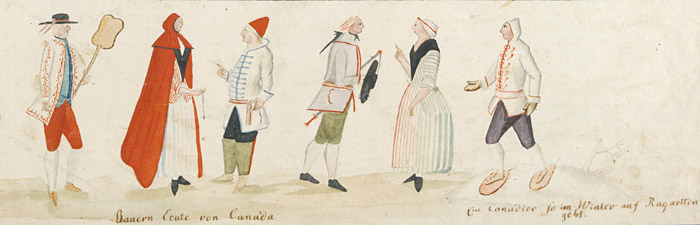
 

A ca. 1780 view of Canadians showing variations in blanket coat cut and trim.
 (Royal Ontario Museum © ROM. 969.37.2)

 In addition to soldiers and Canadians, references survive for blanket coats and jackets being worn by Indians, Slaves and Indentured Servants.

"To JOHN STEPHENSON, Pensacola "New Orleans, April 22, 1769
I hope are [ere] this comes to hand you have recivd. The things I sent you By Savon, and Should this not overtake you at pensacola hope it will find you safe arrivd in England, which Shall be always glad to hear; the Spanish Frigate Saild for the havana 3 days ago We are Still in Suspence About the Result of the Rupture between the French & Spaniards but is the General oppion of the people here that it will fall to the Spaniards if so Cash will Circulate in this place, and the Articels you was kind Enough to promise to send me will Answer extream Well, I omitted to Mention Blankets in the Memorandum, which if you think proper to send please to let them be good Blankets proper for making Blankett Coats with Either black or Blue Strips only [.] I am afraid Mr. Monsanto Will Shortly be pushed very hard for money he owes at Mobile to Messrs. McGillivray & Struthers for Negroes Bought of them a long time Ago[.] I have nothing more at present worth your notice but should this Reach you at pensacola refer you to Mr. McNamara who no[w] goes there[.] I am with due Esteem…P.S. Youl please to send me the Universal History will bound with proper Cutts and Maps tho they should Cost 6d or a Shilling More a Volume. …" (The Merchant of Manchac: The Letterbooks of John Fitzpatrick 1768-1790 ed. Margaret Fisher Dalrymple Baton Rouge: LSU Press, 1978, 46.)
 

Virginia Gazette(Dixon & Hunter), Williamsburg ,November 25, 1775.

   WARWICK, November 15, 1775. RUN away from the Subscriber's Plantation in Prince Edward County, on Saturday the 11th Instant, four Negro Fellows, viz. PRINCE, CATO, CHARLES or TRASH,
and BILLY BURTON.----Prince is a very large Fellow, is an African, and speaks badly, and is very drunken and quarrelsome, he is notable for being an excellent Swimmer and Diver. ----
Cato, a thick well Made Fellow about 5 Feet 6 or 7 Inches high, is also an African, and speaks very broken English, and is a tolerably sober well behaved Fellow.
----Charles or Trash, for he will answer to either Name, is a Native of Jamaica, a small slim Made Fellow, about 5 Feet 4 or 5 Inches high, and about 25 Years of Age.----
Billy Burton, a Mulatto, a stout young Lad, about 19 or 20 Years of Age, was raised at this Place, and is a very well behaved Fellow.
All of them but Trash were clothed this Fall in Dutch Blanket Coats and Breeches, Trash had Clothes such as Water Negroes generally wear, though he and all the others had other Clothes with them,
so that it is probable they will change their Dress.
ROBERT DONALD.


ROBERT OWEN.

Virginia Gazette(Dixon & Hunter), Williamsburg ,April 4, 1777.

    FORTY SHILLINGS REWARD. RUN away from the Subscriber, the 29th of November, a likely young Negro Fellow named JOE,
about 5 Feet 10 Inches high, had on, when he went away, Jacket and Breeches made of dark coloured Kersey, with white Metal Buttons,
a short Coat made of a Dutch Blanket, with white Metal Buttons, Virginia knit Stockings, and plain Shoes. As he was brought up in Williamsburg,
I expect he is lurking about there. Whoever takes up the said Slave, and commits him to Gaol, or brings him to me in James City County,
shall receive the above Reward

JOSEPH HORNSBY. YARMOUTH, April 1, 1777


sometimes blankets were used to fashion jackets as well:

- Maryland Gazette, 23 June 1757
 "Deserted from Francis Ware’s Company, the 14th of this instant June, on his march to Fort-Frederick, Patrick Grame, a Scotchman, aged 25 years,
 5 feet 4 ½ inches high, of a brown complexion, has dark eyes, and black hair, middling long, has a down look, and is mark’d with the small-pox; had on when he went away, a jacket made of a Dutch blanket, grey country-made stockings, and shoes about half worn.
Whoever takes up the said deserter, and delivers him to any of the Recruiting-Officers in this Province, or contrives him to Fort-Frederick, shall have two pistoles reward paid by Francis Ware "


 Virginia Gazette(Purdie & Dixon), Williamsburg ,December 10, 1767. 
  RUN away from the subscriber, about the 3d of last month, in Prince William county, near Dumfries, a Scotch servant man, named ROBERT CRAIG, about 5 feet 5 inches high, by trade a weaver, of a dark complexion, wears his own black short hair, and talks the Scotch dialect very broad; had on when he went away a drab coloured cloth great coat much patched, a jacket made out of an old Dutch blanket, an old felt hat welted round the brim with coloured thread, an old pair of osnabrug breeches, and a pair of ribbed yarn hose. Any person taking up the said servant, and conveying him to me, shall receive a reward of Three Pounds Virginia currency, besides what the law allows.
WILLIAM BRIGGS. N.B. The above servant, I am informed, has wrote himself a discharge.


Virginia Gazette(Purdie & Dixon), Williamsburg ,September 28, 1769.

    NORTH CAROLINA, Sept. 3, 1769. COMMITTED to the publick jail for the district of Halifax an outlandish Negro man who calls himself HARRY, about 25 years old, 5 feet 6 inches high, and his fore teeth very much decayed; has on an old jacket made of a Dutch blanket, Negro cotton breeches, and an old brown linen shirt. He says he belongs to William Hunter, but cannot tell in what province his master lives. The owner may have him on proving his property, and paying charges.
CHRISTOPHER DUDLEY, Jailer.  
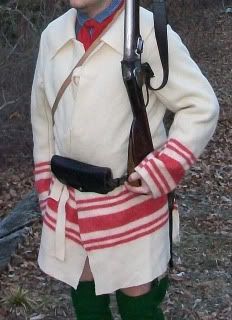


A conjectural reconstruction of a blanket coat I put together using a striped "duffel" blanket 
with stripes similar to the ones shown in the Von Reck images.

The parallel garment among French Canadians was called a Capote, and was sometimes made with cloth, but at others of blankets, and frequently featured a hood and tied closure (see the image at the top of this page).

A British soldier in a blanket coat/capote made from a Point blanket (Von Germann ca. 1777)


 A great discussion of Blanket coats/Capotes in service with the British Army during the revolution can be found here .  Nathan K has blogged on capotes/cappo coats here at the Buffalo trace blog

and instructions for a Von Germann style blanket coat are up at Fort Ticonderoga.


Various methods of fastening and finishing were used in the period:


"a striped Blanket Coat, with flat Pewter Buttons..." NY Gazette 2/2/1767

"a blanket coat with yellow binding..." NY Gazette 5/8/1769

"new blanket coat, tyed with brown yard strings" PA Gazette 8/10/1769


"a short Coat made of a Dutch Blanket, with white Metal Buttons" VA Gazette 4/1/1777

"a homespun blanket coat lappelled and bound with blue ferret..." PA Packet 3/21/1782


 All in all, a blanket coat, whether a hooded overcoat in the Canadian fashion or simply a coat or jacket using a blanket for cloth is another garment to consider when gearing up for winter.




Wednesday, June 26, 2013

Pewter Basins


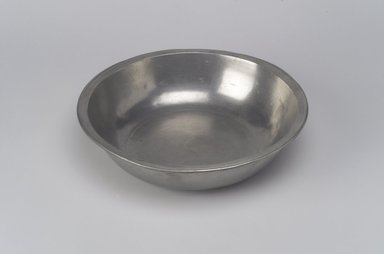
An 18th century pewter basin from the Brooklyn Museum collection
 
https://www.brooklynmuseum.org/opencollection/objects/803/Basin


Pewter basins/basons (usually rimmed bowls of varied size/capacity) are handy, multipurpose items that those portraying Virginia backcountry folks or militia should consider acquiring.  These are fairly lightweight, durable, suitable for fairly hard use (careful with HOT liquids!), and show up in a TON of inventories- even those with a military associations.  In 1775 the Williamsburg Magazine was inventoried and inside were  "fifty one pewter basons , eight camp kettles"  (Journals of the House of Burgesses of Virginia 1773-1776, Volume 13, Pages 223-4 Tuesday, the 13th of June, 15 Geo. iii. 1775 ).  These were widely sold in 18th century stores (the previously mentioned New Dublin store in modern Pulaski carried them, as did Hook's New London store, Partridge store in Hanover and etc.) and were usually sold by capacity (ie quarts, pint and etc).

Jefferson county Virginia (which became Kentucky in 1792) probate inventories show a fairly good amount of them in circulation:

http://books.google.com/books/about/Early_Kentucky_Settlers.html?id=whcQpqnUCEcC


Abraham Keller's inventory [possibly Captain of a Company of George Rogers Clark’s Illinois regiment], from 1782 had  "3 pewter basons,1 plate & 3 spoons, etc."

  His contemporary Robert Travis (also 1782) had "...A parcel of Bar led £ 30 9 Peuter Plates £ 135. 5 Do Basons...".  A year prior, William Brashear had "... 9 Pewter plates 2 Dishes, one bason
    & Some spoons..." Mary Christy (1782) ties with the Travis inventory for best phonetic spelling of pewter with her inventory's "13 small Puther plates...2 small Do Driper...3... puther basons...1 Small Tea pot...1 small puther bottle." [NB I will cover pocket bottles at a later date].

For further reading (additional pictures of a couple of examples of originals can be seen in the first linked book) :

Pewter at Colonial Williamsburg by John Davis

http://books.google.com/books?id=MwJqjePrg1AC&pg=PA132&lpg=PA132&dq=williamsburg+pewter+bason&source=bl&ots=RaES3OqYdk&sig=OvCb_ceuK9Mjp8NP8GvXUnAAEKw&hl=en#v=onepage&q=williamsburg%20pewter%20bason&f=false

and

The Role of Pewter as Missing Artifact:Consumer Attitudes Toward Tablewares in Late 18th Century Virginia by Ann Smart Martin

http://www.sha.org/CF_webservice/servePDFHTML.cfm?fileName=23-2-01.pdf

Friday, March 15, 2013

Cuttoe Knives Revealed


Cuttoe Knives: A material culture study 
by Steve Rayner and Jim Mullins


Trade card of John Cargill, instrument maker at the Saw and Crown, Lomberd street, London. Bears date 1739


In 1775 the intrepid William Cocke rode off alone ahead of his large party of Kentucky settlers on a dangerous 130 mile trip from the Cumberland river.  His mission was to warn an advanced party commanded by Daniel Boone in what would become Boonsborough of their pending arrival in order to prevent the settlement from being abandoned in the face of numerous Indian raids. 

In order to equip him for this journey he was:

"... fixed ...off with a good Queen Ann's musket, plenty of ammunition, a tomahawk, a large cuttoe knife, a Dutch blanket, and no small quantity of jerked beef."

What was this essential "cuttoe" knife that Mr. Cocke was "fixed...off" with?

One of the most ubiquitous and yet mysterious items from the 18th century is the English manufactured "cuttoe knife".  Although mentioned on numerous trade ledgers, account books, newspaper ads and at times even as evidence in murder cases, few real concrete details survive in eighteenth-century documents.  Those details that are available are frequently vague and open to interpretation.

 One of the problems facing the modern researcher of this item is that eighteenth-century spelling tends to be non-standardized, at times phonetic and generally inconsistent. Compounding this problem is the Anglicization and adoption of the French word for knife; "couteau". At this time there are no known labeled images of a "cuttoe" from the 18th century, but two post eighteenth century references point towards "cuttoe" knives being clasp knives in the cutlery manufacturing center of Sheffield:

A Glossary of Words used in the Neighbourhood of Sheffield 1888.

"Cuteau, sb. a large clasp-knife." p. 58.


and from Sheffield in the eighteenth century - Page 67  Robert Eadon Leader - 1901

"The date 1650 has been assigned as the time when spring knives, at first with iron handles, began to be made.  Their inventor is one of those unknown benefactors whose name is omitted from the rolls of
fame.  It has been suggested that as they were originally called couteaux- a name found in use down to a late period [*note: Wilson Joseph, cuttoe and pen knife cutler, Castlefold- 1774]
-the device came from France.  At first spring-knives were but clumsy, and made with only one blade..."

Transcriptions of testimony from the Old Bailey for the murder trial of William Chetwynd, who was Charged with the the Murder of Thomas Ricketts, 12th October 1743; show that this confusing term was also problematic during the eighteenth-century:

                "Hamilton. It was a Sort of a French Knife.

                Council. Was it a Penknife? Or what Knife was it?

                Hamilton. It was a pretty large Knife.

                Council. Was it a Clasp Knife? Hamilton. Yes."


further on in the trial:

                "Council. I think, Sir, you were telling the Court of a French Knife; 
                I own I don't know what they are; but the Question I would ask you, is,
                whether most of you young Gentlemen do not carry these Knives in your Pockets?

                Hamilton. I have heard so; it was a Knife that he always had."

                Council. What kind of a Knife was it?

                Humphreys. It was a Knife with a long Handle.

                Council. Was it a long Blade?

                Humphreys. It was such a Blade as this; this is but a Piece of it.

                Council. It is a French Couteau.

                Prisoner's Council. It is no such Thing, it is only a common French Knife."


Common French clasp knives of the period generally lacked springs, and were simple blades that folded into a boxwood or horn handles (for further reading on these, see Gladysz and Hamilton's excellent Journal of the Early Americas articles).


French folding knife image from Jean Jacques Perret's L'Art du Coutelier ca. 1771

Several examples survive, many complete with French maker's marks on their blades and at times their handles.

To make deciphering this commodity even more difficult, a variety of short swords known as cutteau de Chasse (literally hunting knife) are in contemporary circulation. 


"Lancaster, March 8, 1778. WAS FOUND the 7th instant, and left in the care of Mr. William Atlee in Lancaster, a neat hanger, or cutteau de chasse , which is supposed to belong to some Gentleman of the Army. If the owner of it will apply to Mr. Atlee it will be delivered to him, on paying the charges of this advertisement, and some small gratuity promised by Mr. Atlee to the finder. " (The Pennsylvania Gazette)

When available to the modern scholar, the price (the short sword "cuttoes" being significantly more expensive than cuttoe knives) and context can help decipher which of the two is being discussed
in period documents.


Returning to our cuttoe knives, how can we be sure they were "clasp" or "spring" folding knives as described in the Sheffield references and Chetwynd case above? 


Thankfully advertisements and receipts with a few tantalizing details help confirm this.  The receipt below implies that Cuttoes are in fact 'spring' or folding knives.


Philadelphia, " William West for accot: General Forbes Bot: of Jeremiah Warder. "
Docket: "No. 17 Jera. Warder" Box 3 1758 May 8 Ms, 2 p.
Papers of John Forbes, MSS 10034, Tracy W. McGregor Library of American History,
Albert and Shirley Small Special Collections Library, University of Virginia

Philada: 5 March 8th: 1758

William West for Acco: General Forbes...Bot: of Jerimiah Warden...

6 doz: Black Spring Knives -7/
9 doz: Cuttoe ....ditto -7/
23 doz: do: Larger ...do 7/6
2 doz: Very large ...15/


Other advertisements are even less vague:

"Just Imported in the last Ships from LONDON BRISTOL , &c. By Edward Blanchard, And to be sold at his Shop in Union - Street...by wholesale or retail, cheap for Cash......cutteau and all other sorts of clasp knives...."

( Boston Evening-Post, published as The BOSTON Evening-Post.; Date: 06-23-1760; Issue: 1295; Page: [4];)


"At the Store over Mr. John Dupee's...to be SOLD by Nathaniel Williams...spring Knives & Cutteau ditto, Penknives..."

(Boston News-Letter, published as SUPPLEMENT to The BOSTON News-Letter, and NEW-ENGLAND Chronicle.; Date: 03-25-1762; Issue: 3013; Page: [4]; Location: Boston, Massachusetts)

"pistol capt and cutteau pocket knives; Barlow penknives..."

(Pennsylvania Chronicle, published as The Pennsylvania Chronicle, and Universal Advertiser; Date: From Monday, May 2, to Monday, May 9, 1768; Volume: II; Issue: 15; Page: 117; Location: Philadelphia, Pennsylvania )


Sketchley's Sheffield Directory of 1774 lists only three specific makers of "cuttoe" knives; a modern rendering of those marks appears below.


"Gillot William, ditto [spring knife] & cuttoe at ditto [Heely near Sheffield]" p. 4.
-[dagger pointing left] SYNO


"Waterhouse Jeremiah, table knife and cuttoe cutler, Scotland." p. 11.
* [Maltese Cross]
O
A


"Wilson, Joseph, cuttoe and pen-knife cutler, Castlefold." p. 12.
Y.NOT

Pictured below is a ca 1770 bone handled English "clasp", or "pocket" knife, most likely also termed a "cuttoe" in the 18th-century from a private collection. It is marked (detail at right) to Jeremiah Waterhouse, a Sheffield "table knife and cuttoe cutler" who worked on Scotland Street.


Information on a patent for forming "Cuttoe Scales" leaves little doubt that these are in fact folding clasp knives with springs.

1781 Patent for Cutteau Scales London Gazette 1783:

 "The Commissioners in a Commission of Bankrupt... proceed to the Sale of Two Third Parts of Certain Letters Patent under the Great Seal of Great Britain, dated the 21st of February, 1781, whereby His Majesty gave and granted to James Reaves, of Chesterfield in the County of Derby, Cutler, sole Privilege, during the Term of Fourteen years, of making and vending his new invented Table-Fork-Blades, both Scale and Round Tongues, with two, three or more Prongs; also Spring Knive Scales, commonly called Cutteau or Pocket Knive Scales of various Sorts, made of Cast Metal called Pig Iron, either entirely of the Metal, or intermixed with Steel or oth[e]r Metal or Metals, which, by a new preperation of tempering the several Articles, renders them sufficiently strong and elastick for every Purpose to which the same may be applied..."

In this 1809 reference, what is clearly the handle of a folding knife is described as the "scales". These are subsequently referred to as "handles" being "covered" with horn, etc.

"Penknives. The manufacture of penknives is divided into three departments, the first is the forging of the blades, the spring, and the iron scales; the second, the grinding and polishing of the blades; and the third, handling, which consists in fitting up all the parts and finishing the knife. The blades are made of the best cast steel, and hardened and tempered to about the same degree with that of razors. In grinding they are made a little more concave on one side than the other; in other ways they are treated in a similar way to razors. The handles are covered with horn, ivory, and sometimes wood, but the most durable are those of stag-horn. The most general fault in penknives is that of being too soft. The temper ought to be not higher then a straw colour, as it seldom happens that a penknife is so hard as to snap on the edge."

By 1787 over a hundred specialized "Couteaux" makers were listed in the Sheffield directory; cutlers are listed under the heading of the wares they produce.


"Common Pocket and Penknives. Manufacturers in Sheffield."___30.
"Manufacturers in the Neighbourhood.

Note. Those who make Penknives, have the Word Pen put against their Names; the others make only Couteaux."

11 are marked "Pen," with 107 making "couteaux" of a grand total of 148.

(A Directory of Sheffield; Including the Manufacturers of the Adjacent Villages." Gales and Martin, Sheffield, G. G. & J. Robinson, London. 1787.)

Cuttoe knives came in a variety of sizes and materials (including "pistol cap'd", stag, horn, bone handles and etc).

Table of Goods and prices for the Indian Trade
Charles Town in South Carolina, July 19th, 1762

Knives,
common Clasp 2---1 [pounds of skins] 

[The "common" clasp knife in the list below may be a French style clasp knife lacking a spring]
small Cutteaus 2---1 [pounds of skins]
larger Cutteau 1---1 [pounds of skins]
largest Cutteau 1---2 [pounds of skins]


(Colonial Records of SC/Documents relating to Indian Affairs 1754-1765 William L. McDowell, JRUSC Press, Columbia SC 1970 p566-569)

Several very large specimens survive, and a description of "a riot among a gang of wheel-barrow felons" in Rhode Island from the The Pennsylvania Gazette. May 23, 1787 mentions "A woman of infamous character was seized, and, on searching her, a cutteau knife , about 16 inches long, sharp pointed, was found concealed in her bosom".

Cuttoes knives may have proven popular items for the Indian trade  as they might were thought as less liable to be used in an offensive manner than fixed blade "butcher" or "scalping" knives.

In 1765 Robert Callendar’s Indian goods laden pack train was attacked by
'Cumberland County men' in the belief that it contained offensive weapons such as scalping knives.  Merchant Thomas Wharton rebuffed this, and stated that
he was "satisfied, that no Other than the Common Cutteau Knives were sent; which Knives are well known in England, And are Used by most Farmers in this province..." p. 201.

[Citing Thomas Wharton to Franklin, 25 March 1765, PBF 12: 95. The Papers of Benjamin Franklin (New Haven, 1959), 3: 214-16. Hereafter cited as PBF.]

Although rare in period images and often referred to in somewhat mysterious terminology; the common English clasp knife and the "cuttoe" knife appear to be one and the same.  For an archaeological specimen from 1775, see the James Birmingham grave from 96 in South Carolina.


Tuesday, February 5, 2013

OSFP Errata


Time Smoking a Picture, William Hogart via the MET


As any author will tell you, there are always a few minor (and at times not so minor) errors that show up after publication.  Sadly, I have not been immune to this and the errors I am aware of are listed below.
Sincerely and with apologies,
Jim


page 77 

Caption at top right should read "American rifle featuring American, Dutch and or possibly English and German components." There is a pistol signed “J. Depre Maastricht” in the Visser collection (cat.312) that points to a Dutch origin for the lock at least.


page 85 

Buccaneer muskets of British origin and unique aesthetics certainly existed, and the text should reflect the possibility of an English buccaneer style gun in that context. The gun pictured may be an Anglo restocking of earlier French parts.

page 131 

Letter from Peter Schuyler to William Shirley should be in the New Jersey section, not that of New York. 

page 165 

Benjamin Rogers horn.  Although there was a Virginia Provincial Soldier named Benjamin Rogers, information in the form of a very similar horn (inscribed Freeborn Hamilton most likely a man from Kent County, Rhode Island) has come to light since publication. The stylistic similarities point towards both horns originating from the same hand.  The attribution originally published seems to be incorrect, and barring further information the Rogers horn is likely a Rhode Island piece.


Wednesday, January 16, 2013

"A rough case for his tomahock..."

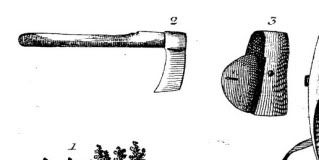
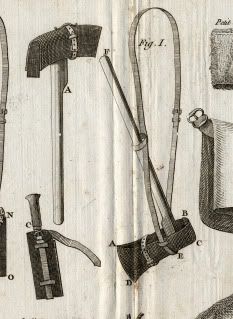
One of the items that frequently pops up in interwebz discussions is a hatchet/tomahawk cover or case.  In the 18th century, it seems to have been fairly common to use a small hatchet simply thrust in the belt or perhaps hanging off the shot bag strap (see Verger's rifleman) with the edge unprotected.

In the Pension Application of Simeon Buford he mentions that he "wore a Belt to carry his hatchett, which had a brass buckle on it, which had inscribed on it “21 Regiment.” 

 Thankfully, some people in the period did use a cover so those who feel compelled to use one have something to go on.

from Knox, John D. (Doughty, Arthur G. Ed.) An historical journal of the campaigns in North America for the years 1757, 1758 and 1760 Volumes I-III, Toronto Canada, Champlain Society, 1914-1916

p352 1759


 "His knapsack is carried very high between his shoulders, and is fastened with a strap of web over his shoulder, as the Indians carry their pack.  His cartouch-box hangs under his arm on the left side, slung with a leathern strap; and his horn under the other arm on the right, hanging by a narrower web than that used for his knapsack; his canteen down his back, under his knapsack, and covered with cloth; he has a rough case for his tomahock, with a button; and it hangs in a leather sling down his side, like a hanger, between his coat and waistcoat."

As the images below will show, there are several forms and ways of doing these in the 18th and early 19th centuries.

 Isaac Shelby's hatchet and cover:


Alexander MacKenzie


1767 Huntsman's rig


Farrier, 11th Dragoons by Morier ca 1750


German Military ca 1783 from "Was ist oficier..." (for originals see Burg Forchtestine):


and a French example from La Porterie ca 1754:


Arthur Wentworth of Bulmer, near Castle Howard, Yorkshire 1767


Friday, July 13, 2012

Up the Valley, southbound goods and people from PA


I recently saw this excellent graphic linked on a message board and thought it was worth sharing (thanks to Bob Sherman in SC for posting it!).


 http://www.carolana.com/SC/Royal_Colony/the_great_wagon_road.html


The course of the Wilderness Road by 1785 Wikipedia


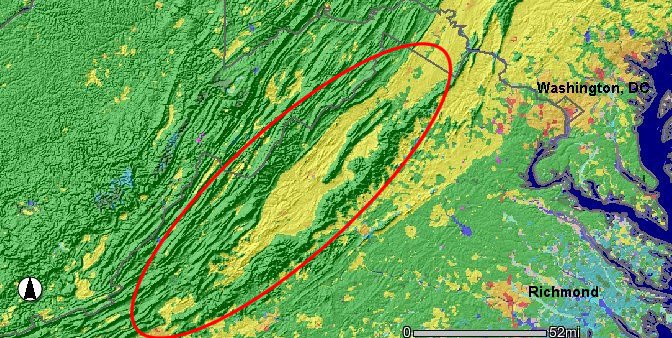
Portions of the road labelled "Wilderness Road to Tennessee" date from the 1760-61 Virginia Provincial Cherokee campaign's protected advance to Fort Chiswell (Wythe County), Stalnaker's Plantation (Chilhowie, where Fort Attakullakulla was built), and the finally the Virginia built Fort at the Big Island on the Holston (Kingsport Tennessee). These frontier roads eventually become part of the "Wilderness road"; the overland route to Kentucky through the Cumberland gap.


The topographic view above illustrates the physical realities and natural barriers of road travel to the backcountry in the 18th century and should explain how and why so many people and goods from Pennsylvania flowed to western Virginia and North Carolina in the 18th century along that route.


Original Conestoga Wagon at the Smithsonian Institution


For some fantastic information on manufactured goods moving from Pennsylvania to North Carolina, (and a nod to the  "Clothing the Carolinas" Blog for posting the link) see the William Sample Alexander Diary, 1770-1778. William Sample Alexander operated a wagon train between Mecklenburg County and Chester County, Pa.

A generalized discussion of topography and it's effect on Virginia settlement patterns can be seen here:

http://www.virginiaplaces.org/geology/topo.html 

When 18th century people said they were heading 'up' the Shenandoah Valley, they meant moving south:

http://www.southernspaces.org/2004/shenandoah-valley  for further reading I highly recommend this book:

http://books.google.com/books/about/The_Planting_of_New_Virginia.html?id=guS_QwTKdp8C

In the late 18th century Benjamin Rush discussed this phenomenon.  His somewhat stilted take can be found in the link below and contains some great info on early settlement:

http://books.google.com/books?id=xtUKAAAAIAAJ&pg=PA213&dq=An+Account+of+the+Progress+of+Population,+Agriculture,+Manners+and+Government+in+Pennsylvania&hl=en&ei=J2XVTePfIMfr0gHDv9T5Cw&sa=X&oi=book_result&ct=result&resnum=1&ved=0CCoQ6AEwAA#v=onepage&q=An%20Account%20of%20the%20Progress%20of%20Population%2C%20Agriculture%2C%20Manners%20and%20Government%20in%20Pennsylvania&f=false


Another excellent graphic addressing roads in the period can be found here:


http://www.carolana.com/SC/Royal_Colony/all_primary_roads_royal_period.html