Tuesday, February 5, 2013

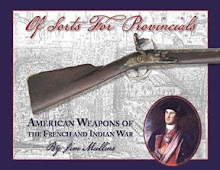
OSFP Errata


Time Smoking a Picture, William Hogart via the MET


As any author will tell you, there are always a few minor (and at times not so minor) errors that show up after publication.  Sadly, I have not been immune to this and the errors I am aware of are listed below.
Sincerely and with apologies,
Jim


page 77 

Caption at top right should read "American rifle featuring American, Dutch and or possibly English and German components." There is a pistol signed “J. Depre Maastricht” in the Visser collection (cat.312) that points to a Dutch origin for the lock at least.


page 85 

Buccaneer muskets of British origin and unique aesthetics certainly existed, and the text should reflect the possibility of an English buccaneer style gun in that context. The gun pictured may be an Anglo restocking of earlier French parts.

page 131 

Letter from Peter Schuyler to William Shirley should be in the New Jersey section, not that of New York. 

page 165 

Benjamin Rogers horn.  Although there was a Virginia Provincial Soldier named Benjamin Rogers, information in the form of a very similar horn (inscribed Freeborn Hamilton most likely a man from Kent County, Rhode Island) has come to light since publication. The stylistic similarities point towards both horns originating from the same hand.  The attribution originally published seems to be incorrect, and barring further information the Rogers horn is likely a Rhode Island piece.


Wednesday, January 16, 2013

"A rough case for his tomahock..."

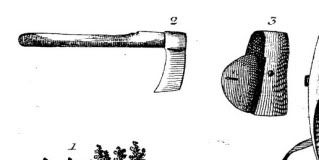
One of the items that frequently pops up in interwebz discussions is a hatchet/tomahawk cover or case.  In the 18th century, it seems to have been fairly common to use a small hatchet simply thrust in the belt or perhaps hanging off the shot bag strap (see Verger's rifleman) with the edge unprotected.

In the Pension Application of Simeon Buford he mentions that he "wore a Belt to carry his hatchett, which had a brass buckle on it, which had inscribed on it “21 Regiment.” 

 Thankfully, some people in the period did use a cover so those who feel compelled to use one have something to go on.

from Knox, John D. (Doughty, Arthur G. Ed.) An historical journal of the campaigns in North America for the years 1757, 1758 and 1760 Volumes I-III, Toronto Canada, Champlain Society, 1914-1916

p352 1759


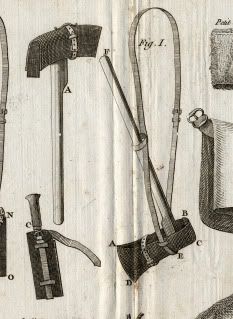
 "His knapsack is carried very high between his shoulders, and is fastened with a strap of web over his shoulder, as the Indians carry their pack.  His cartouch-box hangs under his arm on the left side, slung with a leathern strap; and his horn under the other arm on the right, hanging by a narrower web than that used for his knapsack; his canteen down his back, under his knapsack, and covered with cloth; he has a rough case for his tomahock, with a button; and it hangs in a leather sling down his side, like a hanger, between his coat and waistcoat."

As the images below will show, there are several forms and ways of doing these in the 18th and early 19th centuries.

 Isaac Shelby's hatchet and cover:


Alexander MacKenzie


1767 Huntsman's rig


Farrier, 11th Dragoons by Morier ca 1750


German Military ca 1783 from "Was ist oficier..." (for originals see Burg Forchtestine):


and a French example from La Porterie ca 1754:


Arthur Wentworth of Bulmer, near Castle Howard, Yorkshire 1767


Friday, July 13, 2012

Up the Valley, southbound goods and people from PA


I recently saw this excellent graphic linked on a message board and thought it was worth sharing (thanks to Bob Sherman in SC for posting it!).


 http://www.carolana.com/SC/Royal_Colony/the_great_wagon_road.html


The course of the Wilderness Road by 1785 Wikipedia


Portions of the road labelled "Wilderness Road to Tennessee" date from the 1760-61 Virginia Provincial Cherokee campaign's protected advance to Fort Chiswell (Wythe County), Stalnaker's Plantation (Chilhowie, where Fort Attakullakulla was built), and the finally the Virginia built Fort at the Big Island on the Holston (Kingsport Tennessee). These frontier roads eventually become part of the "Wilderness road"; the overland route to Kentucky through the Cumberland gap.


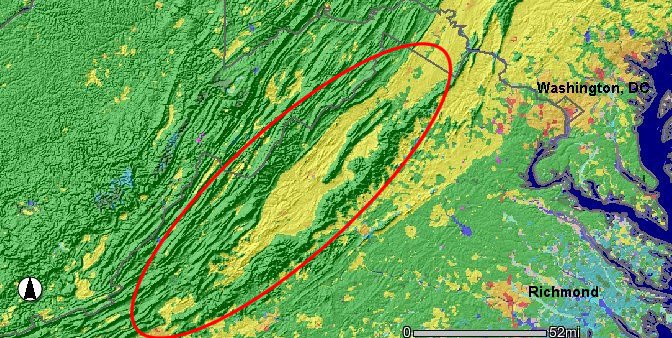
The topographic view above illustrates the physical realities and natural barriers of road travel to the backcountry in the 18th century and should explain how and why so many people and goods from Pennsylvania flowed to western Virginia and North Carolina in the 18th century along that route.


Original Conestoga Wagon at the Smithsonian Institution


For some fantastic information on manufactured goods moving from Pennsylvania to North Carolina, (and a nod to the  "Clothing the Carolinas" Blog for posting the link) see the William Sample Alexander Diary, 1770-1778. William Sample Alexander operated a wagon train between Mecklenburg County and Chester County, Pa.

A generalized discussion of topography and it's effect on Virginia settlement patterns can be seen here:

http://www.virginiaplaces.org/geology/topo.html 

When 18th century people said they were heading 'up' the Shenandoah Valley, they meant moving south:

http://www.southernspaces.org/2004/shenandoah-valley  for further reading I highly recommend this book:

http://books.google.com/books/about/The_Planting_of_New_Virginia.html?id=guS_QwTKdp8C

In the late 18th century Benjamin Rush discussed this phenomenon.  His somewhat stilted take can be found in the link below and contains some great info on early settlement:

http://books.google.com/books?id=xtUKAAAAIAAJ&pg=PA213&dq=An+Account+of+the+Progress+of+Population,+Agriculture,+Manners+and+Government+in+Pennsylvania&hl=en&ei=J2XVTePfIMfr0gHDv9T5Cw&sa=X&oi=book_result&ct=result&resnum=1&ved=0CCoQ6AEwAA#v=onepage&q=An%20Account%20of%20the%20Progress%20of%20Population%2C%20Agriculture%2C%20Manners%20and%20Government%20in%20Pennsylvania&f=false


Another excellent graphic addressing roads in the period can be found here:


http://www.carolana.com/SC/Royal_Colony/all_primary_roads_royal_period.html


Tuesday, June 26, 2012

Fort Lewis Store inventory ca. 1766

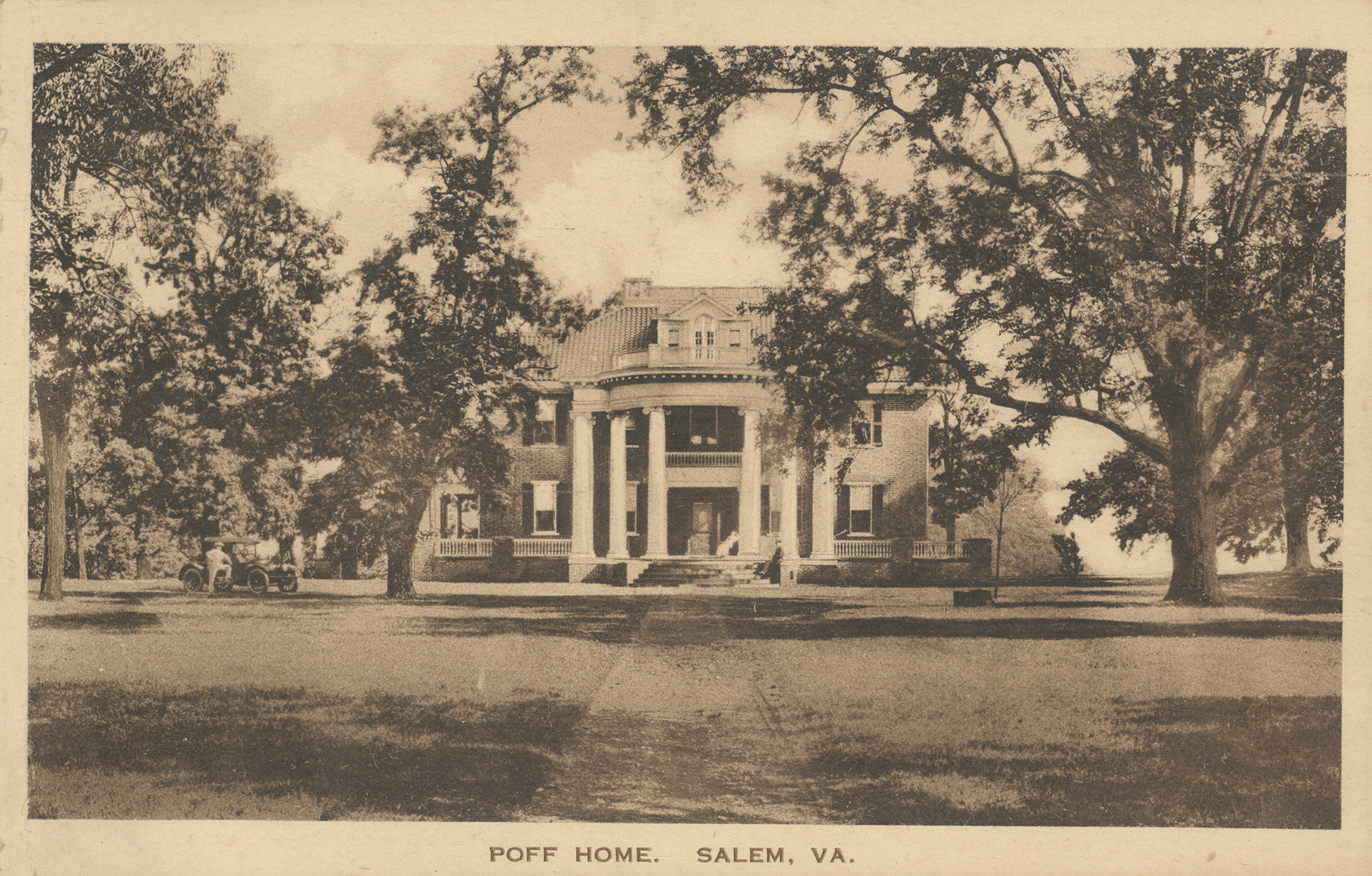
"Poff Home, Salem, Virginia" Better known as Fort Lewis Mansion.

 
Colonial Era artifacts from the Fort Lewis site excavated in the 1960s.


I recently went through an old (first published in 1938) favorite, Kegley's Virginia Frontier http://books.google.com/books/about/Kegley_s_Virginia_Frontier.html?id=Bp0nOrLrPlYC and realized that I had forgotten it contained another back country store inventory for Alexander Boyd's store at Fort Lewis, Virginia.  Boyd had previously been paymaster for the Virginia provincials and as such his name pops up quite a bit in Colony records.  As described by Kegley (p325):

People  of the entire  community seem to have patronized this store,  and from the list of articles obtainable  there  no one needed to suffer from the lack of manufactured goods, or from the absence of raw materials  from  which useful articles  could  be made.     The  stock  of goods, amounting to  £1092/9/5 and farm  were mortgaged  to Alexander Baine, merchant  in Virginia, to secure him as  surety   for  Boyd  to  James  Lyle,  merchant   in  Chesterfield.  

Original swatch of "blew camblett" from 1760. 
Foundling no 15287 from the Foundling Hospital's Threads of Feeling Exhibit

The inventory contains numerous varieties of imported cloths such as  Camblett, Nankeen, Spotted Flannel, Bear Skin, Plains, Callico, Holland, Damask, Thicksett, Forrest Cloth and a wide variety of woolens, linens, silks and blended fabrics.  Household goods included blankets, ruggs, funnels, ceramics and kitchen vessels, a wide variety of books, 38 lbs of Copperas, and sewing notions. Hardware included over 30,000 nails ( 4D, 6D, and 20D sized),  hinges, tools, '100 pains Window Glass', Guns, powder, lead, a still and numerous other mass manufactured and imported goods.  Boyd's personal items included 'Indian Garters, belt, & 1 pr. Mockasoons' ( valued at 1/0/0), 3 Raccoon Hats [cocked hats made of Raccoon fur felt], 'Pistolls', 2  Old Guns, 3 Razors, his wearing apparel, a number of horses, cattle, furniture, Servants under indenture and Slaves.  An advertisement for one of his slaves, Phil; appears here:

http://etext.lib.virginia.edu/etcbin/ot2www-costa?specfile=/web/data/users/costa/costa.o2w&act=surround&offset=670008&tag=Runaway+Slave:+Virginia+Gazette+%28Rind%29,+Williamsburg,+July+18,+1766.++&query=alexander++boyd

As noted in the runaway ad, Boyd also ran a store in New London, where Merchant John Hook would later establish himself.  I highly recommend this book, which covers Hook's operation in depth:  http://books.google.com/books?id=J0P6rmhhP6IC&dq=Ann+Smart+Martin&ie=ISO-8859-1&source=gbs_gdata .  All in all, another interesting account of the wide variety of imported merchandize  available in the Virginia back country prior to the Revolution.

Wednesday, April 25, 2012

Venison Ham

One of the fairly common foodstuffs in back country Virginia that seems to have become somewhat uncommon in the modern era is the Venison ham. Venison hams were sold in McCorkle's store in New Dublin - modern Pulaski, Virginia (likely a sideline for those involved in the deerskin trade) and are mentioned by Smyth as a typical Virginia food in warm weather. John Ferdinand Smythe: A Tour in the United States of America 1784 http://books.google.com/books?id=cCUwAAAAYAAJ&pg=PA41&dq=venison+hams+%2B+tour+of+the+united+states&hl=en&sa=X&ei=lF1FT8jDMcTb0QGstanqAw&ved=0CE4Q6AEwAQ#v=onepage&q&f=false
"The gentleman of fortune rises about nine o'clock; he may perhaps make an excursion to walk as far as his stable to see his horses, which is seldom more than fifty yards from his house; he returns to breakfast between nine and ten, which is generally tea or coffee, bread-and-butter, and very thin slices of venison-ham, or hung beef."
Creswell also mentions them: http://rs6.loc.gov/cgi-bin/query/r?ammem/lhbtn:@field%28DOCID+@lit%28lhbtn30436div15%29%29:
""On Board the Pilot Boat "Sally," Potowmeck River--Thursday, April 24th, 1777. Sailed from Alexandria about noon. Mr. Crafts gave me three venison Hams."" "We gave them a Bottle of Whiskey, a Venison Ham and left them to condole their misfortunes together, but we first took care to secure the Hatch."
A hunter's contract from 1784 specifying Venison hams(thanks to Fred for sharing this info!): http://books.google.com/books?id=DWxXAAAAYAAJ&pg=PA926&dq=1784+venison+ham+cured&hl=en&sa=X&ei=egSYT9OcEqXW0QGwqYnlBg&ved=0CE0Q6AEwAA#v=onepage&q=1784%20venison%20ham%20cured&f=false
"Articles of agreement Enterd Into This Eighteenth Day of October 1784 Between Genl George Rogers Clarke & Alexr. Skinner Physician on the one & John Saunders of the other Part all of Jefferson County in the State of Virginia & Country of Kentucky Witnesseth that the Said Genl. G. Rogers Clark and Alexander Skinner, are to furnish on their Part Three men & one pack Horse with Salt and & Ammunition for the purpose of Making a Hunt procuring Beef - Bear Meat - Bears Oil & Vennison Hams & Curing them in a proper Manner for Keeping Sound of it for use during the winter & Spring - That the said Saunders on his part is as a Hunter to use every possible Means to procure the said Meats &c by pitching upon Good Hunting Grounds & being Assiduous & Industrious & the said Saunders is to See that the meat is properly Salted at the Camp & Send it from time to time to the falls of ohio - The Bears oil properly Curd & The Hams properly Dried - The meat is to be Delivered to the said Skinner at the falls of Ohio - to be disposd off or put up in Bulk or Dried as may be most Convenient The said said Saunders in Consideration of this Duty faithfully to be performd is to be entitled to one third of all the meat & oil so to be procurd which third part shall either be sold when a Market offers on its arrival at the falls or preservd with the Rest he paying his proportion of any farther Curing that may be necessary when it arrives atthe falls or it..."
Cresswell also writes on American ham/bacon preparation, and I took my lead from that method and the sage advice of a very helpful friend who has a lot of experience in curing hams. http://rs6.loc.gov/cgi-bin/query/r?ammem/lhbtn:@field%28DOCID+@lit%28lhbtn30436div14%29%29
"The bacon cured here is not to be equalled in any part of the world, their hams in particular. They first rub them over with brown sugar and let them lie all night. This extracts the watery particles. They let them lie in salt for 10 days or a fortnight. Some rub them with hickory ashes instead of saltpetre, it makes them red as the saltpetre and gives them a pleasant taste. Then they are hung up in the smoke-house and a slow smoky fire kept under them for three or four weeks, nothing but hickory wood is burnt in these smoke-houses. This gives them an agreeable flavour, far preferable to the Westphalia Hams, not only that, but it prevents them going rancid and will preserve them for several years by giving them a fresh smoking now and then. Beef cured in this manner is but very indifferent eating. Indeed the Beef in this country is not equal in goodness to the English, it may be as fat, but not so juicy."
I was lucky enough to get a little space for my deer ham in a local smokehouse after the meat spent some quality time in a salt tub with brown sugar and saltpeter. For a bit of background on Virginia smokehouses, I recommend this article: http://www.history.org/foundation/journal/winter04-05/smoke.cfm As for those in the back country, the Sayer's plantation smoke house (ca 1754-1765) at the site that eventually became Fort Chiswell bucked the 8 or 12 foot square trend noted in the above article and was only 5 feet square. Surprisingly, bricks were used in the foundation and fireplace despite being a very remote homestead when it was constructed (Excavations at Fort Chiswell : an archaeological perspective of Virginia's western frontier by Thomas Claude Funk). After a few weeks smoking, I had a very nicely preserved Venision ham that was very tasty, although a bit more like jerky than the fattier pork hams from the same lot! All in all, a great experiment and I hope to them again. Happy smoking!

Thursday, October 13, 2011

Virginia's "Best Rifle Counties" ca. 1781


Frederick Klette signed rifle of circa 1775-80 Stevensburg in Culpeper County, VA 
 
"I am sorry it has not been in your power to send me the County Returns of Militia. I assure you returns weekley are indispensably necessary to enable the Executive to keep Militia in the Field. I did however on receiving Information from Colo. Walker that the Enemy were reinforced call for one Fourth of the Militia of Washington, Montgomery, Botetourt, Rockbridges Augusta Rockingham and Amherst, which (the last excepted) are our best rifle Counties. They will rendezvous at Charlottesville and there expect your orders..."

Thomas Jefferson to Lafayette May 29th, 1781 (Lafayette in the American Revolution Vol. IV page 143)


Link to Western Va county maps showing the evolution of counties from 1738 on:

http://www.rootsweb.ancestry.com/~vaaugust/maps.html


Virginia's Counties in 1738

Virginia's Counties in 1770

 Virginia's Counties in 1776


Washington County Virginia Wills from 1777-1785 include about:

21 rifles or" Rifle guns"(some described as "old" )
4 Musquet/Musquot/Muskets (one described as "large" and one " old musket & cartridge box ")
4 Shot guns (1 described as a "small shot Gun")
6 described as a "Smooth gun" 

Contrasting that with the data from an article titled Henry County. From Its Formation in 1776 to the End of the Eighteenth Century (The Virginia Magazine of History and Biography Vol. 9, No. 4, Oct 1902); which contains some very interesting extracts detailing the prices of arms for the use of that county during the American Revolution. In all, Henry county impressed 10 smooth bored guns/shot guns and 8 Rifle Guns for the militia of the county from 1776 to 1781.

Tuesday, October 4, 2011

Fun link: the "Mayo Island" Powder horn


From Colonial Williamsburg's excellent online Emuseum


Mayo Island powder horn
May 20, 1774
Maker: George Deval
Origin: America, Virginia, Richmond area
OL: 14" OW: 3 1/8"
Cow horn, wood, ink & brass
Museum Purchase

Acc. No. 2011-4
Engraved powder horn with faceted & carved spout, embellished with a reinforcing ring set slightly back from the tip. The whole of the horn goes from a dark cream color to a darker greenish color as it nears the spout. Its rounded soft wood base plug is retained by 5 cast brass tacks (one of which is missing) and has a rectangular patched repair, with a tiny brass wire loop, is inlet into the center of the plug. Engraving shallowly executed, a problem compounded by subsequent wear.
Inscription(s): "George Deval His Powder Horn Come From Isld. Mayo May 20, 1774"
Label:
By the French and Indian War, engraved powder horns were extremely popular in the American Colonies, and were carried hunting and during military duty alike.
This horn was created either by or for a George Deval of Mayo Island in the spring of 1774. Since the only locatable Mayo Island is in the James River at Richmond, this piece is an extremely rare example of a pre-Revolutionary War Virginia powder horn.


Engraved on the horn is a scene of large masted ships and manned rowing craft filling the waterway around a hilly town, likely representing Richmond. Other decorative engravings include geometric designs, trees and a bird. In a band spanning the lower portion of the horn is the inscription "George Deval His Powder Horn Come From Isld. Mayo May 20, 1774."