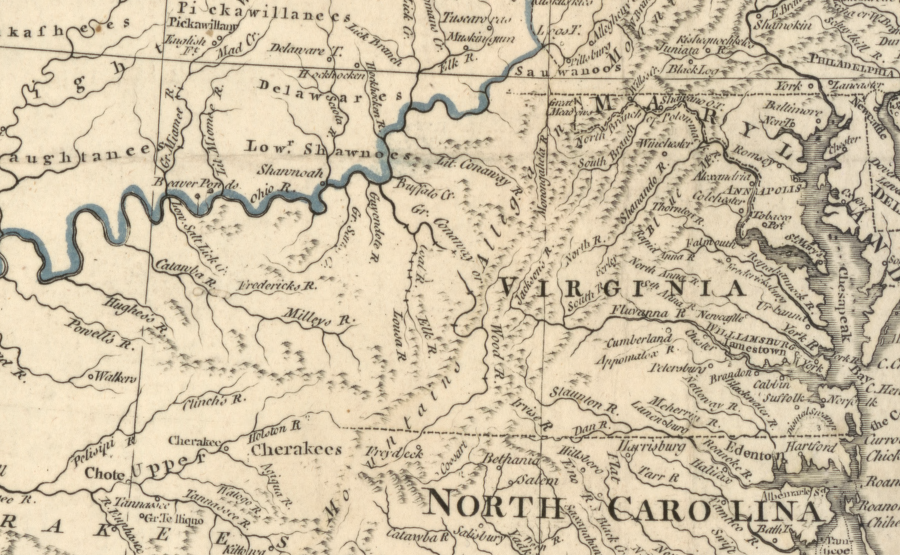
Library of Congress, The United States of North America, with the British & Spanish territories according to the treaty (by William Faden, 1783) showing Pittsburgh, Ohio and the "Canoway" rivers.
In order to secure the strategic mouth of the Kanawha river where it meets the Ohio (also known as Point Pleasant), Virginia raised a 100 man company under Botetourt militia officer Matthew Arbuckle, a veteran of Dunmore's war and the namesake of Arbuckle's fort on Muddy Creek in what is now Greenbrier county, West Virginia (for background information on that front see Frontier Defense by the McBrides or The Archaeological Conservancy's video). Arbuckle's company was organized as regular state troops (not subject to serving outside of Virginia without their consent) under the provisions of the Convention meeting in Williamsburg in July 1775. "An Ordinance for Raising and Embodying a Sufficient Force for the Defence and Protection of this Colony...One other company, consisting of one captain, three lieutenants, one ensign, four sergents, two drummers, and two fifers, and one hundred privates to be raised in the county of Botetourt, and stationed at Point Pleasant, at the mouth of the great Kanawah...under the direction of, and subject to, such orders as they may from time receive from the commanding officers at Fort Pitt." (Captain Matthew Arbuckle:a documentary biography by Joseph C. Jefferds p43). The initial enlistment appears to have been for one year, and a second 100 man company was subsequently added to complement the garrison under Captain McKee, with a two year enlistment and bounty for the original company to continue on service (May 6, 1776 Captain Matthew Arbuckle by Jefferds p47).
McKee later testified that:
I do hereby certify that Matthew Arbuckle deceased was appointed a Captain in the Committee of Bottetout [sic: Botetourt] County (of which Committee I was a member) in September 1775 agreeable to an Ordinance or Convention raising troops for the defence of the Western Frontiers for one year and was continued a Captain two years longer in a subsequent ordinance or convention; which time he serv’d in the capacity of a Captain being together with all the troops stationed on the Ohio [River] incorporated into the 12th Virginia regt. on Continental Establishment in an Act of Assembly passed October 1778[?]. the term of service ending October 1778 and the pay being from Continental paymasters at the [two undeciphered words] mentioned except the [undeciphered] two Mo’s pay [undeciphered word] above which [undeciphered word] of Colo. [undeciphered] Harrisson [sic: Benjamin Harrison, Jr.] who was Commissary and Paymaster for the State of Virginia in that Department. Given under my hand this 13th day Sept. 1784. (Signed) Wm McKee [William McKee] Capt. 12th Virg’a Reg’t. Department of War/ Accountant’s Office/ January 12th 1799
Arbuckle's company mobilized and left Fort Pitt by May of 1776. George Morgan (Of the famous merchant firm of Baynton, Wharton & Morgan and by that time acting as Indian Agent for the middle department) wrote Lewis Morris on May 16, 1776, that "Captain Arbuckle, with a company of Virginia Forces, departed from hence yesterday for the mouth of the Great Kenhawa where they are to rebuild the fort and to remain until further orders from the Convention. I thought it necessary to send an Indian with them, and a proper message on the occasion to the Delawares and Shawnees, accompanied by one of his officers, which I am sure will have a good effect." (Captain Matthew Arbuckle by Jefferds p44). The Dunmore's war era fort at Point Pleasant, Fort Blair, had been abandoned and subsequently burned by Indians. Arbuckle's company arrived and built a new fortification, Fort Randolph, named for Peyton Randolph of Virginia. By October of 1776, Arbuckle's company was reorganized on paper as the 5th company of the 12th Virginia Regiment (Captain Matthew Arbuckle by Jefferds p44).
Clothing and Equipment of Arbuckle's company

Detail of a Map Cartouche from the October 1775 Issue of The Pennsylvania Magazine
(The Ann S.K. Brown Collection, Brown University)

Rifle Trigger Guard Fragment Excavated at the Market House site [Williamsburg, Virginia],
artifact #00022-12AE-00067-AG
Photo by Jim Mullins with permission of The Colonial Williamsburg Foundation
artifact #00022-12AE-00067-AG
Photo by Jim Mullins with permission of The Colonial Williamsburg Foundation
Three men of the garrison lost rifles and clothing in a boat accident as they were transporting provisions down the Ohio from Fort Pitt, two
of which seem to have been distinctive as they had brass boxes [N.B.
having viewed scans of the original document as shown below the linked
transcription by Mr. Harris is in error and the rifles had brass boxes
NOT brass barrels]. This potentially implies the majority of the rifles in the garrison may have been less expensive wooden boxed rifles.

William Grills lost a "Brass Box Rifle, an Exceeding Good One..."
Men of the garrison who later consented to joining the other companies of the 12th Virginia with the main (Continental) army outside of the state of Virginia successfully petitioned for the value of their rifles as they had been entitled to an allowance of 20 shillings per year under the terms of the original enlistment as a state regular battalion.
To the Honourable Board of War
Geo Lyne Majr 12th Virginia Regiment
in behalf of fourteen soldiers of Capt. Michael Bowyers Company of the said Regiment,
begs leave to Petition that their Rifles, Powder Horns &c. may be recd. by the Commissary General of Military Stores & that they are receive for them a reasonable Price. The matter Stands this: by an Ordinance of our Convention this Company amongst others was raised for the purpose
of Defending our Frontiers & not to be drawn from thence without their consent, and each man that furnished himself with a Rifle was to receive for the use thereof 20S Per Annum, since which these men have been taken into the Continental Service & marched with their consent from the Monongahalia to this place that they had neither an opportunity of selling them, or lodging them at their homes: No Man's Goal in support of the common cause oughtto operate to his prejudice, that I trust they will receive the value of their Rifles & refer to the Capt's list inclosed.
May 19, 1777 George Lynne Maj.
Petition of Geo Lyne
Maj 12 Virg Bat
read 20 May 1777
prayer granted
Deserter descriptions from the Pennsylvania Packet show clothing worn by some of the men who likely left the garrison for service with the main army and point to the general use of hunting shirts with trousers.


An additional 12th Virginia deserter description from the 13 August 1777 issue of the Pennsylvania Gazette as quoted on page 177 of Phillip Katcher's Uniforms of the Continental Army mentions "Four deserters wearing hunting shirts...Three also wore leather breeches, while the fourth wore trousers or overalls." I have not yet been able to acquire a scan of this particular ad and it may yield further context as to which portion of the 12th Virginia is in question among other details. Knapsacks seem to have been in use by the garrison, in addition to the above deserter description for James Halstead that mentions a knapsack, the pension application of William Pryor mentions the use of them at the Fort in the course of describing the near mutiny caused by General Hand's order reducing the garrison's provisions and pay.

Detail of an Iroquois tumpline or hoppus ( Am1983,23.1 ) in the British Museum
Captain Arbuckles Estate included "1 Beeded Hoppis"
Captain Arbuckles Estate included "1 Beeded Hoppis"
Officers, or at the very least Captain Arbuckle, seemed to have been dressed in "regimentals" as they are referenced in and 1851 deposition of Nancy Edgar (Captain Matthew Arbuckle by Jefferds p102). Captain Arbuckle was killed in 1781 by a falling tree in a storm (the same tree struck Nancy Edgar's father), and his probate inventory (Captain Matthew Arbuckle by Jefferds p97-99) contains several items worth noting:
"Coat Jackett & britches shoes stockings...hat & stock with gloves...1 Beeded Hoppis...One riffle gunn & shot bag...One silver stock buckles knee buckles & sword buckles...1 large silver handled butcher knife..."
A discussion of Virginia’s Independent Frontier Companies by Gabriel Neville can be found here at JOTAR
Although not in Arbuckle's company, a Tory Rifleman named Sergeant William Grant is worth investigation. Grant was drafted and enlisted in the 50 man "Capt. Michael Bowyers's Company of Riflemen, to be stationed at the mouth of the Little Kennarah [Little Kanawha] upon the River Ohio." He was for a time posted in the Tygart's valley during the Cherokee campaign (likely at Westfall's fort in Beverly WV) and deserted to the English army during the Philadelphia campaign of 1777 while in the 12th VA (alternate link here). His narrative illustrates how some of these frontier companies ended up with the main army.


