Showing posts with label Colonial Williamsburg. Show all posts

Thursday, March 2, 2023

Fowling pieces and Shotguns of Colonial Virginia

Portrait of James Lewis ca. 1772 by Charles Willson Peale at Colonial Williamsburg Foundation emuseum Note the blued barrel, keyed or wedge "sliding loop/sliding bolt" fastener, and brass mounts.

Undoubtedly the most common form of civilian firearm in Colonial Virginia; the fowling piece was a useful and versatile item capable of taking both large and small game depending on the size of the shot and charge that was used to load the piece. Advertisements and primary documents from the era point towards a predisposition in Virginia towards imported English fowling pieces, frequently with walnut stocks and around a four foot long barrel. Bores in the 1/2 inch, 5/8s inch and 3/4 inch range predominated. Some colonial era stores stocked fowling pieces (commonly referred to as "guns") at various price points. Virginia merchant William Allason stocked fowling pieces and trading guns by Wilson in his stores. Customers could purchase ready made stock on hand, place orders with their custom specifications though their local stores, or, (in the case of the more prosperous gentry) order directly with English factors or Gunsmiths in England. Gun orders by mail with makers who are mentioned by name in the Norton papers include Blythe, Clark, Moore, and Stanton. Prices ranged due to the quality of locks, mountings and embellishment. 


English Fowler by William Staples of Birmingham (d 1771). Private Collection

 Alexander Henderson's Virginia Colchester Store Letterbook has the following order information from 1761:  

1 doz. Guns at 10/per gun...1/2 doz. Guns at 15/per Gun + "PS at the Request of two of my very good Customers, I beg leave to add- 2 good & well fixed guns, the Barrell to be 4 feet 4 inches long and of good Substance, the Bore to be three quarter of an inch Diameter, with a very good Lock & Plain mounting- 1 ditto, the Barrell the same Length & substance with the above, the Bore to be half an Inch Diameter with good Lock & plain Mounting- These three Guns I would chuse to be very good but not too costly and I fancy London is the best place to order them from."  


Brass trigger guard finial from a fowling piece excavated at Point of Fork Arsenal in Virginia. Giles Cromwell collection.

 Invoice- London October, 1767, George Washington Papers June 6, 1765-March 9, 1775:

"1 Handsome fowling Piece 3 feet 2 inches in the Barl 3/4 inch bore, fine silver Mountg, with Water pan Lock, Walnut Stock, barrel blewed within a Silver Sight, a false britch and sliding bolts, worm to the Rammer & List Case [cost 8/8/0 ]" Gill Gunsmith in Colonial Virginia p13 


David and William Geddy advertisement. Virginia Gazette, August 8, 1751 
 
 
Imperfect cast brass wrist escutcheon from the Geddy site, Williamsburg Va. James Geddy and Sons Colonial Craftsmen. Colonial Williamsburg Archaeological Series No. 5 page 22


Although very affordable imports were widely available prior to the Revolution, it was sometimes advantageous to repair older fowling pieces. Williamsburg Gunsmith James Geddy advertised in 1739 that he had on hand "a long Gun, about 6 or 7 feet in the Barrell, was brought by a young Gentleman of Gloucester County, to me, the Subscriber, in Williamsburg, to be new Stock'd and Lock'd..." (Gill's Gunsmith of Colonial Virginia p28)


A composite long fowler from the Woodson family of Virginia survives in the collections of the Virginia Museum of History and Culture. The gun features an 0.80 caliber recycled 17th century barrel that is approximately 6 feet long, a round faced lock by Collicott of Bristol dating prior to 1773, and is brass mounted with reused Long land style British musket furniture. Overall length is 89 inches. A 1738 advertisement by James Geddy mentioned "large Guns fit for killing Wild-Fowl in Rivers." This very long barrel is indicative of such a use. Shorter, lighter guns were generally favored for upland hunting. Virginia Militiaman Thomas Kitchens mentioned "When I went out to Guilford I took my small shotgun..." in his pension application.


John Page portrait from Colonial Virginia Portraits showing some interesting fowler details and a flask.
 

Jim Kibler recently uploaded a great video on the aesthetics of English fowlers from this period.



Sunday, August 4, 2019

Colonial Williamsburg Weapons Conference

Weapons of War: Military Arms in Revolutionary America

October 11-13, 2019


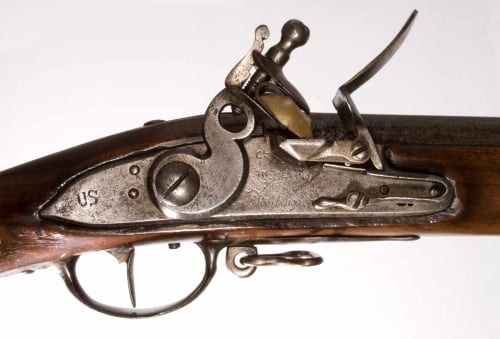
Rappahannock Forge Musket Colonial Williamsburg 

" In 1754, British and French soldiers arrived in America in numbers never seen before on North American soil. Thousands of European soldiers joined colonial militias and Native American allies in nine years of bloody fighting—the French and Indian War. With these soldiers came the first large-scale influx of military weaponry into the American colonies. Before then, the colonists’ arms were a mix of the obsolete, the old and the odd. Most firearms were privately owned and suited more for shooting game than combat, while others were outdated weapons captured in previous conflicts.

The social and economic repercussions of this war contributed directly to the onset of the American Revolution 12 years later, when many French and Indian War veterans would fight once again to decide the fate of the British colonies. A fresh wave of cutting-edge military weaponry arrived with the American Revolution, adding to the diverse assemblage of arms types already in existence in 18th-century North America.

Weapons of War offers students, military historians and antique collectors the chance to learn about the various types of arms and accoutrements that came to America during this formative period. From the archaeologically recovered fragments which tell us what was really used during the Revolutionary period to the conservation of surviving artifacts, we will explore a diverse array of materials and ways of appreciating them through modern eyes."

"Some presentations at the conference include (Virginia Gazette Article):

  • “Multiple Pathways and Different Lenses: Interdisciplinary Work at Knox’s 1778-1779 Winter Cantonment of the Continental Army” lecture by keynote presenter John L. Seidel, associate professor of anthropology and environmental studies and Center for Environment and Society at Washington College director.
  • “Selected Virginia Weapons of the American Revolution,” presented by Giles Cromwell.
  • A discussion about the battles of Lexington and Concord by Joel Bohy, "Antiques Roadshow" appraiser and director of historic arms and militaria with Skinner, Inc. of Marlborough, Mass. (a CWF blog post by Joel Bohy can be found here ).
  • “‘Small Arms of The Dutch Fabrick’ in 18th-century British America” by independent researcher Jim Mullins.
  • “‘For the Defense of the Colony:’ Tracking ‘New Jersey’ Wilson-contract Muskets from the Seven Years War to the Revolution,” presented by curator Mark A. Turdo of the Museum of the American Revolution."


Erik Goldstein Senior Curator of Mechanical Arts & Numismatics 
 Colonial Williamsburg Foundation

Colonial Williamsburg offers a closer look at the arms of the American Revolution
August 8, 2019 Q&A WITH ERIK GOLDSTEIN

"Who would you recommend this conference to?

Anyone with an interest in the French & Indian and Revolutionary Wars will love this conference, as it’s got something for all areas of interest. With such a diverse group of speakers, Weapons of War will appeal to arms collectors, historians, educators, museum professionals, living historians and the generally curious."

Register By
September 20, 20195:00 PM

While there visit the new exhibit  “To Arm against an Enemy: Weapons of the Revolutionary War”

Model 1763 Infantry Musket
Maker: Royal Manufactory at Maubeuge, Origin: France, Maubeuge
OL: 61" musket; 18" bayonet, Iron, steel and walnut
Learn more here

Now Open at The DeWitt Wallace Decorative Arts Museum