Showing posts with label virginia. Show all posts

Wednesday, May 17, 2023

Revolutionary War Roanoke: William Fleming's Powder Magazine

Although conveniently near the state operated lead mines near Fort Chiswell in modern Wythe county- the Revolutionary War era families of Southwest Virginia frequently had dangerous shortages of arms, powder, and flints; particularly after the mobilization of Virginia's 15 Continental regiments who then carried large quantities of arms outside of the State. A significant portion of these arms would never return to Virginia.

[Col. William Preston to Governor Henry July 8th 1778.]

 "... The Inhabitants of both mostly collected into Forts, and we are sorry to find that numbers of Our effective Men are not  armed, which we can only account for from the Number of Firelocks that were purchased in these parts, for the use of the State & the People being prevented from again supplying themselves, as the Importation from Germany fails the Gunsmiths being mostly engaged to work for the Publick.  This dificiency has induced us to Apply to your Excellency to get an order for one hundred & fifty riffles, or Muskets for each County as they can be spared from the publick magazine.  on any plan your Excellency shall think proper to adopt in the distribution, should you grant our request, we propose sending down from the Arms We forbear particularizing the Murders committed by the Enemy tho they are many at present as it is a desagreeable subject.

And subscribe Your Excellencys Most Obt Hble Servts

Wm Fleming.
Wm Preston."

Preston's request for additional firearms seems to have fallen on deaf ears, but plans to forward ammunition had already been set in motion.

   Governor Patrick Henry to Col. Wm Preston
"Wmsburg June 27th 1778.

Sir: I am favor'd with yours by Mr. Madison & Send by him
£1,500 for furnishing provisions I also direct Colo Southall of Henrico to hire a Waggon & send in it 1,500lb powder of the best rifle kind & 5,000 Gun flints. This powder & the Flints to be lodged at Colo Flemings & to be for the general use of the So Western Frontier."

Scottish born physician and Virginia Provincial officer William Fleming served his new home of Virginia with distinction throughout the French and Indian war, and suffered multiple gunshot wounds while serving as a Volunteer at the battle of Point Pleasant in 1774. Those severe wounds would end his ability to actively serve as an officer in the field during the Revolution, although he would later travel extensively in Kentucky on business and would continue to practice his career in medicine.

After retiring from Virginia Provincial military service Fleming resumed his civilian life as a physician and land speculator, marrying and building a home for himself in what would become Roanoke, Virginia by 1768.

Fleming's home from Colonel William Fleming of Botetourt, by Edmund P. Goodwin

Fleming wrote Governor Henry that "I have built a house of squared timber 16 feet by 14, sufficient to hold any Stores necessary to this quarter." adding that "Six Men I thought necessary to keep here as a gard for our little magazine." Fleming's personal magazine appears to have been an above ground building near his personal home, unlike the in ground powder magazines he would have been familiar with at Fort Ligonier in Pennsylvania and Fort Chiswell. 

 
Conjectural drawing of Fleming's Magazine.

 
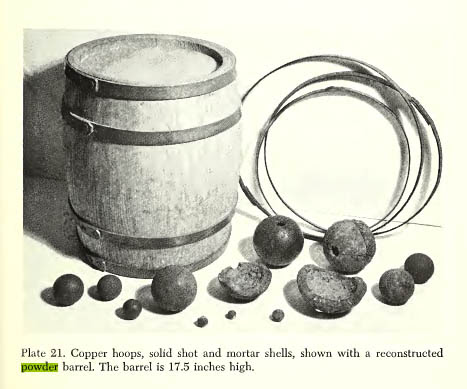
Copper hoops from English gunpowder casks excavated at Fort Ligonier (ARCHAEOLOGICAL INVESTIGATION OF FORT LIGONIER 1960-1965 by Jacob L. Grimm p79). The gunpowder stored by Fleming was likely French or possibly Dutch in origin.

 Fleming acknowledged receipt of the gunpowder and flints in July:

[Fleming to Henry ]July 19 1778]

"The 16th Inst I received 1462 lbs. of G: powder and the Flints agreeable to your Excellencys orders. 38 lbs. of the Powder was lost in the Carriage up by the heads of two of the Barrels being loose, this with what was in store before makes 2909 lbs. now in my care. Colo Southal desired the Waggon to be loaded down to lessen the expence. I derected the Waggoner to take a load of Country lead left near this. I am since informed he only took the half. should your Excellency think proper the remainder might be lodged here, as there is not 100 lbs. of Lead in store...Several persons have Applied to me for G. powder, as they could not be supplied elsewhere on this occasion, I let them take some from the County store at 12/ p. lb. which I suppose will reimburse the State An Account of which I keep. Your Excellency will receive with this a request from Colo Preston & myself in behalf of Montgomery & Botetourt counties for some fire arms." 

Despite being precluded from active field service as an officer by his injuries, Fleming played an active role in munition logistics and defensive planning for western Virginia during the Revolutionary war.


Worn flints from Cook's Fort, Monroe County, WVa via youtube


William Preston wrote to William Fleming that "I would be much obliged to you for 100 flints as several of my Guns are useless for want of them." [May 30, 1778]

"John Madison to Col Wm Fleming 2ZZ80 ALS
5th April 1779

My Dr Colo:
The frequent reports we have of the Hostile Intention of our Sable Neighbours is by no Means Clever, for which reason I would fain Put my Family in the best Posture of Defence I Possibly can, Say Good Sir can you spare me a Musquet or two at any Price or can you supply me with a little Amunition in case of Danger. I think you Intimated that I might have 2 or 3 Dozen of Gun Flints pray send them by Rowland for I have not one
I am with much Esteem Yr Obt Servant
John Madision."
[John Madison to Fleming April 5, 1779]


Powder Horn marked "William Fleming His Horn 1782" MESDA


In addition to ammunition, Fleming also handled small arms. In a letter to Governor Jefferson dated January 19, 1781, Fleming mentions "The Waggoner who took up the Salt to Washington County brings down a Chest of Arms, containing thirty four Firelocks that want repairing, with Six that are in order, retained for the use of the Militia makes up the compliment of Arms committed to my care..." (Works of Jefferson Vol. 3 pages 407-8).

For further information on Fleming I highly recommend Colonel William Fleming of Botetourt, by Edmund P. Goodwin and William Fleming, Patriot, by Clare White.

Wednesday, April 12, 2023

"...to James Young for 3 hundred Napsacks" 1776

 Prior to the Revolution, French and Indian War era supplies held in the Williamsburg Powder magazine held "one Tierce of Leather Shot Bags, and another of Canvas Knapsacks." (Journals of the House of Burgesses of Virginia 1761-65, Volume 10, Page 306, Thursday, the 20th of December, 5 Geo.
iii. 1764
).

 A somewhat contentious item to modern material culture scholars; the "New Invented Napsack and haversack in one" was peddled to Maryland authorities in 1776 as being previously adopted by soldiers in Pennsylvania, New Jersey, and Virginia. Evidence survives that Maryland and Pennsylvania utilized this design, but little information exists other than the sales pitch to document their use in Virginia. In fact, some Virginia Continental units like Captain Taliaferro's company of the 2d Virginia drew osnabrig linen from the Public Store on November 6th, 1775 to make up both separate haversacks and knapsacks:

"73 yds Ozns deld Capt Taliaferro for knapsacks @ 1/6 9 yds do for Haversacks deld ditto @1/6” (Journal of the Public Store at Williamsburg, p208. Gregory Sandor, ed.)


Saml. Chase Esqr. Philad. Feby 9 1776 

Sir

The above is a rough draft of the new Invented Napsack and haversack in one That is adopted by the American Regulars of Pennsylvania, New Jersey & Virginia @ 8/6 each. I could furnish any quantity that may be wanted for Maryland by ye first of April. Best cartouch boxes, for 23 rounds, with a pouch, large flap, and Shoulder Belt - @8/6 Bayonet Belts, to go over ye Shoulder with a double frog to Carry a Bayonett & Tomahawk @4/6. Gun Slings @2/each, priming wires & Brushes @7/6 doz. Any quantity of the above articles that may be wanted for ye province of Maryland, you may depend on being punctually & carefully supply’d with, if you see proper to employ Your Obdt. Ser, J. Young 


J. Young to Samuel Chase, 9 February 1776, enclosed in Samuel Chase to Thomas Jenifer, 10 February 1776, "Journal of the Maryland Convention, 26 July-14 August 1775/Journal and Correspondence of the Maryland Council of Safety, August 29, 1775-July 6, 1776," William Hand Brown, Archives of Maryland, vol. 11, (Baltimore, Md., 1892), 150. A "rough draft of the new Invented Napsack and haversack in one that is adopted by the American regulars of Pennsylvania, New Jersey & Virginia ...," contained in Samuel Chase to J. Young, 9 February 1776, is found in the Maryland State Papers, (Red Books), Archives of the State of Maryland, access. no. MdHR 4561, loc. 1-6-3-38, 4, item 13 


Warrant to  James Young  for 3 hundred Napsacks delivered to James Hunter in Fredericksburg, July 1776

 Day Book, Council of State, 1776 July 12-Aug. 3 Library of Virginia

A warrant in the Council of State of Virginia day book, includes payment to someone named James Young for 300 knapsacks. It is tempting to assume that this is the same "J. Young" producing "New Invented Napsack and haversack in one" but further research is necessary to confirm if this is indeed the case.  In Mary R. M. Goodwin's Clothing and Accoutrements of the Officers and Soldiers of the Virginia Forces 1775-1780, she notes that "On July 22, the Council ordered that a letter of credit be written to "Mr Young, in Philadelphia to supply" Captain John Nelson with "Saddles & Accoutrements for his Troop of Horse."[McIlwaine, Journals of the Council°, Vol. I, pages 60-61.& Ibid., page 85.]


Friday, August 19, 2022

For the Virginia Troops, a Quantity of Cloathing, 1778

"...for the Virga Troops a Quantity of Cloathing..."


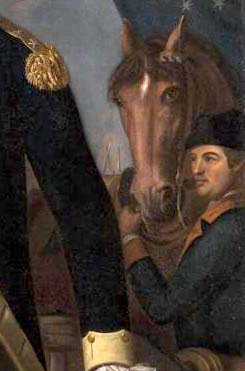
Detail from Charles Willson Peale's 1780 portrait of George Washington after Princeton, Mount Vernon.


In the fall of 1778 a quantity of waistcoats and breeches were issued to the Virginia Continental line.

“...Resolved, That the Governor be requested to order by the first opportunity, as much baize from the public store, as will make waistcoats, to be sent for the Virginia non-commissioned officers and soldiers in the Continental army, and delivered to them gratis, and also such worsted or woolen caps, as may be in the said store, and one thousand blankets.”
H.R. McIlwaine, ed. Official Letters of the Governors of Virginia, Richmond, 1926, Vol. I, November 14, 1778

At least 1,711 of the 2,068 waistcoats appear to have all been constructed of red fabrics other than baize:

784 Red flannel Waistcoats
435 Best Red Cloth Waistcoats
492 Red Serge Waistcoats
(John Moss and Christian Febiger, October 29, 1778, Invoice for Blankets and Clothing, Washington papers)


To George Washington from Colonel Christian Febiger, 4 November 1778 From Colonel Christian Febiger Elizabeth Town [N.J.] the 4th of Novbr 1778.

May it please your Excellency By Order of Generall Woodford I have been in philadelphia and gott made up and procured for the Virga Troops a Quantity of Cloathing Viz. 2194 pair of Breeches, 2068 Vests, 2200 Shirts 1294 Blanketts some Caps, Shoe Buckles etc. etc., which I have brought on with me, Those Goods the Governor of Virginia has order’d either to be sold to the Troops at the Reasonable Rates mention’d in the Invoice or given gratis to such men as have not receiv’d their Quota allow’d by Congress for this Year.1 Major Genl Lord Stirling order’d me to take our proportion out at Pompton where our Brigade now is, an[d] as he had Reasons to think, that the other two Brigades would soon be order’d into Jersey, he directed me to receive your Excellencys Commands, whether their proportions should be sent them immediately or be stored on this Side till they came. I have been inform’d of your Excellencys Orders, that no Cloathing should be issued to the Troops, untill a sufficiency arrivd to Cloath the whole Army.


The 2,194 pairs of breeches were made up in the following colors and farbrics:

“1903 Blue & Green Cloth Breeches…291 Pair Red Serge Breeches”
(John Moss and Christian Febiger, October 29, 1778, Invoice for Blankets and Clothing. The Writings of George Washington from the Original Manuscript Sources, 1745-1799. John C. Fitzpatrick, Editor.)


A manuscript by General William Woodford (dated September 11, 1778) that recently went up for sale at Heritage Auctions enumerates the colors, variety and types of cloth available in this issue. It is likely that the blue breeches contained in the 1903 Blue & Green Cloth breeches" were "light Blue" given the amount of light blue cloth in the inovice.


"Invoice of all the goods brought to Philadelphia from Virginia for the use of the Troops of that State, as per the report of Lieut. Colo. [William] Heth who was sent with instructions from the Brigadiers & Field Officers of the Virginia Line to take charge of them upon their receiving an acct. from Mr. Stark of their arrival this the 21st of August 1778...


Cloth Swatches ca. 1765 from The Exeter Cloth Dispatch Book, 1763-1765

7 1/2 Peices of Scarlet Broad Cloth 175 3/4 yds.
10 ps Buff Do ...287 3/8 yds.
26 ps light Blue do...712 yds.
8 ps Coarse Do...290 yds.
9 ps Mid. Green Do....337 yds.
1 ps Coarse Do...33 yds.
8 ps Coarse Red...300 yds.
12 ps Do Do...397 yds.
4ps fine Black...113 yds.
1500 yds Coarse brown Linen, a large proportion of which is little better than Crocus
664 dozn of Hose...
1300 pair of Shoes
1707 Shirts
3155 pr Shoes
576 Shirts
444 black Stocks
144 ready made short brown vests, without any kind of facings
625 yds coarse blue Shalloon
no kind of Trimmings except a large quantity of very indifferent green Thred
The Goods sent up last winter from Virginia were committed to the care of three Officers who delivered them out pr orders from the Virginia Brigadeers & kept an exact acct. of the articles delivered... "

Saturday, July 30, 2022

Inventory of Stores at Vause's Fort 1757

(1756) George Washington Papers, Series 4, General Correspondence: George Washington, Diagrams of Frontier Forts. [Manuscript/Mixed Material] Retrieved from the Library of Congress, https://www.loc.gov/item/mgw442497/.

In 1756 the privatly owned (and variously spelled) Fort Vass/Vause/Vauxe in modern Shawsville, Virginia, was burned during a French and allied Indian raid by a war party led by Battle of the Monongahela veteran François-Marie Picoté, sieur de Belestre II. Vause's fort was possibly simply a fortified log house or perhaps a two story log "blockhouse" as it was described in the in the Boston and New York newspapers. As part of a defensive "Chain of Forts," Virginia Provincials were assigned to rebuild a "one hundred feet square in the clear" fortification at, or near the site of the original fort on Vause's property.
The location of the second (Hogg's) fort at Vause's has been confirmed, the location of the nearby original (burned) fort has yet to be determined. For information on the archeaology at Fort Vause see "The Second Fort Vause" by Kim McBride (The Archaeology of French and Indian War Frontier Forts. ). Despite being able to pinpoint the outline of the second fort and bastions, McBride writes that "No evidence was found of construction methods of the curtain walls or other structures that connected the bastions...if this construction was entirely above ground, it has likely been obliterated." It is worth noting that the Council of War recommendations for building these forts suggested "Stockades to be 14 feet long" implying walls made of vertical logs placed in the ground. Unless traces of the post molds have been obliterated by plowing, the earthen walls of the second Fort Vause may have been constructed in the same manner as those of Fort Loudon in Winchester, Virginia; described by Andrew Burnaby as "logs filled up with earth."
Colonel George Washington checked on the construction progress in October of 1756. The location was considered very important as "..The fort at Vass's (which Capt. Hogg is now building) is in a much exposed gap; subject to the inroads of the Southern Indians, and in a manner covers the greatest part of Bedford and Halifax." [November 9, 1756. A Plan of the Number of Forts, and strength necessary to each extending entirely across our Frontiers, from South to North.]
Captain Peter Hogg's efforts at fort construction were slow and expensive, additionally payroll irregularities led to him being stripped of his command. Washington wrote to Hogg in July of 1757 that:
I have great complaints made concerning your manner of carrying on the works at the Fort you are building. It has cost infinitely more money than ever was intended for it. and, by the injudicious spot of ground you have chosen to fix it upon, it has caused a general clamour.
Mr Bullet and Mr Fleming inform me, that you refuse to do the necessaries belonging to it.
I therefore desire you will immediately upon receipt of this, deliver up the company, arms, stores and fort, to the command of the former; that the Kings Service may not suffer: You are to take Lt Bullet’s receipt for every thing delivered to him.

Hogg was ordered to compile an inventory of stores to turn over to Lt. Bullet in 1757, a transcription of which is below.

"Inventory of the Stores Belonging to ye Garrison at Vasses
To powder Gross Wt---Lbs 106
To Bullets 264lb
To Firelocks-9
Do Same -9
To Gun Barrils-7
To Militia Muskets-2
To Bayonets not in Repair-8
To Cartridge Boxes of Militia-16
Do of Comp ye[?] Worn out-8
To Deserters Coats-2
Do Vests-1
Do of Britches-1
Do of Hatts [?]-1
Do of Stocks do-1
Do of Blankits[Blankets]-8

To Baggs-14
To Flower Lib Wt 3857
To Beef Dried Lbs Wt 1383
To Hanged Porck Lib. Wt. 72 1/2
To pickling Tubs-13
of Brass Kittles-5
of Iron Do-3
of Horses Belonging to the publick-4
of Broad Hoes-4
of Spades-16
of Shovels-4
of Chissels-21
of Augers-16
of Gouges-5
of Broken Do-1
of Compasses-2
of two feet Rules-1
of Broken Do -2
of adzes-5
of Gimblets-5
of Hewing Axes-12
of Broken Do-1
Of Falling Do - 27
of Country made Do -14
of Whipsaws-4
of Crosscut Do-4
of Hand Do-5
of Claw Hammers-4
of Lathing Do-2
of Whipsaw Files-6
of Cross Cut do-1
of Handsaw Do -4
of Saw Sets-2
of Steal [Steel]-Lib Wt- 13 1/2
of Grind Stones-3
of Cordage in a Running Tackles 30 lb
of Hatchets-1
of Frying Pans -2
of Suits of Serjts Clothes-1
of Militia Swords-9
of Regimental Stockings 47 pairs
of Ladles--Worn-1
of illeg files illeg 2
of Corn in Store by Judg 1/2
of Capt illeg & Received of Do in hande of Lt] 22 Bush 60 Bushels
Note the Above Contains a True Coppy the Inventory of Stores by Capt Hog Deliveded as per my Rects [illeg] Bullitt"
[the origin of the tools listed above are on a seperate document in this packet titled " Accot of Tools Recd for Building the fort on Roanoke"- for example "Tools Sent from Winchester by the Waggon" A few items appear on the second list that are not on the first, for example "Ditto from fo Wm...1 Grindstone 2 iron potts 2 brass Kettles 2 frying pans 2 pewter Tankards Iron Laddle ... 1 Bar of Steel"

[on reverse] Inventory of Stores at Vauses Fort no-date

(1757) George Washington Papers, Series 4, General Correspondence: Peter Hog to Thomas Bullitt, August 4, Inventory of Stores. August 4. [Manuscript/Mixed Material] Retrieved from the Library of Congress, https://www.loc.gov/item/mgw442639/.

------------------------------------------------------------
1757 A Roll o fye Comp. of Late Capt. Hogs with Acct of theire State of Clothes Arms & c. Aug. 4
Name/Clothes of Compy/Arms of Do.
[Clothes of Compy]Coat/Vests/Brcs[Breeches]/hats/Shts[Shirts]/St-illeg[Stockings]/Shoes/[???likely Rowler Rollers/neckstocks]/Hav [haversacks]/Blankits/
[Arms] FireL/Bayo?/Cart B[?]
1. Jn. Johnston - Bayonet Strap wanting
8. Benja. Goss-Gun left by Maj. Lewis's order at Fort Dinwiddie
10. Moses [?] Burns - Gun lost when he deserted
11.David Tate -Blanket purchas'd by Capt Hog
13. Abm. Bledeso- no belt
15. Wm Blanton - no strap
26. Val [?] Mchiche [?illeg? Natl/Jas McBride???] - [Firelock] he brought from the Meddows & looks upon it as his own
29. And.w Fowler - Cartridge box & Bayonet lost on Sand creek

Sunday, October 24, 2021

THE STORY OF THE NEW RIVER: Blueridge PBS documentary

A new documentary that touches on some topics and locations mentioned elsewhere in this blog just premiered on Blue Ridge PBS and may be of interest to some of the readership. "The Story of the New River" is currently streamable (for a limited time) here for free and is also available for purchase from Blue Ridge PBS.

Tuesday, October 19, 2021

An interview with Wayne Trout, Gunsmith.

Although this post is a departure from my usual content and scope, I thought an interview with my good friend and gunsmith Wayne Trout would be of interest to the readers here. Wayne is a talented, humble and helpful man; I always enjoy visits with him at his shop. For inquiries, Wayne can be reached at: wayne.trout@gmail.com
What is your professional background and where are you from?

I was born in Norfolk VA and lived there 57 years. I graduated from VA Tech in 1973 with a BS in biology. I played VHSL sports in high school and NCAA sports in college. After graduation I finally found full time employment in April 1974 in the City Real Estate Assessor's office. I spent my entire professional career, 32 years, in the office. I was appointed to the chief position, City Assessor, in 1989 and held that position for 17 years until my retirement in 2006. In 2008 my wife of 43 years- Margo, and I moved to Giles County Virginia where we currently reside. We have a daughter and son, both of whom are married, and 8 grandchildren.
How did you get started building muzzle loaders?

I joined up with one of the North South Skirmish Association (N-SSA) teams in 1975 and competed in the N-SSA for about 35 years. I had the good fortune of shooting on several national championship teams during that time. It was the N-SSA competition that got me started building guns. A good friend and I were having to rework the internal parts on our reproduction locks at least twice a year. We noted that the guys shooting original guns never had to do lock work. So, we decided to buy original locks and build rifles around them. When I had finished my rifle the chair of the N-SSA small arms committee expressed interest in buying it from me. I told him I had no interest in selling the gun and gave him what I thought was an outrageous price and he said that if I decided to let it go to tell him! Because I enjoyed doing the rifle build I purchased parts and started another one. Before I had finished it someone had said they wanted to buy it when I was done. As a result I estimate that I built around 30 copies of civil war rifles for shooting competition. Around 2008 I bought a flint long rifle kit and built it. While that rifle will never see the light of day, the ability to utilize a degree of artistic license in building a gun really appealed to me, especially since the civil war rifles had to be exact reproductions of the original guns.. So, I thought I would do another. When I had completed the second kit I took it to a show in Harrisonburg VA. I walked into the showroom and almost immediately someone asked me if it was for sale and they bought it! I guess that pretty well sums up how I got to where I am today.

Who have you learned the most from?

Living in Norfolk I had the good fortune of being about 45 minutes away from Colonial Williamsburg. Almost once a week I would drive there and go to the gun shop and aggravate the guys in there. At the time Richard Frazier, Clay Smith and Richard "Sully"Sullivan were the journeyman smiths and George Suiter was the shop master. All four men were of great help and encouragement to me. Even now I maintain regular contact with George Suiter and have annual contact with Clay and Sully. At George's insistence I started taking classes at the NMLRA gunsmithing school at Western Kentucky University. I have had the distinct pleasure and privilege of working under masters like Jack Brooks, Art DeCamp, Jim Kibler, Mark Silver and my good friend George Suiter.. I have also had the good fortune of getting to know Jim Chambers, Mark Thomas and many other people who are at the top of the long rifle art. Lastly, I had the distinct pleasure of being able to spend extended time with my dear old friend Bob Harn. I was able to work in Bob's shop while my wife Margo and I vacated the winter climate of the Virginia mountains for Florida. I have been very fortunate to receive instruction and critique from folks I consider the best at what they do.

Trout's 2019 Contemporary Longrifle Associatioin show display via the Contemporary Makers blog

What is it about building rifles vs. fowlers or muskets that intrigues you?

As I alluded earlier, the art of long rifle building is much different than reproducing an 1861 Springfield rifle, 1855 Harpers Ferry or any other civil war shoulder arm. All I did was make an exact duplicate of the original military weapon. The artistic skills needed to complete a longrifle and the ability to apply some degree of personal interpretation far exceeds and is considerably more rewarding than making an exact copy of a military gun that is no different than any other weapon of its kind. While I greatly enjoy building and decorating long rifles I would say that there really is not any part of the build that is easier from me than others, they're all difficult! I do, however, enjoy the finishing work of carving and engraving, but it takes a long time to get there.
Who is your favorite historic gunsmith or rifle style and why?

Because I am a native Virginian, I gravitate primarily to the work of early Virginia gunsmiths. While I appreciate the arms from throughout the long rifle era, I prefer the early work, say from 1760-1790. The graceful lines of an early Virginia or Lancaster County gun with their clean, crisp lines I find very appealing.
What advice would you give an aspiring gun maker?

If I were to advise an aspiring gunmaker I would say to find someone who has original guns. The ability to handle originals provides a tremendous amount of "tactile memory" that will prove invaluable in moving forward in the art. The study of originals will help to add that third dimension that is often needed when studying flat photos in a book.

What is your most frequently used reference book/resource?

Spending time looking at and studying those "flat" photos in books like Shumway's Rifles of Colonial America Volumes 1 and 2 and Kindig's Thoughts on the Kentucky Rifle in Its Golden Age is of great benefit. Also, don't be afraid to take classes. Learning from those who have mastered the skills of barrel inletting, stock shaping, furniture inletting, making patch boxes and furniture, carving, engraving and any other associated skills will prove much more beneficial than the school of "hard knocks".

Tuesday, May 19, 2020

Revolutionary war Virginia cartridge boxes

Cartouche Boxes

In the opening stages of the American Revolution, many Virginians in Militia companies, or the new Continental regiments were armed with older "Cartouch" or Cartridge boxes (frequently called "belly" boxes in modern parlance) that belted around the waist, and/or shot bags and horns. Many arms shipments from England in the past had included these cartouch boxes with bayonets as part of a complete "stand of arms." Around 1,200 cartouch boxes were inventoried in the Williamsburg Powder Magazine in 1775 and helped supply the fledgling Virginia Continental Regiments (Journals of the House of Burgesses of Virginia 1773-1776, Volume 13, Pages 223-4.) These boxes were light and economical. A thin leather flap was nailed over a painted wooden box. Belt loops were nailed to the front of the wooden block. As defined in The Gentleman's Compleat Military Dictionary (1759):

CARTRIDGE-BOX  is a Case of Wood, or turn'd Iron covered with Leather , holding a dozen Musquet Cartridges; it is wore upon a Belt, and hangs a little higher than the right Pocket-Hole.

[Cartridge] POUCH; a Grenadier's Pouch, is a square Case or Bag of Leather, with a Flap over it, hanging in a Strap of about two Inches broad, over the left Shoulder...

Although the British generally differentiate the two by using the terms box [belly] or pouch [shoulder] , American soldiers were not always as unambiguous, such as James Johnston, who testified that " my Cartridge box was never of [off] my neck"


British issue "Belly" Cartouch box from historical image bank


In 1776, multiple contracts and payments went out through the State for Cartouch/Cartooch boxes as detailed by Mary Goodwin (CLOTHING AND ACCOUTREMENTS OF THEOFFICERS AND SOLDIERS OF THE VIRGINIA FORCES 1775-1780. From the RECORDS of the PUBLIC STORE at WILLIAMSBURG)

" The Committee of Safety for Virginia (which committee had charge of such things for the state until the new government was formed in June, 1776) contracted for supplies for the army. On February 19, 1776, the committee contracted with Mr. Anthony Noble, of Berkeley, to "furnish 1,000 cartouch boxes, Belts and bayonet cases at the price of 9s. each "[Calendar of Virginia State Papers, Vol. VIII, pages 90...]"

 Noble was also involved in manufacturing arms with his partner Adam Stephen.

Wartime shortages caused Adjutant General and soon to be Quartermaster General, Timothy Pickering to suggest to Governor Jefferson that Virginia substitute waist boxes of the "belly" type instead of shoulder pouches in 1780.
To Thomas Jefferson from Timothy Pickering, 3 July 1780
War-Office July 3d. 1780

"Sir
We did ourselves the honour of writing to your Excellency on the 20th ulto. when we expected to be able to send you 2000 cartridge boxes: but we have been disappointed; and Major Peirce has received at present but between six and seven hundred: nor, are we certain how soon the rest can be furnished. But as the whole number will be incompetent to the demands of your state, we beg leave to suggest to your Excellency the expediency of getting a quantity made in Virginia; and as the time is pressing, a slighter kind may be provided. The British have for several years past furnished their new levies with cartridge boxes made of close wood (as maple or beech) with no other covering than a good leathern flap nailed at the back near the upper edge, and of sufficient breadth to cover the top and whole front of the box: they are fixed to the body by a waist belt which passes thro’ two straps that are nailed to the front of the box. Cartouch boxes of this kind will answer very well, and may be made at small expence and with great dispatch."


Soft Pouches

Shoulder slung pouches seemed to have been preferred, and they offered quite a bit more protection than the waist belt boxes that had only a single leather flap . A variety of forms, materials and capacities are noted in the early portion of the Revolution in other states (some holding 17 rounds, others 23 and etc.) but many featured a bag with a leather flap and shoulder straps nailed to the back of the wooden block from the exterior.

"On March 300 1776, the Committee contracted with Messrs. Faulk and Burkhard to furnish "for the use of the army fifteen hundred cartooch Boxes with proper Belts at the price of 8s. 6d each; 1000 Bayonet Belts with double Frogs at the price of four shillings each; 2000 priming wires and brushes at 5a. p'r Dozen, and 500 pair of shoes at the,price 7s.6d. p'r pair, to be delivered at the Town of Fredericksburg within six weeks from this day, and approved of by the Commissioners of the Gun Manufactory there "[Calendar of Virginia State Papers, Vol. VIII, pages 145, quoted in Goodwin]"  

The Faulk/Foulk and Burkhard were apparently Pennsylvania merchants. The inclusion of bayonet belts/double frogs in the Faulk transaction may imply that these were shoulder worn soft pouches. Faulk/Foulk was also linked in payments for "sundries for the public use" with a merchant named Young, possibly the same Young peddling the "New Invented Napsack & Haversack in one" who was also selling "Best cartouch boxes, for 23 rounds, with a pouch, large flap, and Shoulder Belt - @8/6 Bayonet Belts, to go over ye Shoulder with a double frog to Carry a Bayonett & Tomahawk @4/6."


Fragmentary 23 hole pouch from Neumann's Collector's Illustrated Encyclopedia

A proposed "Contract for 3000 Cartridge boxes, to hold 23 rounds, with a bag, a large strong flap to cover the bag and box, and a buff belt with a buckle." was offered by the State of Virginia to harness maker Edward Simpson of Fredericksburg. Associated correspondence indicates that Simpson initially made and delivered to the Quartermaster at least two hundred boxes by March of 1781; with the balance due at the end of May. By December he had produced less than half of the 3,200 in the contract as the state of Virginia could only provide him with half of the funds agreed upon to procure the necessary materials. Hyper inflation further limited the purchasing power of the limited amount he did receive. Since the state had cartridge boxes in the amount of "3600 which we have in Store" as well as the British accoutrements newly "taken at York" his obligation was amended to Simpson's suggested 1,200 total by the Governor's Council on December 19th, 1781 (Record Group 8, Executive Papers, Governor Benjamin Harrison, 1781-1784, Accession 44660 Library of Virginia). Incidentally, George Connolly's oddly specific pension application states that prior to being wounded by gunshots at the battle of Petersburg in 1781 "after firing 23 rounds himself." It is interesting to note that the pouches and "New Invented Napsack and haversack in one" offered for sale to Maryland by a contractor named "J.Young" in 1776 were described as "Best cartouch boxes, for 23 rounds, with a pouch, large flap, and Shoulder Belt - @8/6."

For information on making this type of pouch click here.


Tin Canisters

Tin Cartridge boxes or Canisters, were used in the Continental army as a substitute for leather cartridge boxes. At times, these canisters were misused. In 1777, Lieutenant "Rains of the 15th. Virga. charg'd with sending a Soldier (William Bluford) to bring water in a tin Cartouch box, found not guilty by the unanimous opinion of the Court." (Valley Forge orderly book of General George Weedon of the Continental Army ...).

"An original canister. Photo courtesy Paul Ackermann, Conservator, United States Military Academy." from  The Complete Continental Cartridge Cannister Chronicles by Michael Barbieri

 On the 16th of November, in 1779, the Virginia Board of War meeting in Williamsburg directed "... that to supply the want of leather Cartridge boxes, of which there is a great scantiness, two thousand tin boxes such as are used in the Continental Army by Light Infantry be immediately made, that recommendations be immmediatley sent out to county Lieutenants to have the arms and military stores in their possession, put into the best order..." Jefferson, Madison, and the Executive Council noted three days later that  "....they approve of having tin Cartridge Boxes made as proposed by the board of War..."

A substantial number of Canisters show up in returns from Capt. Charles Russell, Assistant Deputy Quarter Master for Virginia:


 112 "Tin Cannisters" February 1781; Boyd's Ferry Virginia

"Muskets-220, Bayonets-70, Ditto Slings-400, Cartg Boxes-69, Gun Flints-5640, pounds lead-2368, Pickers & Brushes-400, Tin Cannisters-112, ditto Slings -190, Fifes-20, Drums-6, Pair Drum Sticks-32, Oil Bottles-7..." (Summary Account of Articles purchased, Received and of the Issues and Deliveries therof under the direction of Capt. Charles Russell DQM for the district of Boyd Ferry from the first day Feb till the last day 1781 Inclusive, National Archives: Roll 30, Target 1,Volume 108).

Further information on these tin canisters or cartridge boxes has remained scanty, but the quote below implies that two hundred were issued in May, 1781:

Mr. W. Porter, C.M. Stores
Chesterfield Court-House, Va. May 5, 1781
Sir:- You will take under your charge five wagons, containing 400 stand of arms, complete with bayonets, &c. 200 leather cartridges, two hundred tin canisters, and two thousand flints, and you will proceed immediately to Suffolk. Immediately on your arrival, you will acquaint General Muhlenburgh of it. You will not by any means deliver any of the above articles without General Muhlenburgh's particular order."


"New Construction" Boxes


"New Construction" box from Museum of the American revolution

By 1779 some Continental soldiers were receiving 29 hole "new construction" boxes that mimicked the higher quality British issued pouches and provided a much greater amount of protection for the ammunition.These boxes were among the highest quality accoutrements being produced by Continental artificers for the infantry.


Receipt for "N. Const.d C Boxes" belonging to Woodford's Brigade of Virginia Continentals on June 18th, 1779. (Volume 130 Journal of Military Stores Delivered and Received Aug 9, 1778-Feb 18, 1780 NA 606471).

The Virginia Continentals of Woodford's Brigade appear to have been first issued a small number of "New Construction" Cartridge boxes on June 18th, 1779. Other units such as the 2nd Pennsylvania Brigade received them much earlier on January 8th of the same year; at a time when Woodford's Brigade was still being issued tin and damaged old construction leather boxes. Muhlenburg's Brigade of Virginians received 192 "New" Cartridge boxes on August 7th, 1779, likely of the "New Construction" pattern. 

Some new construction boxes may have been delivered to the state of Virginia from Continental stores as implied by Col. Febiger when he complained that the cartridge boxes the Virginia recruits he was organizing received substandard boxes- "many of the old construction" in 1781.

Domestic Production


Thomas Jefferson's 1781 Circular-Letter to the County Lieutenants of Virginia pleaded that:

"...every man who has or can procure a Gun have it instantly put into the best order a Bayonet fitted to it, a Bayonet belt, Cartouche Box, Canteen with its strap, Tomahawk, Blanket and knapsack. Some of these articles are necessary for his own safety and some for his Health & Comfort. The constant exhausture of the Public Stock of these Articles by calls from all Quarters renders it vain for the Militia to expect to be supplied from thence when they come into the Field, and nothing is so
easy as for every man to have them prepared while quiet and at Home. The cartouche box with a leathern Flap, a wooden canteen with its strap and a knapsack of thick linen (the better if plaid [possibly painted]) are what may be had in any man's family and there are few neighborhoods which do not afford artificers equal to the repair of a Fireloack and furnishing it with a Bayonet..."

In his deposition on the naval service of Northern neck resident Robert Hall,  John Neal "recollects the fact of his father making cartouch boxes for the men, & his mother melting up pewter basins into musket balls."

Maryland Purchase

In 1780/81, approximately 2,000 cartridge boxes of an unknown type were procured from "A Mr. Patoun of Baltimore." Patoun "sent us some Cartridge Boxes. They were brought in a vessel of Mr. Braxton's to Annapolis where the vessel being sold they were left and I have heard nothing of them since. I must beg the Favour of you to get them brought on if possible. Any supply of the same Article as also of Cartridge Paper and Flints which the Board of war can send on are essentially wanting." (Thomas Jefferson to Benjamin Harrison, 29 January 1781).  After several letters and a bit of confusion on how these boxes were to be transported to Virginia Captain John Pryor wrote to Col, Davies on October 14th, 1781 that:

"I am glad to hear the Cartridge Boxes have arrived. I hope they are leather ones. They never were more wanted. pray direct Capt: Bohannan to send the whole of them down."


Boxes Issued for Militia Service 

Several pension applications and receipts show that Virginia Militia were regularly issued proper military cartridge boxes and muskets in 1780 and 1781; even when they entered service with civilian arms.

Pension application of Thomas McDearman S5749 f8VA+f13VA

Thomas McDearman one of the Virginia Militia
has Served his Tower [tour] of Duty in Genl. Stephens's Brigade
& delivered up his Gun & Cartridge Box – and is hereby
discharged by me
the 8th of November 80 S/ Nath'l G. Morris [Nathaniel G Morris]
Major [illegible]


Pension application of Daniel Holder W9064 Ruth Holder f29VA

Hilsbough
Hilsborough Jany 30th 1781
Rec'd by Order of Colo. Gunby from Daniel Holder One Gun Bayonett and Cartridge Box.
S/ [illegible signature, possibly "Pat Danelly" ]. Lt. & A. [Lieutenant & Adjutant]


Pension application of Thomas Kitchen (Kitchens) R5998 f19VA

I was drafted sometime before the battle of Gilford [Guilford] Courthouse [March 15, 1781]... 
I cannot recollect the precise date. 
I was placed on for they called the Bullock gard [guard?] while the battle was being fought.When I went out to Guilford I took my small shotgun (for if I had not taken it with me they would have pressed it into service so I might as well take it.). I showed it to my Colonel, he said as I was a small follow I might keep it. But the rest of the officers took it from me, valued it and gave me a receipt for the valuation. And gave me a great heavy musket and cartridge box. They took my musket when they gave me my discharge, but never gave me back my little gun and I never got anything to do any good for my receipt. They asked me for my cartridge box. I told them I had none, so they said no more about it. I had thrown it away during our retreat at Guilford's battle. We were compelled to retreat at the top of our speed and it was so large and I was so young that I pulled out my cartridges slipped them into my knapsack and threw the cartridge box away.
 
Some North Carolina Militia soldiers were also issued muskets and bayonets despite mustering with civilian arms. Francis Myrick stated that "when he was attached to Greene's Army his gun, shot bag and powder horn was taken from [him] and a musket and cartridge boxes was given to him in their stead".

Conclusion:

What were these cartridge boxes being issued in Virginia like? Complaints about the quality of the boxes were circulated:


"Sir,
the 300 cartouch boxes, that I informed you I understood were on the road coming from Virginia, are just come in. I have received them and can assure you that they are not worthy of the name. Numbers of them are without any straps, others without flaps, and scarce any of them would preserve the cartridges in a moderate show of Rain-what straps there are to the boxes of are linen."

Jefferson to E Stevens, 4 August 1780

"Richmond, August 4, 1780.
Sir,
Your several favors of July the 16th, 21st, and 22nd, are now before me. Our smiths are engaged in making five hundred axes and some tomahawks for General Gates. ... We are endeavoring to get bayonet belts made. The State quarter-master affirms the cartouch boxes sent from this place, (nine hundred and fifty-nine in number,) were all in good condition. I therefore suppose the three hundred you received in such very bad order, must have gone from the continental quarter-master at Petersburg, or, perhaps, have been pillaged, on the road, of their flaps, to mend shoes, &c. I must still press the return of as many wagons as possible. All you will send, shall be loaded with spirits or something else for the army. By their next return, we shall have a good deal of bacon collected. The enclosed is a copy of what was reported to me, as heretofore sent by the wagons.

I am. Sir, with the greatest esteem,
your most obedient, humble servant,
Th: Jefferson."

Sadly, to my knowledge, no original cartridge boxes with an iron clad Revolutionary war Virginia provenance survive. Correspondence from 1781 points towards a motley mixture of the soft pouch/old construction boxes, new construction boxes, waist belt boxes and tin canisters being in use in Virginia. An intriguing and unique 9 hole leather covered waist box was found in Virginia with early 19th century newspaper cartridges in it is pictured in The Cromwell Collection.

Danish born Colonel Christian Febiger of the 2d Virginia commanded the General Rendezvous of Virginia's newly recruited Continental troops in 1781. After the British surrender at Yorktown, he wrote that:

"The arms in general are good but the cartouch boxes bad, many of the old construction and wore out. Some with waist belts, others without any belts at all slung by pieces of rope or other strings- I could wish that a quantity of British arms and accoutrements not exceeding 600 stands may be sent me."
( Fiebiger to Col Davies Dec. 3, 1781 )

Note: This is an updated and expanded post that was originally published in 2017.

Monday, April 13, 2020

French Rampart Muskets in the Revolutionary War Southern Theater by Jim Mullins


By 1778, Virginia was in dire need of additional arms, having armed her 15 Continental regiments, and other forces, which then took those arms out of the state. From September 1775 to July 1776 alone, the Virginia Committee of Safety had purchased some 3,325 Muskets and 2,098 Rifles from private hands (P109-124 The Gunsmith in Colonial Virginia, Harold B. Gill, Jr. Williamsburg, Va. [1974]). In 1781, Thomas Jefferson estimated over 5,500 arms had been “Carried into Continental service” from Virginia, which is a considerable number for a state that was at that time fielding 6,235 regulars and militia yet had only 71,052 free men over age 16 in Jefferson’s population estimate the year afterwards.

As a result, supplies of arms were running short, as illustrated by a letter from backcountry Militia Colonels William Preston and William Fleming to Virginia’s Governor Patrick Henry, dated July 8th 1778:
“… we are sorry to find that numbers of Our effective Men are not armed, which we can only account for from the Number of Firelocks that were purchased in these parts, for the use of the State...” (Collections of the State Historical Society of Wisconsin, Wisconsin Historical Publications Collections Volume XXIII Draper Series, Volume IV p106)

Early on in the revolution, Virginia and other American states sought munitions and assistance from Europe including a past enemy, France:

Virginia Gazette, Purdie, March 22, 1776, page 2
Williamsburg, March 22.
"It is an undoubted fact, that between 8 and 9000 wt. of gunpowder is just brought into this colony, from one of the French islands, with a number of fieldpieces, four and six pounders, some muskets, &c."

Included in these various shipments of French arms were a number of "Rampart muskets". Governor Thomas Jefferson wrote in January of 1781 that of 5000 stands of arms "We received of Continental arms in 1779... one half of which were rampart arms...."

12,000 rampart muskets arrived in Portsmouth, New Hampshire on April 20, 1777 aboard the Amphitrite and an additional 1,500 were landed at Portsmouth, New Hampshire on January 8th, 1778 aboard the Dutchess d'Grammont (American Military Shoulder Arms, Moller v. 1, Appendix 5).
In addition to complete rampart muskets, "From 1777 to 1780, at least 16,000 rampart musket barrels were received from France." (American Military Shoulder Arms, Moller, v. 1, p. 136).

What is a Rampart Musket?


An unaltered French model 1717 Rampart Musket 
Overall: 63 1/4" Barrel: 47" x .75 caliber Lockplate: 7 1/8"

In the 17th century, French arms makers were producing oversized (both matchlock and later flintlock) “rampart” or “demi-citadelle” muskets that were “used for the defense of the Places [fortifications]." 


Detail of plate 65 Artillerie pratique (1846) "Armes de guerre...fusil de rampart" showing a matchlock rampart musket with a hook, sometimes referred to as an "Arquebuses a croc".

Pierre Surirey de Saint Remy’s Mémoires d'artillerie contains a 1716 ordinance that notes that they will cost 25% more than a common soldier’s musket and were being procured from the same shops that were making the regulation infantry muskets. (Mémoires d'artillerie, In three volumes In quarto by Pierre Surirey de Saint Remy Volume 3 Paris, 1745 p 427-428). French Army small arms were officially standardized with the 1717 regulations, and a parallel, larger “rampart” sized version of the 1717 musket and later, the 1728 model musket were produced. Didier Bianchi estimates production at 30,000-40,000 for 1717 rampart muskets and a smaller unknown number of 1728 rampart guns (French Military Small Arms volume 1 p18-22).


A banded 1728 rampart musket style gun with a large, non regulation .85 caliber fully octagonal barrel (similar to the illustration of a matchlock rampart gun shown in Artillerie pratique). No complete specimens matching the 1728 regulations are known to the author at this time, and this atypical barrel may represent a thrifty arsenal reuse of an older barrel from French stores or a working life replacement (courtesy the Cromwell Collection). Other French rampart guns with non regulation barrels are in collections in France and America.
 
These rampart muskets differed from the common infantry muskets as they had thicker stocks and larger bores (rampart muskets weighed roughly 10.5 lbs, the same as an English "King's Pattern" Long land musket vs the roughly eight pounds of the contemporary French infantry musket): 

“The bullet of the soldier's musket is from eighteen to a pound [.69” bore firing .65” ball]; And the bullet of the rampart musket, is of an ounce or of sixteen to the pound [.73” bore firing .68” ball, roughly the same size as English muskets]”(Encyclopédie méthodique. Arts et métiers mécaniques. Tome 1 / , par Jacques Lacombe; Paris 1782)

Rampart muskets also lacked sling swivels or provisions for mounting a bayonet. These features suited the rampart musket’s intended use as a shoulder fired weapon that bridged the gap between the infantry muskets and light artillery for the defense of fixed positions. Lieutenant William Grant of the 42nd regiment mentions the difficulty in attacking the French entrenchments at Ticonderoga in 1758 “gave the enemy abundance of time to mow us down like a field of corn, with their wall-pieces and small arms, before we fired one single shot.” (The Royal American Regiment: An Atlantic Microcosm, 1755–1772, Alexander V. Campbell, p95) The “wall-pieces” Grant mentioned were likely a portion of the 1,000 stands of rampart muskets brought to Canada in 1755 (French Military Arms and Armor in America, 1503-1783, René Chartrand, p. 160-161)


An American restocked 1717 rampart musket's lock. Private Collection. 

 
Three unique and large (over 1 1/8"s) frizzen bridles from 1717 Rampart muskets have been recovered at the Point of Fork Arsenal site in Virginia (courtesy the Cromwell Collection). Additional rampart musket parts have been excavated in Virginia.

 Virginia’s stock of Rampart muskets from Continental stores, which lacked bayonets had "long lain dormant…supposed useless for the field"  (THE REPUBLIC OF LETTERS: The Correspondence between Thomas Jefferson and ...By James Morton -- Ed. "Smith, Madison and the Virginia Congressional Delegation to Governor Jefferson Philadelphia Apr. 27, 1781; also see Madison papers p88 Va. Delegates to TJ April 27th 1781) and remained in storage for two years while more suitable guns were issued. Other states were not as picky, and hundreds were lent to Pennsylvania in order to arm her militia:

"...When we had the honour of waiting on the council & consented to furnish arms for the militia, our views were confined to those who should form the guard in this city : the state of the public stores will not at present warrant a more extensive supply. We expect a quantity of rampart muskets from Virginia in a few days; they are substantial arms without bayonets : out of these the 750 asked for may be lent to the state. The one ton of powder you requested shall be delivered to your order."


Model 1728 Rampart lock found at Guilford Courthouse
This lock can be confirmed as a 1728 Rampart lock by the larger than musket sized 7.3 inch overall length. Note the lack of the bridle on  the frizzen spring featured on the 1717 models.

North Carolina received 2,200 rampart arms in 1780, and a 1728 pattern Rampart musket lock (identifiable as such due to the lock’s larger size) was recovered on the battlefield at Guilford Court House (fought on March 15, 1781). This likely indicates that some North Carolina issued rampart muskets were used in that battle. 

In December 1780, American traitor Benedict Arnold, now a British General, accompanied by Colonel John Graves Simcoe’s Queen’s rangers and other troops arrived in Virginia, attacking Richmond on January 5th, 1781. Arnold's force caused significant damage, and the poorly armed Virginia militia proved ineffective at stopping his invasion.

By April British reinforcements under General Phillips had reached Virginia and on April 27, 1781 the urgent needs for more arms brought these "useless" rampart muskets to the forefront. Several Virginia Delegates (Madison, Bland and Smith) wrote to Governor Thomas Jefferson on April 27th, 1781 from Philadelphia that:

"Having discovered that there were a considerable number of Rampart Arms belonging to the U.S. at this place, which have long lain dormant, (having been supposed useless for the Field,) we have found on enquiry that with a small alteration, and fixing Bayonettes to them they are capable of being renderd exceeding good Field Arms; & knowing the necessity of the State for a Supply of that article we have been extreemely desireous to have them alterd and Sent on with all possible dispatch…”

Paying for these alterations proved problematic. The Virginia delegates
“…flatterd ourselves that this might have been done expeditiously by the Intervention of some Virginia Merchants who had money in this City which they offerd to dispose of for the purchase of the Arms from the Continent; to have them fitted and transported at their own expence, and on their arrival in Virginia giving the State the offer of them upon terms yielding them a reasonable Profit for their trouble and expence in so doing; but when they gave in their proposals to us in writing, we were extreemely sorry to find that what would yield them a profit, (far short as they informed us of what might be obtaind by vesting their money in other Articles of Commerce,) greatly exceeded any allowance we thought ourselves Justifiable in agreeing they shd. receive, especially when we considerd the fowl condition of the treasury of the State, and that we must engage the faith of the State for the Immediate advance of one half the Money, and the payment of the other half on the delivery of the Arms. This determined us to embrace an Alternative, which we hope in the End will prove more Eligible; we have in consequence of that determination procured an Order of Congress to the board of War to have two thousand Stand immediately alterd and fitted up for field Service, to be forwarded with all possible expedition to Virginia and the remainder to be sent to Maryland and North Carolina.

A request was made for Jefferson to furnish
“the amount of 1,300 Pounds hard money_ or its Value in Paper,' such as will Circulate in this State; without which we find it will absolutely be impracticable to carry into execution a measure which will be productive of the greatest advantage to the Southern States, for want of some fund in this City we have often found ourselves greatly embarrassed, and frequently absolutely prevented from expediting Succours of whose consequences we are fully apprized to the Southward…”

In case this financial request was declined, the Virginia Delegates' Agreement with Pennsylvania gunsmith Ebenezer Cowell ("Agreement between the delegates of Virginia and Ebenezer Cowell of Philadelphia, to "Cut and put in good Repair two Thousand Ramport Muskets, the Property of the said State." April 2, 1781 published in Papers of James Madison, Vol 3 p86-Wm T. Hutchinson and Wm Rachal eds.) included a mechanism for him to receive 800 stands of these arms to resell himself in lieu of payment should the Virginian’s tenuous payment fall through.

"PHILADELPHIA April 27th. 1781

Memorandum of an Agreement entered into this 27th of April 1781

Between the Honble The Delegates of the State of Virginia on the one

Part, and Ebenezer Cowell of the City of Philadelphia on the other.'-


The said Cowell doth hereby undertake to Cut and put in good Repair two Thousand Rampart Muskets, the Property of the Said State, in the same Manner, and of the same length as those now Shewn in the War Office, at the rate of Seven Shillings and Six Pence Hard Money, or the value thereof in Paper Money at the Time of Payment. And the said Cowell doth hereby engage to finish Twelve Hundred of the said Muskets in Fourteen Days from this Time, and deliver the same to the orders' of the said Delegates to be transported to the said State of Virginia-and the Residue before the day of Payment.


And the said Delegates do hereby engage to Pay the said Cowell or order the said Sum of Seven Shillings and Six Pence Hard Money or the real value thereof in Paper m[oney] for each Musket, in Sixty days from the day of the Date of these Presents; and they hereby agree that if it is not paid at that Day, that the Eight Hundred Muskets or so many there­ of as shall be sufficient for the [pu]rpose shall be immediately sold to satisfy the said Cowell his demand according to this agreement.

JAMES MADISON JUNR

THEOK: BLAND M. SMITH

EBENEZER CoWELL"

Cowell worked quickly, on May 1, 1781 Madison and the Virginia Congressional Delegation were able to report to Governor Jefferson that“We had previous to his coming taken some measures which we flatter ourselves will yield about 2000 good muskets in about two weeks. .. The 1100 Stand belonging to the State have at length gone forward, with most of the other Articles brought hither with them." (THE REPUBLIC OF LETTERS: The Correspondence between Thomas Jefferson and ...By James Morton -- Ed. "Smith May 1, 1781 Madison and the Virginia Congressional Delegation to Jefferson)."

Seven days later the same delegation reported “About 400 of the Rampart arms to be made into good Muskets and fixd with Bayonettes for the State as advised in ours of last week are finishd and will be sent forward immediately and the others are finishing with all possible Expedition."(THE REPUBLIC OF LETTERS: The Correspondence between Thomas Jefferson and ...By James Morton -- Ed. "Smith Madison and the Virginia Congressional Delegation to Governor Jefferson, Philadelphia May 8, 1781)."

An altered 1717 rampart musket that has been cut for a bayonet featured in the 2019 Society of the Cincinnati program "Gifts from the Sea: The Miraculous Stories of Two Continental Army Guns" 

Around this time an additional army under British General Lord Charles Cornwallis reached Virginia from North Carolina.

By May 22, 1781, George Weedon was able to report to Lafayette that he had "a letter this post from the Board of war dated [14th? Inst.] They inform 250 Stand of repared Rampart Arms were set out from Phila. and 250 more would follow in three days." (George Weedon to Lafayette May 22, 1781 Fredericksburg Va- Lafayette in the American Revolution vol 4 page 125).

On May 29, 1781 Col. Grayson, sent General Weedon the following account of arms (George Weedon Military Correspondence (Mss.B.W41) at the American Philosophical Society- Grayson's letter of June 26th confirms that these were "four thousand Rampart arms...for the use of the Southern Militia" ).
Dr. Sir.

An account of the Arms is as follow:-


Sent on} 1,100.- property of the State- from R. Island.

1000- Do.- Rampart Arms. repaired


1000. Do.- ...Ready }at this place

500... Continental...Do.-


1000... Do. on their way from West point


In all...4.600.-

The thousand repaired rampart arms for the State & the five hundred Continental Arms for the new levies, will go on this week: the thousand which are on the way from West point will be sent as soon as they arrive:- As to swords, and pistols, which you write for, I am doing all in my power, perhaps you may get part: if the State agent who is here, can get money to put them together, the Board will furnish him with the limbs [?]and charge them to the state- Sweet Virginia goes on as usual, the agent is sent up to purchase an immense quantity of articles without a farthing of cash in his pockett: as to the credit of the State I don't believe any body would trust her for half a crown:- There never was more maneuvering than to get the rampart arms, & have them repaired. I shall comuel [?illeg] the Delegates of the State and fall upon all the ways and means upon the face of the Earth to get your swords and pistols. As to Musketts, I think you are in a pretty good way.- Wayne has at last marched through:- 600. new levies will shortly join you from Maryland and Delawar: Moylan's horse will go in fourteen days amounting to 60 dragoons: Pray with Steubans 1200 & this force cannot you look Cornwallis in the face?-

The old story of evacuating N. York has revived again:- the idea is ridiculed by some but I own I am among those who do not think such a measure improbable:- I am very impatient to hear when the last detachment from N. York has gone; I have always thought they were for Chesapeake bay, but from their being out to Camp, I begin to think they have gon to Charles town._ The advices next week from Europe hold the most agreeable expectations.- France is firm, & Holland determined to act vigourously.

Having a great number of letters to answer, must conclude, with assuring you I am one of the most indus: trious men in the City---

Yr. Affect. friend.

Since writing the above, we have served out fifty pair of pistols, and a thousand cartridge boxes.- Pray inform me what you want every thing shall be done that can be done."

Virginia's Governor Thomas Jefferson followed up in a letter to Lafayette on May 31st, confirming "...Mr. Ross's Agent in Philadelphia on the 9th. instant forwarded 275 Stand of Arms and a ton of Powder to Fredericksburg; on the 11th he forwarded another stand of Arms; on the 18th. he forwarded 600 stand of Arms, and by this time expected the remainder of the 2000 engaged from Congress by the board of war...." adding that "I must pray you to take such measures....as may secure these Stores from fall in in with the enemy and moving them to where they may be useful to you."

By June 1781, the arms were being issued in Virginia, Colonel William Grayson wrote Weedon that

I have been indefatigable about procuring Arms, and I am now authorized to tell you you will be supplyed to a much greater extent than I expected by the first day of July, there shall be a sufficient quantity of arms in Virginia for all your purposes :- therefore skirmish, but risque not a general action; The Congress have ordered three battalions of Militia from Maryland & from this State: Maylans [Moyland] goes in ten days from this with Sixty Horse well accoutred- & I presume that Green will shortly return. Inclosed is a list of the rampart Arms sent on: exclusive of those taken by Baron Steuban [likely used to arm Gaskin’s Virginia Continental Battalion. See Steuben to Greene, 5118/81, PTJ 5:668; Steuben to Oliver Towles, et al., 5/17/81, Steuben Papers; Richard Claiborne to Jefferson, 5/18/81, PTJ 5:665-66; Davies to Steuben, 5/22/8l, Steuben Papers.].- I shall send you by every Part returns of the quantities the name of the waggoners, point of destination & the route they will take. I shall push hard to get leave to go to Virginia, after the affair with regards to the arms is carried into full execution:" (George Weedon Military Correspondence (Mss.B.W41) at the American Philosophical Society. 1781 June 5. Grayson, Col. - Encloses list of arms sent on... pg. 106.)

Although termed “substantial arms" , on June 26th, Colonel William Grayson asked Weedon’s opinion of the rampart guns succinctly noting “The militia cannot grumble about them being heavy, as they are precisely of the same weight with a Brittish muskett.” ( George Weedon Military Correspondence (Mss.B.W41) at the American Philosophical Society. 1781 June 26. Grayson, William. to Weedon ). Despite being at first considered “useless” when compared to the prolific contemporary French muskets like the 1763 "Charlevilles"; a considerable quantity of fifty to sixty year old French rampart guns were “made into good Muskets and fixd with Bayonettes” at a critical time when Virginia and other southern states needed them most. 


NB: I'd like to express my extreme gratitude to Steve Delisle, André Gousse, Erik Goldstien, The Colonial Williamsburg John D. Rockefeller Library staff, Giles Cromwell, Jim Kochan, and the American Philosophical Society for assisting with this research project.