I recently had the opportunity to hear a lecture on Dunmore's War by Glenn F. Williams, Ph.D.; author of the excellent book "Dunmore's War: The Last Conflict of America's Colonial Era", and found it highly informative and enjoyable. Williams did an admirable job explaining a murky and confusing topic. The author has a few additional speaking dates on his schedule and I highly recommend attending if you can.
" In 1754, British and French soldiers arrived in America in numbers
never seen before on North American soil. Thousands of European
soldiers joined colonial militias and Native American allies in nine
years of bloody fighting—the French and Indian War. With these soldiers
came the first large-scale influx of military weaponry into the
American colonies. Before then, the colonists’ arms were a mix of the
obsolete, the old and the odd. Most firearms were privately owned and
suited more for shooting game than combat, while others were outdated
weapons captured in previous conflicts.
The social and economic repercussions of this war contributed
directly to the onset of the American Revolution 12 years later, when
many French and Indian War veterans would fight once again to decide the
fate of the British colonies. A fresh wave of cutting-edge military
weaponry arrived with the American Revolution, adding to the diverse
assemblage of arms types already in existence in 18th-century North
America.
Weapons of War offers students, military historians and
antique collectors the chance to learn about the various types of arms
and accoutrements that came to America during this formative period.
From the archaeologically recovered fragments which tell us what was
really used during the Revolutionary period to the conservation of
surviving artifacts, we will explore a diverse array of materials and
ways of appreciating them through modern eyes."
“Multiple
Pathways and Different Lenses: Interdisciplinary Work at Knox’s
1778-1779 Winter Cantonment of the Continental Army” lecture by keynote
presenter John L. Seidel, associate professor of anthropology and
environmental studies and Center for Environment and Society at
Washington College director.
“Selected Virginia Weapons of the American Revolution,” presented by Giles Cromwell.
A
discussion about the battles of Lexington and Concord by Joel Bohy,
"Antiques Roadshow" appraiser and director of historic arms and militaria with Skinner, Inc. of
Marlborough, Mass. (a CWF blog post by Joel Bohy can be found here ).
“‘Small Arms of The Dutch Fabrick’ in 18th-century British America” by independent researcher Jim Mullins.
“‘For
the Defense of the Colony:’ Tracking ‘New Jersey’ Wilson-contract
Muskets from the Seven Years War to the Revolution,” presented by
curatorMark A. Turdo of the Museum of the American Revolution."
Erik Goldstein Senior Curator of Mechanical Arts & Numismatics
Anyone with an interest in the French & Indian and Revolutionary Wars will love this conference, as it’s got
something for all areas of interest. With such a diverse group of speakers, Weapons of War will appeal
to arms collectors, historians, educators, museum professionals, living historians and the generally curious."
Model 1763 Infantry Musket
Maker: Royal Manufactory at Maubeuge, Origin: France, Maubeuge
OL: 61" musket; 18" bayonet, Iron, steel and walnut
Learn more here
Now Open at The DeWitt Wallace Decorative Arts Museum
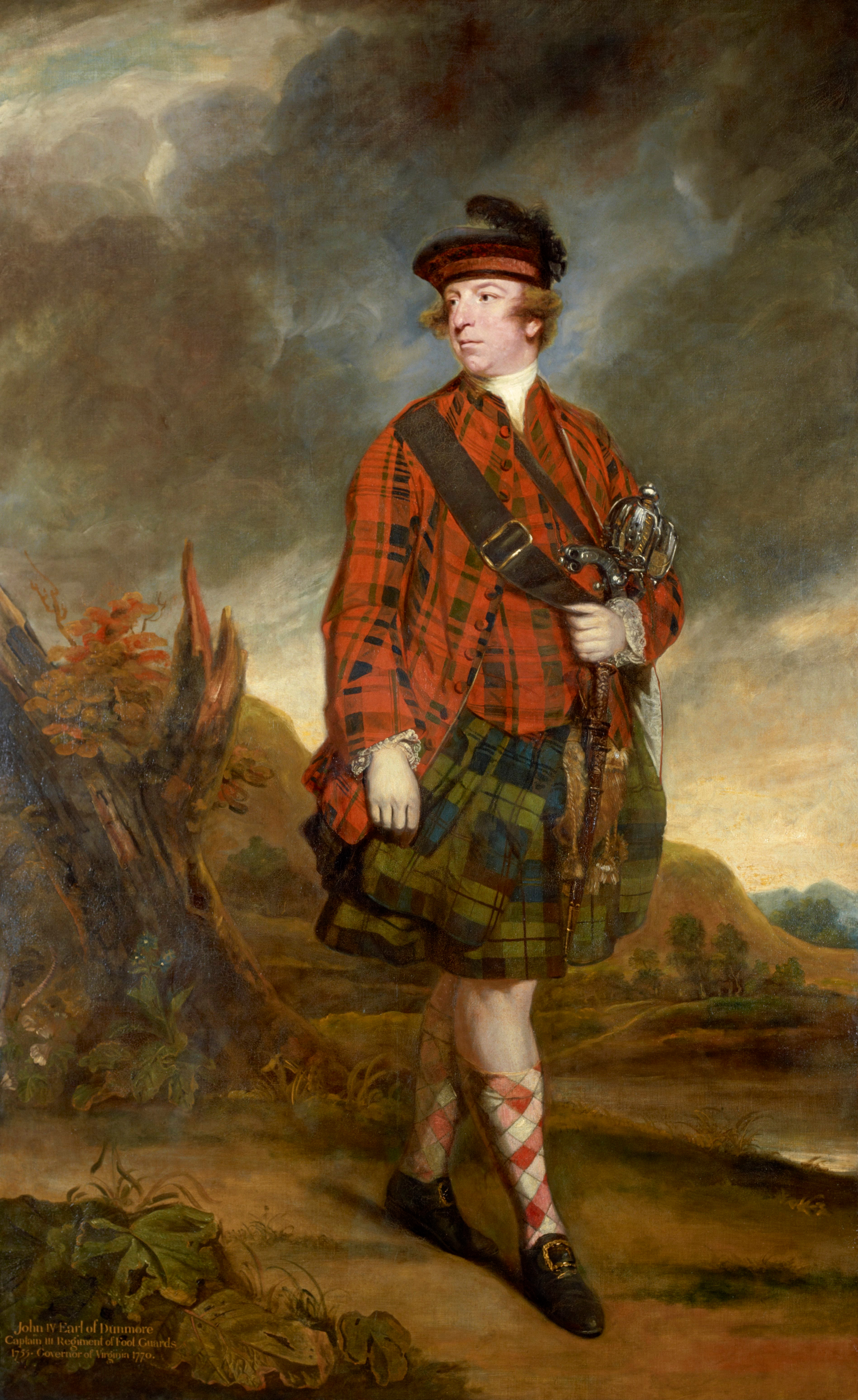
An often overlooked late colonial era campaign, "Dunmore's War" culminated in the October 10th, 1774 battle of Point Pleasant between Virginia Militia and a force of largely Shawnee Indians in modern day West Virginia. Sometimes controversially referred to as the first battle of the American Revolution, the campaign led to further friction between Virginians and Royal Governor John Murray, 4th Earl of Dunmore.
Sir Joshua Reynolds - John Murray, 4th Earl of Dunmore - Google Art Project
The Virginia militia was embodied in two wings, Andrew Lewis commanding the men who fought at Point Pleasant and Dunmore personally commanded the Northern Wing which was in the field but not present at the battle.
Generally speaking, Virginia militia was not uniformed, and wore their civilian clothes for service (typically a coat, waistcoat and breeches). Hunting shirts of various colors were favored by the "Back Wood's Rifleman" as described by John Ferdinand Smyth Stuart:
"Their hunting, or rifle shirts, they have also died in a variety of colours, some yellow, others red, some brown, and many wear them quite white...Sometimes they wear leather breeches, made of Indian dressed elk, or deer skins, but more frequently thin trowsers. On their legs they have Indian boots, or leggings made of coarse woolen cloth...”
A 1777
watercolor of a Virginia rifleman attributed to Lt. Richard St. George
Mansergh St. George of the British 52nd Regiment of foot.
However, some companies received issued osnabrigs (unbleached natural colored linen) hunting shirts and blue wool leggings for the expedition and would have been fairly uniform in appearance.
"Dr. Colo. I have got as fare as Mr. Branders with a handful of Men out of my own Company. I think our Number of private Men is thirty one....the Men I have, are fit for the business, but are badly fix'd, for want of Hunting shirts, and Blankets; but as I hear Mr. Branders Waggon,is on this side New River; I hope we shall get supply'd...I shall be glad Sir., if it can be done, to have a Gun provided against we come down, as I have a very good Hand without: when I was in the service before, there was near twenty press'd Guns: which the Country freely pay'd for, and I doubt not, but the same necessity will be allowed now..."
Both hunting and body shirts were procured at McCorkle's store in what is now Pulaski county Virginia by officers commanding companies on the expedition. Individual soldiers purchased cuttoe knives, printed hankerchiefs and wool cloth.
[Col. William Christian to Col. William Preston. 3QQ89] Head Of Rich Creek, Septr. 3: 1774 "I am informed that Men & provisions were moving from Stanton Wednesday and thursday was a week and that several Compys were at the Warm Springs. It is also said Mathews dont propose taking out all the flour at once, but to send back the pack horses from the mouth of Elk. That LA. Dunmore wrote to Ch. Lewis that some of his men had taken some little Towns & killed three or [four] people & that his Lordship was at fort Pitt. The above news came by one of the Woods's. He says also that there is Jents plenty and all goods necessary for the men such as Shirts Blankets Leggons."
Portraying Dunmore's Command: Sky Meadows State Park, August 10, 2024
In addition, the "Northern" Wing serving directly under Dunmore may have used cockades. "My Brother Jams went with Dumore as a Lieutenant. He raised some of his men in our county. They had Cockades of red ribond. I admired the looks of these soldiers so much I would have been glad to have went with them if I had been old enough." (Westward Into Kentucky: The Narrative of Daniel Trabue p42). Immediately after the battle Dunmore was described as "dressed in a Dutch blanket" which may refer to him using a blanket as a matchcoat or perhaps as a blanket coat.
1774 Virginia Militia Arms
Although the Militia law had expired, the general framework seems to have been followed.
That every person so as aforesaid inlisted (except
free mulattoes, negroes, and Indians) shall be armed in
the manner following, that is to say: Every soldier
shall be furnished with a firelock well fixed, a bayonet
fitted to same, a double cartouch-box and three charges
of powder, and constantly appear with the same at the
time and place appointed for muster and exercise, and
shall also keep at his place of abode one pound of
powder and four pounds of ball, and bring the same with
him into the field when he shall be required.
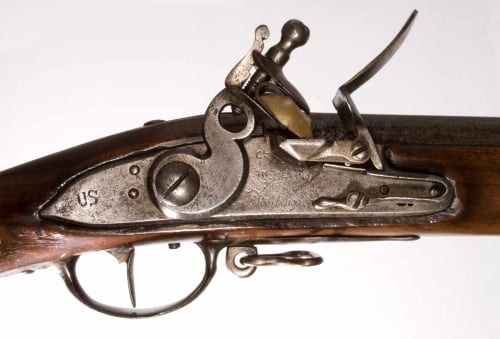
Archeological evidence and primary source documents point to the many of the muskets in use during this period as King's Pattern Long Land "Brown Bess" style or Dutch muskets, both of which were imported in sizeable numbers during the French and Indian war. Primary document use of the generic term "gun" suggests the very common fowling piece or shotgun was in the mix, and many of the men under Lewis seem to have been armed with rifled guns.
"It appears to your Committee from the Deposition of John Frederick Miller, keeper of the Magazine, that in June last [1774] there were thirty barrels of Gun Powder, containing each about fifty weight, in indifferent order; that, by the Governor's directions, he sifted twenty seven barrels, out of which he made up twenty six Casks and better, the other three he left unsifted; That the President, soon after, sent to the Governor, then on the Frontiers, eight of those he had sifted, three hundred Muskets, Bayonets, Cartouch boxes and Carbines, which have never been returned; That one hundred and sixty of the said Muskets were furnished out of the Palace, and soon after replaced out of the Magazine; That the said Miller, by order of the President, also delivered out about fifty stand of Arms, to some Gentlemen of this City, which have not been returned."
1770s rifle by Adam Haymaker of Winchester Virginia.
Haymaker was later paid for "repair of Guns" for the campaign in October 1775.
The troops under Lewis were described by William Preston as"being mostly armed with rifle guns, and a great part of them good woodsmen, are looked upon to be at least equal to any troops for the number that have been raised in America. It is earnestly hoped that they will, in conjunction with the other party, be able to chastise the Ohio Indians for the many murders and robberies they have committed on our frontiers for many years past."
Ammunition was in short supply,and Maj. Arthur Campbell wrote to Col. William Preston that "..I make no doubt but your last supply of Ammunition will encourage the Inhabitants much, as I think every Man have 1/2 doz shoots a piece having direct[ed] the Powder to be divided by their Gun-Measures."
[Captain John Floyd to Col. William Preston. 33S42, 43.] Sept. 18th 1774... I am in hopes we shall make out pretty well about kettles we are also allowed 60 yards of tent cloth for a company...” p. 206-07.
[Col. William Christian to Col. William Preston. 3QQ146.] “Camp Union Septr. 12, 1774... The kettles and Tents were chiefly distributed before I came I could get but 16 or 17 battered tin kettles for all Fincastle & but few Tents But I am told oxen brigs [unknown symbol or doodle here] enough for Tents will be brought with the Pack horses to morrow If the major is not marched when you get this Intelligence I really think we ough[t] to send over the whole Country and try to beg or borrow kettles for to do withougt[sic] is very hard almost [im?]possible It will presently make men sick to live on Roasted meat without broath.” p. 198.
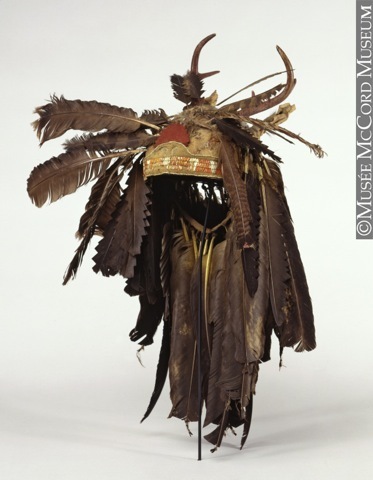
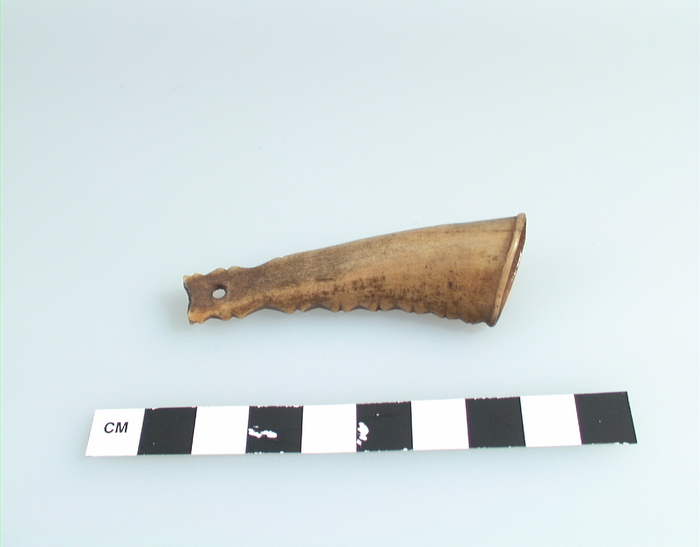
Although the transient Algonquian speakingShawnee Indians were protagonists in the 18th century struggle for control of the Virginia back country and Ohio Country; comparatively few museum artifacts are attributed to them. The compilation of information below is far from exhaustive and I am indebted to those who have shared and published this information before. I hope to add more sources as they come to hand. For further reading on the Shawnee, I recommend Warren's The Worlds the Shawnees made.
Reverend David Jones 1773 "I WOULD dismiss the subject about these Indians, only it will be expected that some description of their apparel should be given* In this respect they differ nothing from most of other Indians. ...The men wear shirts, match-coats, breechclouts, leggings and mockesons, called by them mockeetha. Their ornaments are silver plates about their arms, above and below their elbows. Nose jewels are common. They paint their faces, and cut the rim of their ears, so as to stretch them very large. Their head is dressed in the best mode, with a black silk handkerchief about it; or else the head is all shaved only the crown, which is left for the scalp. The hair in it has a swan's plume, or some trinket of silver tied in it. The women wear short shifts over their stroud, which serves for a petticoat. Sometimes a calico bed-gown. Their hair is parted and tied behind. They paint only in spots in common on their cheeks. Their ears are never cut, but some have ten silver rings in them. One squaa will wear five hundred silver broaches stuck in her shift, stroud and leggings. Men and Women are very proud, but men seem to exceed in this vice.'Tis said that they suffer no hair to grow on their body, only on their head. Some pull out their eyebrows."
A Shawnee/Savanah.war party were captured in South Carolina in 1753.
When interrogated by the Governor Glen, the common use of feathers in their hair was
suggested:
"-Governor (to the Interpreter). Ask if this Feather belongs to him?
-PRISONER. We wear it as an Ornament on our Heads .All our Indians dress the same Way"
Swan's plumes are mentioned above by Jones, a black Ostrich plume was mentioned by Rideout in 1788. A variety of colors of Ostrich plumes were imported from Africa for both the Indian trade and millinery.
-Virginia Gazette, Purdie and Dixon, October 14, 1773, page 2 "Ladies
fashionable Riding Hats, with black, blue, and white Ostrich feathers
for them..." -Virginia Gazette, Rind, May 12, 1774, page 3 "blue, black, and white ostrich feathers..."
-History of the Maumee River basin ..." By Charles Elihu Slocum p150: Detroit for the year ending 20th August, 1783, before the treaty of peace, viz : 230 pieces Blue strouds; 20pieces Red strouds;...300 large feathers, red, blue, green ; 300 Black ostrich feathers..."
"Wednesday, December 7th, 1774. Went to Winchester...Saw four Indian Chiefs of the Shawnee Nation, who have been at War with the Virginians this summer, but have made peace with them, and they are sending these people to Williamsburg as hostages. They are tall, manly, well-shaped men, of a Copper colour with black hair, quick piercing eyes, and good features. They have rings of silver in their nose and bobs to them which hang over their upper lip. Their ears are cut from the tips two thirds of the way round and the piece extended with brass wire till it touches their shoulders, in this part they hang a thin silver plate, wrought in flourishes about three inches diameter, with plates of silver round their arms and in the hair, which is all cut off except a long lock on the top of the head. They are in white men's dress, except breeches which they refuse to wear, instead of which they have a girdle round them with a piece of cloth drawn through their legs and turned over the girdle, and appears like a short apron before and behind. All the hair is pulled from their eyebrows and eyelashes and their faces painted in different parts with Vermilion. They walk remarkably straight and cut a grotesque appearance in this mixed dress. "
Trade Lists and Clothing
When David Jones wrote that "some description of their apparel should be given* In this respect they differ nothing from most of other Indians..." he drove home the point that speaking broadly, Indian consumers from Georgia to Maine purchased and were given many of the same types of goods, and as Edmund Atkin noted in 1755, the Shawnee were "the greatest Travellers in America".
"...Goods fit for a Present for the Six United Nations together with the Shawanse, Delawares, Twigtwees, Picts and Windotts Strouds...Duffils....Halfthicks....Garlix (to be made into plain shirts for men...to be made into shirts for men, ruffled with Muslin...flints...Gartering and Bedlace, the gartering scarlet and Star...Ribbon, deep red, blew, and green...Striped Callimancoe lively colours, Mens's large worsted caps...cuttoe knives...100 Guns, small bored, and 25 pr pistols... 5 doz. Cutlasses...square Indian Awl Blades, Brass kettles...wire..Beads small white...50 Meddals with His Majesty's picture on one side and the British Coat of Arms on the other...with a loop to put a ribbon through...Whatever quantity of Lace Cloths and Hats and Feathers shall be thought proper, I imagin that scarlet cloth cuff'd and lapell'd with blew, laced with common single lace would be acceptable as any."
Fort Johnson 25 Janr?. 1757. The Papers of Sir William Johnson, Volume 9 p592 Another Belt to the Shawanese King returning him thanks for the early Intelligence he sent me and desiring he would constantly accquaint him of the Enemies Motions in that part of the Country, also exhorting him & his Nation to adhere firmly to the Treaties & Friendship subsisting between them & the English which they would find to be their Interest & with all giving them a hearty Invitation to come & join His Majestys Arms when called upon. Sr. Wm. gave the Messenger 10 Dollars, a fine Scarlet Blanket with several Rows of Ribband on it, a fine Ruffled Shirt a Silver Arm Band for the Kings Son — Pipes, Tobacco, Powder & Ball & a pair of Snow Shoes — so parted
p649 1757 Janry Brought over
To an Express sent to me by the Shawanese King with News of a Body of French and Indians coming from Mississippy...4/-/- To a Do. a Scarlet Strowd with Ribbons to it...3/-/-
Thomas Rideout An Account of my Capture by the Shawnee Indians on the River Ohio in 1788
"My Dress consisted of a calico shirt, made by an Indian woman without a
collar, which reached below the waist; a blanket over my shoulders,
tied round the waist with the bark of a tree; a pair of good buckskin
leggings, which covered almost the thighs, given me by the great war
chief, a pair of moccasins, in which I had pieces of blue cloth to make
my step easier; a breech-cloth between my legs; a girdle round my waist;
and a small round hat, in which the Indian placed a black ostrich
feather by way of ornament (the smaller the hat the more fashionable)."
The 1922 Guide to the Heye Foundation Museum of the American Indian includes a reference to a pair of "Shawnee Deerskin Leggings" but I have not been able to find images or a current location for this item.
In addition to trade lists with French and English "trade" guns, a few indications of the types of weapons used by 18th century Shawnee warriors can be found in primary sources and through archaeology.
Col. John Bradstreet, December 4, 1764 "from the Governt of Pennsylvania all the Shawnees and Delawar Indians are furnished with rifle barrel Guns, of an excellent kind, and that the upper Nations are getting into them fast..."
(p77 British Military Flintlock Rifles, 1740-1840; De Witt Bailey)
Artifacts from the Bentley site in Kentucky, also known as Lower Shawnee town (abandoned in 1758 due to flooding) included a French fusil fin sideplate, an English cuttoe knife fragment and a kettle fragment with a sheet brass ear/bail lug. The fusil sideplate is very similar to the mounts on an intact Thollier fusil fin with a long gilt decorated barrel that is in a private New England collection.
Brass mounted French fusil de chasse (private collection).
Shawnee town of Wakatomika (1st village of that name which was destroyed in August of 1774) goods including a possible
limestone "Micmac" pipe bowl and what is likely a French trade fusil
lock and rammer pipe from Dresden Ohio.
In 1753, six suspicious "Northern Indians" captured and questioned by South Carolina militia "... said they were from the river Ohio, of a nation named Savannahs or Shawanoes...They had guns of the French make, and were well armed." The Scots Magazine - Volume 15 - Page 415
"*
* * told that of 430 Shawnese Warriors or upwards that came out, only
200 had returned, as they were Assisted by the Mingoes, Tawas &
Wiandots. and perhaps had several Delawares with them, it confirmed the
Judgement we formd £ found to be 23 Guns 80 Blankets 27 Tomahawks with
Match coats Skins Shout [shot] pouches pow[d]erhorns Warclubs &c.
The Tomhawks Guns & Shout pouches were sold & amounted to near
100 1..."
"Our men got upwards of 20 scalps, 80 blankets, about 40 guns, and a great many tomahawks; and intended in a few days to go over the river, to meet the Governor, 20 or 25 miles from their towns. The Indians the Governor lately concluded a peace with, it is assured, were in this battle. We suppose they have had the other struggle before this time, and are very impatient to know the issue. "
Pipe Tomahawk ca. 1770 Attributed to Richard Butler, gunsmith at Fort Pitt. Made for Lt. John Maclellan of Pennsylvania. The quilled decoration may be Shawnee in origin.
Although to my knowledge, there are no known war clubs with an iron clad 18th century Shawnee provenance [please correct me if I am wrong], 18th century writers mentioned they were visually distinct from those of other tribes:
Col. John Floyd to Col. William Preston, Boonesborough, 7/21/1776; 2: "After the girls came to themselves enough to speak, they told us there were only five Indians, four Shawanees & one Cherokee; could all speak good English. They said they should take them to the Shawanee Towns: and the war club we got was like those I've seen from that nation. Several words of their language which they retained was known to be Shawanee.." [33S300-305 Draper Manuscripts: Daniel Boone Papers, 1760-1911, Series S, Wisconsin Historical Society Madison, Wisconsin]
Shawnee town of Wakatomika (destroyed in August of 1774) goods including a possible
limestone "Micmac" pipe bowl and what is likely a French trade fusil
lock and rammer pipe from Dresden Ohio.
In addition to a July 26, 1753 Pennsylvania Gazette reference to a Shawnee black buffalo hair "string for tying of slaves", a possible 1790 reference to a Shawnee quilled tumpline or hoppis from "Incidents attending the capture, detention, and ransom of Charles Johnston of Virginia" (the war party in question was "fifty-four Indians, consisting chiefly of Shawanese and Cherokees") is discussed in RS Stephenson's excellent article The Decorative Art of Securing Captives in the Eastern Woodlands. The 1753 reference appears to be the same incident reported in the London Public Advertiser, as quoted inCherokee Power by Rayalthough this time adding "a bit of Black Wampum, Cords for tying slaves when made prisoners, a cross of silver, and several bracelets of the Same metal."
Governor [Glen]: Who gave you this Belt of Wampum? .
Prisoner: This Belt I had it made for myself, and bought it that if I took any Prisoners and tied him, I might put it round his Neck. .
Governor [Glen]: (taking up a .Ligament of a black Colour made up of Buffalo's Wool) . What is the Use of this?
Prisoner: It is to tie my Prisoners with.
A Journal of two visits made to some nations of Indians on the west side of the River Ohio, in the years 1772 and 1773" by David Jonesavailable here, mentions the ceremonial use of false face masks and turtle shell rattles among the Shawnee.
On October 10th, 1756, Colonel George Washington sent an express to Lt. Governor Robert Dinwiddie including an overview of his "remarks and observations on the situations of our frontiers". Washington had left his quarters in Winchester for Augusta Courthouse (Staunton) in late September. Hoping to gather a large militia force to "scour the woods,..and,... fall in with the enemy", he waited in vain for several days before proceeding with only five men including Virginia Ranger Captain and militia officer William Preston to Colonel Buchanan's house at Looney's Ferry (modern Buchanan Virginia).
A modern, conjectural sketch of William Preston as a Virginia Ranging company officer, ca. 1756
From there he rode roughly 60 miles away to the modern town of Shawsville, Virginia at "Vass's, on the Roanoke" where Virginia Provincial Captain Hogg was [re] building a fort." The earlier Fort at Vass or Vause/Vauxe/etc. (termed a "blockhouse" in the Boston and NY papers) was burned in a June 1756 raid by a war party led by Battle of the Monongahela veteran François-Marie Picoté, sieur de Belestre II- likely the southernmost attack conducted by Canadian troops in that war. Some of the prisoners from the Fort were carried into captivity as far off as Detroit and Quebec. Ranging Company Sergeant Peter Luney testified that he lost “a rifle Gun of the value of Four Pounds ten Shillings” when he was captured at Fort Vause.
A 1740s French Marine musket, the stock is branded "Au Roy" Private Collection.
Belestre would be in Virginia again after an unsuccessful raid on Fort Cumberland, Maryland in 1757; this time as a prisoner of the Virginia Provincials at Fort Loudon in Winchester. Belestre's nephew, Philippe Dagneau of Saussaye, St. Ours and three French soldiers were killed in the same ambush . Washington's account of Belestre's (aka "Velistre") capture can be found hereand there is also his June 20th, letter mentioning Belestre's interrogation.
Washington reported that "We got safely to Vass's, where Captain Hogg, with only eighteen of his company, was building a fort, which must employ him till Christmas without more assistance."
Hogg would eventually be relieved of his command, and an interesting Inventory of the Stores Belonging to ye Garrison at Vasses survives from the next year when he was forced by Washington to relinquish the fort to Captain Thomas Bullitt.
After a disappointing tour of Hogg's efforts, Washington reported that "From Vass's I came off with a servant and a guide, to visit and range of forts in this country; and in less than two hours after, two men were killed along the same road." Then on to "within five miles of the Carolina line, as I was proceeding to the southernmost fort in Halifax, I met Major Lewis on his return from the Cherokees, with seven men and three women only of that nation."
Washington's final stop was Fort Trial in Halifax (near modern Martinsville). Fort Trial was later described by J.F.D. Smyth as "... a quadrangular polygon, inclosed with large timber, and cuts of trees split in two, about twelve or fixteen feet high above the ground, standing erect, and about three or four feet in the earth, and quite close together, with loop holes cut through about four or five feet from the ground for small arms. There was also something like a bastion at each angle, which, however, could scarcely be faid to flank the curtains; and a log-house, musket proof, on each side of the gate. ". Within the area, nearly in the centre, was a common house framed and boarded, filled in, to the height of fix feet, with stones and clay on the inside, as a de- fence against small arms; it was covered only with shingles made of pine, which could be easily fet on fire as well as every other part of the whole structure, without exception."
After leaving Fort Trial, Washington continued on to Captain Preston's Garrison on the Catawba, Fort William.
Honble. Sir: In mine
from Halifax I promised your Honor a particular detail of my remarks
and observations upon the situation of our frontiers, when I arrived
at this place. Although I was pretty explicit in my former, I cannot
avoid recapitulating part of the subject now, as my duty, and
its importance for redress are strong motives.
From Fort Trial on
Smith's River, I returned to Fort William on the Catawba, where I met
Colonel Buchanan with about thirty men, (chiefly officers,) to
conduct me up Jackson's River, along the range of forts. With this
small company of irregulars, with whom order, regularity,
circumspection, and vigilance were matters of derision and contempt,
we set out, and, by the protection of Providence, reached Augusta
Court House in seven days, without meeting the enemy; otherwise we
must have fallen a sacrifice, through the indiscretion of these
whooping, hallooing gentlemen soldiers!
Washington was not only disappointed by the lack of progress at Vause's, but also the very low number of Cherokee allies Lewis was able to gather. He followed up with Dinwiddie on the sad state of Virginia's frontier militia and forts in November once he returned to Winchester in the November 9th letter linked above.
This jaunt afforded
me an opportunity of seeing the bad regulation of the militia, the
disorderly proceedings of the garrisons, and the unhappy
circumstances of the inhabitants... Then these men, when raised, are to be continued only one month
on duty, half of which time is lost in their marching out and home,
(especially those from the adjacent counties,) who must be on duty some time before they reach their
stations; by which means double sets of men are in pay at the same time,
and for the same service. Again, the waste of provision they make is unaccountable; no method or
order in being served or purchasing at the best rates, but quite the
reverse. Allowance for each man, as other soldiers do, they look upon as the highest indignity, and
would sooner starve, than carry a few days' provision on their backs for
conveniency. But upon their march, when breakfast is wanted, knock down the first beef, &c, they
meet with, and, after regaling themselves, march on until dinner, when
they take the same method, and so for supper likewise, to the great oppression of the people....I might add, I believe, that, for the want of proper laws to govern the militia by (for I cannot
ascribe it to any other cause), they are obstinate, self-willed,
perverse, of little or no service to the people, and very burthensome to the country. Every mean individual
has his own crude notions of things, and must undertake to direct. If
his advice is neglected, he thinks him self slighted, abased, and injured; and, to redress his
wrongs, will depart for his home. These, Sir, are literally matters of
fact, partly from persons of undoubted veracity, but chiefly from my own observations.
Secondly, concerning the garrisons. I found them very weak for
want of men; but more so by indolence and irregularity. None I saw in a
posture of defence, and few that
might not be surprised with the greatest ease...Of the ammunition they are as careless as of the provisions, firing it away frequently at
targets for wagers. On our journey, as we approached one of their forts,
we heard a quick fire for several minutes, and concluded for certain that they were attacked; so we
marched in the best manner to their relief; but when we came up, we
found they were diverting at marks.
These men afford no assistance to the unhappy settlers, who are
drove from their plantations, either in securing their harvests, or
gathering in their corn... Of the many forts, which I passed
by, I saw but one or two
that had their captains present, they being absent chiefly on their
own business, and had given leave to several of the men to do the same.
Yet these persons,
I will venture to say, will charge the country their full month's pay."
Aside from the Yorktown campaign, Washington also came through the southern states and somewhat near his 1756 route again in 1791.