Showing posts with label militia arms. Show all posts

Tuesday, July 9, 2019

Virginia Militia clothing and equipment in Dunmore's War, 1774

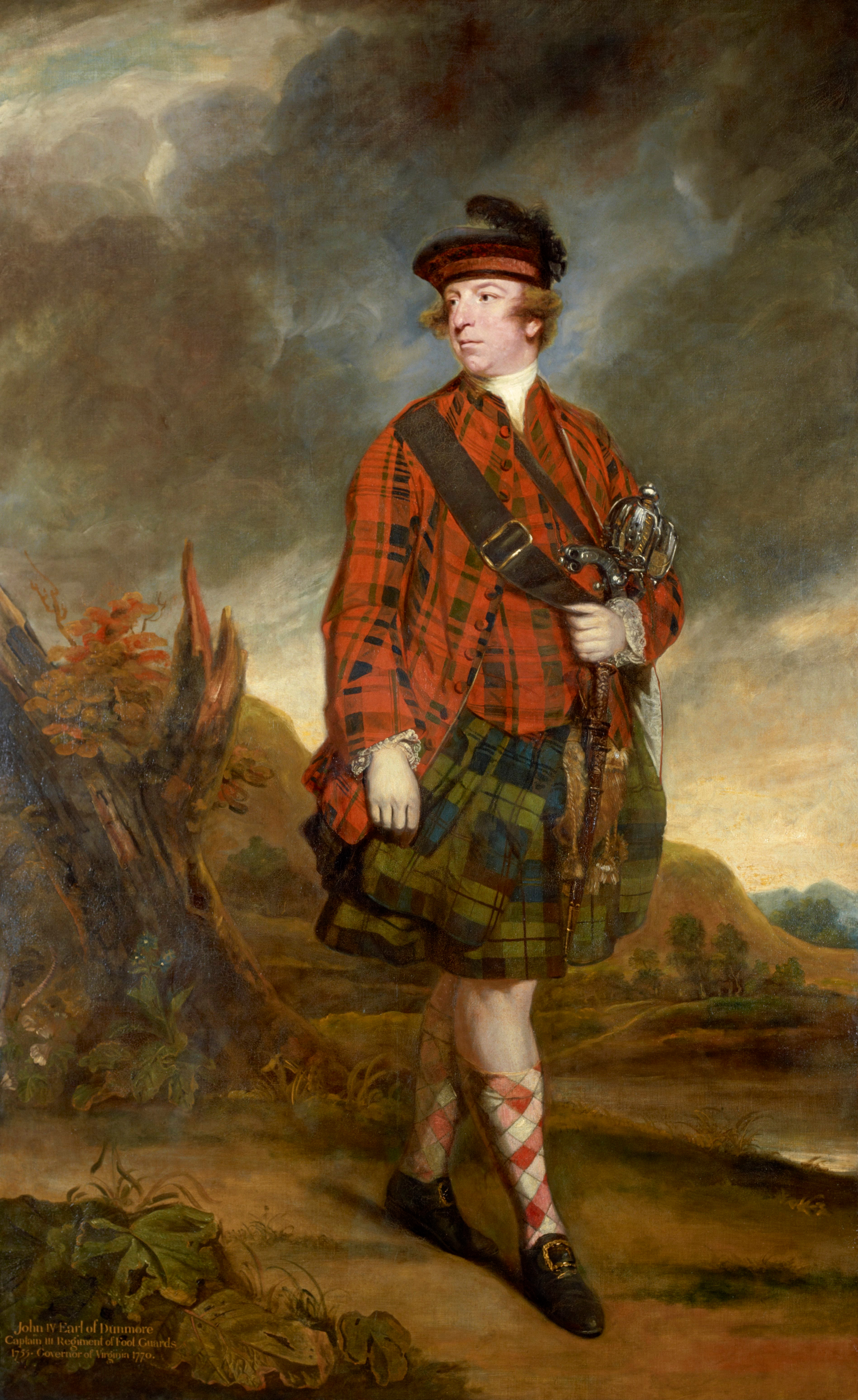
An often overlooked late colonial era campaign, "Dunmore's War" culminated in the October 10th, 1774 battle of Point Pleasant between Virginia Militia and a force of largely Shawnee Indians in modern day West Virginia. Sometimes controversially referred to as the first battle of the American Revolution, the campaign led to further friction between Virginians and Royal Governor John Murray, 4th Earl of Dunmore. 

  
Sir Joshua Reynolds - John Murray, 4th Earl of Dunmore - Google Art Project

An in depth discussion of the causes and politics behind the campaign are a bit involved for a blog post, but I highly recommend the recent scholarship on this campaign by Glenn F. Williams, author of Dunmore's War: The Last Conflict of America's Colonial Era. Additionally the Documentary History of Dunmore's War has a large amount of primary source information.

The Virginia militia was embodied in two wings, Andrew Lewis commanding the men who fought at Point Pleasant and Dunmore personally commanded the Northern Wing which was in the field but not present at the battle.


1774 Virginia Militia Clothing

 Gordon Riots London militia 1780
1863;0214.774  British Museum

Generally speaking, Virginia militia was not uniformed, and wore their civilian clothes for service (typically a coat, waistcoat and breeches). Hunting shirts of various colors were favored by the "Back Wood's Rifleman" as described by John Ferdinand Smyth Stuart:

"Their hunting, or rifle shirts, they have also died in a variety of colours, some yellow, others red, some brown, and many wear them quite white...Sometimes they wear leather breeches, made of Indian dressed elk, or deer skins, but more frequently thin trowsers. On their legs they have Indian boots, or leggings made of coarse woolen cloth...”

A 1777 watercolor of a Virginia rifleman attributed to Lt. Richard St. George Mansergh St. George of the British 52nd Regiment of foot.


However, some companies received issued osnabrigs (unbleached natural colored linen) hunting shirts and blue wool leggings for the expedition and would have been fairly uniform in appearance.

August 28th, 1774

"Dr. Colo. I have got as fare as Mr. Branders with a handful of Men out of my own Company.  I think our Number of private Men is thirty one....the Men I have, are fit for the business, but are badly fix'd, for want of Hunting shirts, and Blankets; but as I hear Mr. Branders Waggon,is on this side New River; I hope we shall get supply'd...I shall be glad Sir., if it can be done, to have a Gun provided against we come down, as I have a very good Hand without: when I was in the service before, there was near twenty press'd Guns: which the Country freely pay'd for, and I doubt not, but the same necessity will be allowed now..."


Both hunting and body shirts were procured at McCorkle's store in what is now Pulaski county Virginia by officers commanding companies on the expedition. Individual soldiers purchased cuttoe knives, printed hankerchiefs and wool cloth.


 [Col. William Christian to Col. William Preston. 3QQ89] Head Of Rich Creek, Septr. 3: 1774
  
"I am informed that Men & provisions were moving from Stanton Wednesday and thursday was a week and that several Compys were at the Warm Springs. It is also said Mathews dont propose taking out all the flour at once, but to send back the pack horses from the mouth of Elk. That LA. Dunmore wrote to Ch. Lewis that some of his men had taken some little Towns & killed three or [four] people & that his Lordship was at fort Pitt. The above news came by one of the Woods's. He says also that there is Jents plenty and all goods necessary for the men such as Shirts Blankets Leggons."


Portraying Dunmore's Command: Sky Meadows State Park, August 10, 2024


In addition, the "Northern" Wing serving directly under Dunmore may have used cockades. "My Brother Jams went with Dumore as a Lieutenant.  He raised some of his men in our county.  They had Cockades of red ribond. I admired the looks of these soldiers so much I would have been glad to have went with them if I had been old enough." (Westward Into Kentucky: The Narrative of Daniel Trabue p42). Immediately after the battle Dunmore was described as "dressed in a Dutch blanket" which may refer to him using a blanket as a matchcoat or perhaps as a blanket coat.

1774 Virginia Militia Arms


 Although the Militia law had expired, the general framework seems to have been followed.

That every person so as aforesaid inlisted (except free mulattoes, negroes, and Indians) shall be armed in the manner following, that is to say: Every soldier shall be furnished with a firelock well fixed, a bayonet fitted to same, a double cartouch-box and three charges of powder, and constantly appear with the same at the time and place appointed for muster and exercise, and shall also keep at his place of abode one pound of powder and four pounds of ball, and bring the same with him into the field when he shall be required.

 
Dutch musket sideplate from Fort Ashby, WVa. 
 
 
Dutch Musket private collection
 
Archeological evidence and primary source documents point to the many of the muskets in use during this period as King's Pattern Long Land "Brown Bess" style or Dutch muskets, both of which were imported in sizeable numbers during the French and Indian war. Primary document use of the generic term "gun" suggests the very common fowling piece or shotgun was in the mix, and many of the men under Lewis seem to have been armed with rifled guns.


 Va Gazette (Rind) August 4, 1774 page 3

As noted, in Glenn Williams' detailed scholarship, the Northern wing's arms were augmented by 300 muskets with bayonets and cartouche boxes from Williamsburg. Further confirmation of this comes from the Journal of the house of Burgesses v6 p223 June 13 1775:

"It appears to your Committee from the Deposition of John Frederick Miller, keeper of the Magazine, that in June last [1774] there were thirty barrels of Gun Powder, containing each about fifty weight, in indifferent order; that, by the Governor's directions, he sifted twenty seven barrels, out of which he made up twenty six Casks and better, the other three he left unsifted; That the President, soon after, sent to the Governor, then on the Frontiers, eight of those he had sifted, three hundred Muskets,
 Bayonets, Cartouch boxes and Carbines, which have never been returned; That one hundred and sixty of the said Muskets were furnished out of the Palace, and soon after replaced out of the Magazine; That the said Miller, by order of the President, also delivered out about fifty stand of Arms, to some Gentlemen of this City, which have not been returned."


1770s rifle by Adam Haymaker of Winchester Virginia. 
Haymaker was later paid for "repair of Guns" for the campaign in October 1775.


The troops under Lewis were described by William Preston as "being mostly armed with rifle guns, and a great part of them good woodsmen, are looked upon to be at least equal to any troops for the number that have been raised in America. It is earnestly hoped that they will, in conjunction with the other party, be able to chastise the Ohio Indians for the many murders and robberies they have committed on our frontiers for many years past."

Ammunition was in short supply, and Maj. Arthur Campbell wrote to Col. William Preston that "..I make no doubt but your last supply of Ammunition will encourage the Inhabitants much, as I think every Man have 1/2 doz shoots a piece having direct[ed] the Powder to be divided by their Gun-Measures."

 1774 Virginia Militia Camp Equipment


Both linen tents and tin kettles were in use by the men of the expedition.

[Captain John Floyd to Col. William Preston. 33S42, 43.]
    Sept. 18th 1774...
    I am in hopes we shall make out pretty well about kettles we are also allowed 60 yards of tent cloth for a company...” p. 206-07.


      [Col. William Christian to Col. William Preston. 3QQ146.]
    “Camp Union Septr. 12, 1774...
    The kettles and Tents were chiefly distributed before I came  I could get but 16 or 17 battered tin kettles for all Fincastle & but few Tents  But I am told oxen brigs [unknown symbol or doodle here] enough for Tents will be brought with the Pack horses to morrow  If the major is not marched
when you get this Intelligence I really think we ough[t] to send over the whole Country and try to beg or borrow kettles for to do withougt[sic] is very hard almost [im?]possible
 It will presently make men sick to live on Roasted meat without broath.” p. 198. 

Friday, December 22, 2017

North Carolina Militia Arms 1755


By 1756, North Carolina Militiamen were required and be "provided with a well fixed Gun, and a Cartridge Box, and a Sword, Cutlass or Hanger, and have at least nine Charges of Powder and Ball, or Swan Shot, and three spare Flints, and a Worm and Picker...". Having previously mentioned the great Hyde County NC Militia list, (with a tip of the hat to Jas. Rogers who posted it a long time ago)  I thought exploring the stats and likely forms from that list might be worthwhile.  In the list, 57 individual arms are named by type, giving us a fantastic glimpse of the variety in use in this coastal county during the French and Indian War.  They are shown below in order of commonality in this militia company.

Muskets = 21 total (36%)


Dutch Musket, Private Collection.


Of the muskets in circulation in NC at this point, the majority were likely the muskets of the "Dutch" variety recently imported by the Tower and distributed to North Carolina's militia and Provincial troops.  In a letter from Governor Dobbs to the Board of Trade dated December 15, 1755 “the 1000 arms I got when I came over will be distributed to the five companies raised and to be raised and to the Militia of the exposed Counties and near the sea coast for our Defense ammunition or lead we have none but from hand to mouth and very little in the Merchants hands…” (Colonial Records of NC pages 461-462).


Fowling pieces = 12 total (21%)


Fowler by Turvey ca. 1765


English fowling pieces (or as sometimes termed shotguns) were likely the most common civilian firearm in British North America at this time. Fowling pieces were multi purpose guns that could fire a ball or smaller shot, and came in a wide range of lengths, quality and embellishment. Prices varied accordingly, but were typically 1/2, 5/8 or 3/4 inch bored with four foot or longer barrels.


The North Carolina Museum of History collections database includes a  Richard Wilson marked 54 inch 20 gauge barrel in what appears to be an early 19th century restocked gun marked "Caleb Crews" and "MARCH 15/ 1781 " on the buttplate. Crews was born in Virginia in 1738, migrated to Granville County, NC and fought at the battle of Guilford Court house on that date. (H.1989.97.1).

A 1764 shipment to Wilmington, North Carolina for six fowling pieces of varied quality and price can be found in the Robert Hogg Account Books. Hogg was a merchant in Charleston, S.C. and Wilmington, N.C. [ Vol 1.  Robert Hogg Account Books, #343, Southern Historical Collection, Wilson Special Collections Library, University of North Carolina at Chapel Hill.]

No. 15 Invoice of Sundrys Shipp'd by Hogg & Clayton on Board the Schooner Mary Ann Betty, Thos Corbett for Wilmington consig'nd Fr Clayton on Acc & risque of the Shippers...

Capt. Corbett June 5 1764

31 3 Keggs Gun powder 75 lb
32    1 fine fowling Piece    -/18/-
    1 do            1/-/-
    1 do            1/5/-
    1 do            1/10/-
    1 do            2/-/-
    1 do            2/10/-

                9/3/-"


Detail from a 1754 Moravian map of "Wachovia" by Andreas Hoger showing what appears to be a smoothbore Germanic fowler, possibly depicting Herman Loesch’s personal gun and successful hunt on 29 October 1754. ( MESDA )

Fuzees = 10 total (17.5%)


An ambiguous term, in this instance "Fuzees" most likely means cheap Indian trading or "Carolina" guns instead of the lightweight military style muskets which were also sometimes described in a similar fashion. The colony of North Carolina had previously utilized  Indian Trading Guns for militia use in the 1748, as well as "Cartooch boxes" and  "Cutlashes" during "the time of the Spanish Allarm at Brunswick".


These typically featured smaller bored four foot barrels, sheet brass furniture and lower grade locks. The Annely Bristol made trade musket pictured above is shown in more detail on page 138,-139 in Hanson's Firearms of the fur trade. Images of a trade fusil by Bumford can be found here.


Buckaneeers = 8 total (14%)


 English Buccaneer musket by Cookson

English Buccaneer muskets were at this point, outdated club butt muskets, generally made with long barrels, 3 screw (frequently "dog") locks, and were popular in the Caribbean and African trade.  North Carolina probate inventories turn up a good number of these prior to the Revolution.  The doglock pictured above from the Swedish Royal Armoury collection is shown in more detail on page 136,-137 in Hanson's Firearms of the fur trade and has a 50 inch barrel.


Carbines = 6 total (10.5%)


North Carolina's 1756 Militia act authorized:
  
 "Troops of light Horse, in any County of this Province; which Troop or Troops, so appointed, shall be exempt from mustering in any of the Foot Companies within their several Counties, and shall be mounted on Horses not less than fourteen Hands high, and accoutred with a good Case of Pistols, a Carabine, with a Swivel, Belt and Bucket, a broad Sword, and Cartridge Box, with twelve Charges of Powder and Ball, all of his own Property..."


"Carabines" or Carbines with Swivels in this period were generally 37-42 inch barreled musket style arms with a .65 inch (aka Carbine) bore or .75 inch (musket) bore, and a metal bracket opposite the lock side that held a ring or swivel for carrying the gun hands free while on horseback.  Given the dearth of information about Tower carbines being imported for colonial militia use at this time, these were most likely commercially purchased. Despite the later legal exemption from infantry service for militia troopers, these carbines may represent men who were only partially equipped serving on foot vs. horseback.  Cavalry equipment was in short supply in North Carolina.  In a letter from William Mackenzie to Arthur Dobbs dated November 24, 1755 Mackenzie explained:

Should have sent you long ere now the number of Troopers und’r my Command, but my indisposition for Two Months past prevented me. I muster’d them twice & the greatest number that appear’d were Sixteen, not One of which was accouter’d according to law. I can’t fine them, as they are all willing to purchase the acoutriments fit for a Gent’n Trooper, but such is not to be had here. 


 Excavated pistol parts from the Kluttz site (Saratown) Stokes county NC

 Pistol by Francis Smart, London, ca. 1695 Skinner auctions


The remainder (1%) of the arms in this list are unspecified. Although certainly not complete, this list gives us a great jumping off point for documented arms in North Carolina militia use for the French and Indian War, and for the opening phases of the American Revolution.

In addition to the arms from the list above, shipments to Wilmington for Robert Hogg in 1763 include the following:

No. 9 Invoice of Sundries Shipped by Hogg & Clayton on board the Schooner Mary Ann Betty Thos. Corbett for Wilmington consign'd Fr Clayton...10 December 1763

Trunk 61
1 1/2 Doz. Cartouch Boxes    1/2    6/10/1
6 Buck handled Cutteaus & Belts [swords]    18/    1/7/-
6 Boiled white Ebony handled Do.         14/4    1/6/-
1 Doz. Shott Bags 17        1/3    -/18/9
1/2 Doz. Powder Flasks 18
1/2 Doz Do.         19
4 Do 20
Amount Brought Forward
3 Powder Flasks No 21    3/3        9/9
1 Doz Gun hammars 23        8/        /16/-

North Carolina Revolutionary War Arms

I recently came across this reference in the excellent  NPS Valley Forge research report to damaged "muskets...rifles... and fuzees" linked to the NC Continental line in 1777/8, but I haven't yet been able to run down the original manuscript (Footnote #27. "Return of arms signed by A. Thomas, 17 March 1778, North Carolina State Archives").


 Valley Forge Historical Research Report Volume II
By Wayne K. Bodle and Jacqueline Thibaut, National Park Service (1982).

On the topic of damaged arms, the Pension application of Henry Guthrie W4975 has some interesting information regarding the repair of captured arms from Moore's Creek Bridge in 1776:

"in the beginning of the year 1776 there was a gang of Tories collected together in Randolph County and on their way to Wilmington was defeated [probably a reference to the Battle of Moore's Creek Bridge, February 27, 1776]1 their guns taken from them and a great many of them taken Prisoners and them and their guns Brought to Halifax and I was Commanded to stand guard over them. I was not more than 2 or 3 days on that guard before Nicholas Long the deputy quarter master general took me from that and set me to repairing the guns that was taken from the Tories, and I think there was 2 or 300 guns and chiefly wanting repair seeing that it would take me so long to repair them myself I spoke to Long to get some Person to help me, but he said he knew of no person he could get it. I told him of Turner Mason who lived in my neighborhood and he sent me after him, he came and worked one week and finding that the wages was less than he was willing to work for, he quit and left it all for me to do. I do not know what time of the year 1776 I began to work on the guns, nor what time in the year 1777 I quit, but I very well recollect that I was at that work when General Lee2 with his Army marched through to meet Clinton the British General at Charlestown, which I think was the last of May or the first of June and I continued at that work that summer and the ensuing winter and I shall recollect that winter while I lived there being 2 weeks the coldest weather in January I ever felt in the State of North Carolina. I continued at the business until I had repaired all the guns that were thought worth repairing, then Long dismissed me after serving I think about Twelve months."


 French Arms in North Carolina during the Revolutionary War

 
 French arms seem to have been very rare in Pre Revolutionary War North Carolina. Cary and Kay's Slave Runaways in Colonial North Carolina (p23) mentions a runaway captured with a "French musket" in Chowan County near Mattacomack creek in June 1774; likely a pre 1754 model. In 1778 some North Carolina regulars in South Carolina received French muskets and bayonets while in Charleston.  The pension application of North Carolina militiaman James Barnes mentions that he "Marched to the Ten Mile House [SC] there we drew New French Muskets & left our old Guns that we set out with from home..." prior to becoming a P.O.W. at the battle of Brier Creek on March 3, 1779. Barnes served in the Edgecombe county regiment under Captain Lee. North Carolina began seeing imported French arms in increasingly larger numbers by 1780, including 2,200 fifty year old French Rampart muskets.

North Carolina militia private Francis Myrick's pension application states that prior to the Battle of Guilford Court house in March of 1781"...when he was attached to Greene's Army his gun, shot bag and powder horn was taken from [him] and a musket and cartridge boxes was given to him in their stead." John Runyon's pension application states that "sometime in November 1781 Shortly after Surrender of Cornwallis he volunteered in the said County & State aforesaid & entered the service under Captain Williams for one month for the purpose of Guarding some Waggons that was going to Newbern [ sic, New Bern] N. C. to bring off a quantity of Public Arms that was Deposited there I think they were principally French muskets, we went to New Bern, got the Arms & brought them off and gave them up to Major Hogan [sic, James Hogun?] at Duplin C. H. North Carolina. Served one month this tour.”

English Muskets

Both the pension applications of militia horseman William Peters and militiaman Isaac Johnson mention captured "British muskets" from Wilmington in 1781.
 

A brief discussion of rifles in 18th century North Carolina is here.