Showing posts with label rifles. Show all posts

Thursday, August 22, 2019

Notes on 18th century Rifles in North Carolina

Early references to rifles in North Carolina are somewhat rare, and completely absent from a 1755 list of arms used by the coastal Hyde County militia company of Henry Gibbs. Below are a few scattered references that I hope to add to as I find more.

Moravian Rifles

Edward Marshall’s Rifle- further discussion can be found here

Moravians arrived in North Carolina from Pennsylvania to establish a settlement and industry at their land termed "Wachovia" as early as 1753 (first establishing a village at Bethabara and subsequently Salem). The community included gunsmith Andreas Betz, his apprentice Joseph Muller, the gun-stocker Johan Valentine Beck and locksmith/gunsmith Johan Jacob Loesch (Jr.); who are discussed in Eric Kettenburg's excellent article Moravian Artisans in North Carolina. Having local gunsmiths did not end the importation of Moravian made rifles from Pennsylvania (likely due to the demands of other projects in the new settlement):

 "1757 May: Sundry Accounts...Dr ye Locksmith (at Bethlehem) Abraham Steiner for a Gun for Jacob Steiner in Wachovia. £3.10." (Moravian Gun making of the American Revolution p. 24)

Kettenburg's article notes a "1758 request to provide Betz with his own gunsmith shop (separate from the smithy) indicates an increased need for repair work, possibly amongst the arms off the Brethren themselves but also very likely amongst the increasing number of 'strangers' utilizing the services of the Moravian tradesmen."


 Christian Oerter rifle made in 1775 at Christian's Spring, Pennsylvania


1775 Oerter lock

Arthur Dobbs mentions "thirty men on horseback armed with muskets and rifled guns" in a 1762 letter from Brunswick.

War of the Regulation

The Journal of William Tryon's journey to Hillsborough

 "Deep River Camp, Fryday 16th Sept: 1768.
Parole—Hillsborough.

The Guard upon His Excellency's Quarters and camp guards to be furnished by the Mecklenburg Battalion and to mount as usual.

The Captain of each Company to inspect the Arms and Ammunition of the men and to see that the lead that was delivered to them is run into bullets of a proper size for their rifles. As this is an essential duty the Governor recommends it to them to observe it with great punctuality, and make report to-morrow morning of the condition of the Arms and Ammunition to the commanding Officers of their respective regiments who will make report of the same to His Excellency to-morrow morning before the Troops march."


An account of the battle of Alamance in 1771 (SC Gazette May 30, 1771) mentions Regulators "Sculking being Trees and Bushes with their Rifles loaded..."  Rifles were present on the side of Governor Tryon's forces as well, and compensation was requested for several rifles that were lost in the battle.
 
Pennsylvania sources

In an older post I discussed the flow of goods from Pennsylvania to the Southern back country via the great wagon road (vs the water route to Kentucky via Fort Pitt).  William Sample Alexander operated a wagon train between Mecklenburg County, NC and Chester County, Pa. (tip of the hat to the "Clothing the Carolinas" Blog for posting the link). Two entries from the William Sample Alexander Diary (1770-1778) provide some interesting info as to the possible source of a 1770s rifle manufactured in Pennsylvania that was purchased through Alexander and delivered to a North Carolina customer (these two may be different purchases but I suspect the pricing discrepancy is from conversions between currency in North Carolina and Pennsylvania.


"For Capt Jas. Alexander1 ryfal [rifle] gun 
3 feet 7 Inches Inches long light and handy received 4 dollars-"
William Sample Alexander Diary #1504-z, Southern Historical Collection, The Wilson Library, University of North Carolina at Chapel Hill.


 "...4£ 10/ to dickert for gun..." 
William Sample Alexander Diary #1504-z, Southern Historical Collection, The Wilson Library, University of North Carolina at Chapel Hill.


An early Jacob Dickert rifle from Rock Island Auction

Kentucky Rifle Foundation  display of Jacob Dickert rifles 2019 Eastern Pa. Longrifle show

The Pennsylvania gunsmith involved was most likely  Jacob Dickert of Lancaster, a prolific and popular gunsmith. Dickert's career (and excellent full color images of the rifle shown below) is covered in Moravian Gun making of the American Revolution p124-129.


J. Dickert Signature on a rifle barrel


Early Dickert Rifle from Rifles of Colonial America Volume 1


I recently came across this reference in the excellent  NPS Valley Forge research report to damaged "muskets...rifles... and fuzees" linked to the NC Continental line in 1777/8, but I haven't yet been able to run down the original manuscript (Footnote #27. Return of arms signed by A. Thomas, 17 March 1778, North Carolina State Archives).


 Valley Forge Historical Research Report Volume II
By Wayne K. Bodle and Jacqueline Thibaut, National Park Service (1982).



Tuesday, July 9, 2019

Virginia Militia clothing and equipment in Dunmore's War, 1774

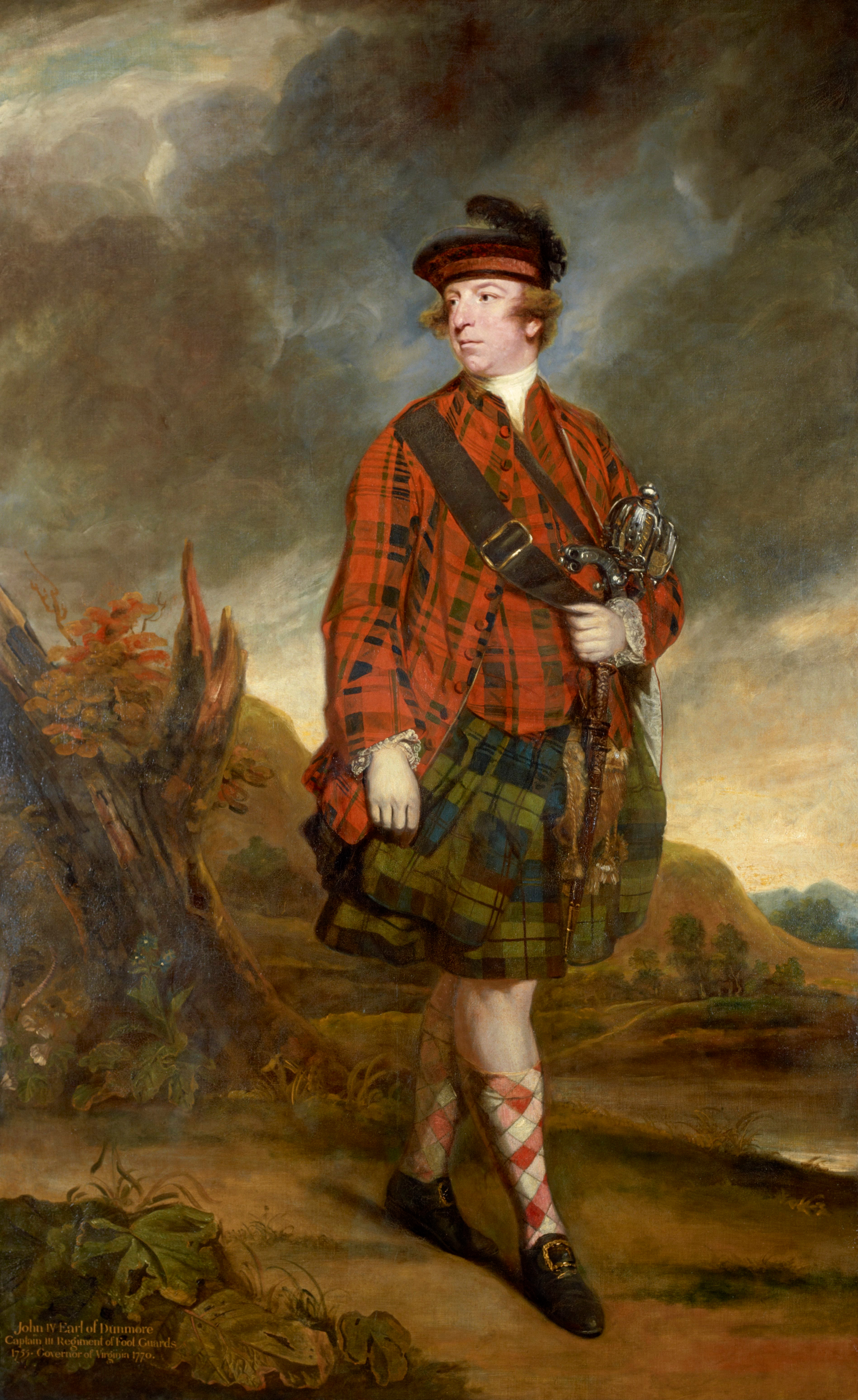
An often overlooked late colonial era campaign, "Dunmore's War" culminated in the October 10th, 1774 battle of Point Pleasant between Virginia Militia and a force of largely Shawnee Indians in modern day West Virginia. Sometimes controversially referred to as the first battle of the American Revolution, the campaign led to further friction between Virginians and Royal Governor John Murray, 4th Earl of Dunmore. 

  
Sir Joshua Reynolds - John Murray, 4th Earl of Dunmore - Google Art Project

An in depth discussion of the causes and politics behind the campaign are a bit involved for a blog post, but I highly recommend the recent scholarship on this campaign by Glenn F. Williams, author of Dunmore's War: The Last Conflict of America's Colonial Era. Additionally the Documentary History of Dunmore's War has a large amount of primary source information.

The Virginia militia was embodied in two wings, Andrew Lewis commanding the men who fought at Point Pleasant and Dunmore personally commanded the Northern Wing which was in the field but not present at the battle.


1774 Virginia Militia Clothing

 Gordon Riots London militia 1780
1863;0214.774  British Museum

Generally speaking, Virginia militia was not uniformed, and wore their civilian clothes for service (typically a coat, waistcoat and breeches). Hunting shirts of various colors were favored by the "Back Wood's Rifleman" as described by John Ferdinand Smyth Stuart:

"Their hunting, or rifle shirts, they have also died in a variety of colours, some yellow, others red, some brown, and many wear them quite white...Sometimes they wear leather breeches, made of Indian dressed elk, or deer skins, but more frequently thin trowsers. On their legs they have Indian boots, or leggings made of coarse woolen cloth...”

A 1777 watercolor of a Virginia rifleman attributed to Lt. Richard St. George Mansergh St. George of the British 52nd Regiment of foot.


However, some companies received issued osnabrigs (unbleached natural colored linen) hunting shirts and blue wool leggings for the expedition and would have been fairly uniform in appearance.

August 28th, 1774

"Dr. Colo. I have got as fare as Mr. Branders with a handful of Men out of my own Company.  I think our Number of private Men is thirty one....the Men I have, are fit for the business, but are badly fix'd, for want of Hunting shirts, and Blankets; but as I hear Mr. Branders Waggon,is on this side New River; I hope we shall get supply'd...I shall be glad Sir., if it can be done, to have a Gun provided against we come down, as I have a very good Hand without: when I was in the service before, there was near twenty press'd Guns: which the Country freely pay'd for, and I doubt not, but the same necessity will be allowed now..."


Both hunting and body shirts were procured at McCorkle's store in what is now Pulaski county Virginia by officers commanding companies on the expedition. Individual soldiers purchased cuttoe knives, printed hankerchiefs and wool cloth.


 [Col. William Christian to Col. William Preston. 3QQ89] Head Of Rich Creek, Septr. 3: 1774
  
"I am informed that Men & provisions were moving from Stanton Wednesday and thursday was a week and that several Compys were at the Warm Springs. It is also said Mathews dont propose taking out all the flour at once, but to send back the pack horses from the mouth of Elk. That LA. Dunmore wrote to Ch. Lewis that some of his men had taken some little Towns & killed three or [four] people & that his Lordship was at fort Pitt. The above news came by one of the Woods's. He says also that there is Jents plenty and all goods necessary for the men such as Shirts Blankets Leggons."


Portraying Dunmore's Command: Sky Meadows State Park, August 10, 2024


In addition, the "Northern" Wing serving directly under Dunmore may have used cockades. "My Brother Jams went with Dumore as a Lieutenant.  He raised some of his men in our county.  They had Cockades of red ribond. I admired the looks of these soldiers so much I would have been glad to have went with them if I had been old enough." (Westward Into Kentucky: The Narrative of Daniel Trabue p42). Immediately after the battle Dunmore was described as "dressed in a Dutch blanket" which may refer to him using a blanket as a matchcoat or perhaps as a blanket coat.

1774 Virginia Militia Arms


 Although the Militia law had expired, the general framework seems to have been followed.

That every person so as aforesaid inlisted (except free mulattoes, negroes, and Indians) shall be armed in the manner following, that is to say: Every soldier shall be furnished with a firelock well fixed, a bayonet fitted to same, a double cartouch-box and three charges of powder, and constantly appear with the same at the time and place appointed for muster and exercise, and shall also keep at his place of abode one pound of powder and four pounds of ball, and bring the same with him into the field when he shall be required.

 
Dutch musket sideplate from Fort Ashby, WVa. 
 
 
Dutch Musket private collection
 
Archeological evidence and primary source documents point to the many of the muskets in use during this period as King's Pattern Long Land "Brown Bess" style or Dutch muskets, both of which were imported in sizeable numbers during the French and Indian war. Primary document use of the generic term "gun" suggests the very common fowling piece or shotgun was in the mix, and many of the men under Lewis seem to have been armed with rifled guns.


 Va Gazette (Rind) August 4, 1774 page 3

As noted, in Glenn Williams' detailed scholarship, the Northern wing's arms were augmented by 300 muskets with bayonets and cartouche boxes from Williamsburg. Further confirmation of this comes from the Journal of the house of Burgesses v6 p223 June 13 1775:

"It appears to your Committee from the Deposition of John Frederick Miller, keeper of the Magazine, that in June last [1774] there were thirty barrels of Gun Powder, containing each about fifty weight, in indifferent order; that, by the Governor's directions, he sifted twenty seven barrels, out of which he made up twenty six Casks and better, the other three he left unsifted; That the President, soon after, sent to the Governor, then on the Frontiers, eight of those he had sifted, three hundred Muskets,
 Bayonets, Cartouch boxes and Carbines, which have never been returned; That one hundred and sixty of the said Muskets were furnished out of the Palace, and soon after replaced out of the Magazine; That the said Miller, by order of the President, also delivered out about fifty stand of Arms, to some Gentlemen of this City, which have not been returned."


1770s rifle by Adam Haymaker of Winchester Virginia. 
Haymaker was later paid for "repair of Guns" for the campaign in October 1775.


The troops under Lewis were described by William Preston as "being mostly armed with rifle guns, and a great part of them good woodsmen, are looked upon to be at least equal to any troops for the number that have been raised in America. It is earnestly hoped that they will, in conjunction with the other party, be able to chastise the Ohio Indians for the many murders and robberies they have committed on our frontiers for many years past."

Ammunition was in short supply, and Maj. Arthur Campbell wrote to Col. William Preston that "..I make no doubt but your last supply of Ammunition will encourage the Inhabitants much, as I think every Man have 1/2 doz shoots a piece having direct[ed] the Powder to be divided by their Gun-Measures."

 1774 Virginia Militia Camp Equipment


Both linen tents and tin kettles were in use by the men of the expedition.

[Captain John Floyd to Col. William Preston. 33S42, 43.]
    Sept. 18th 1774...
    I am in hopes we shall make out pretty well about kettles we are also allowed 60 yards of tent cloth for a company...” p. 206-07.


      [Col. William Christian to Col. William Preston. 3QQ146.]
    “Camp Union Septr. 12, 1774...
    The kettles and Tents were chiefly distributed before I came  I could get but 16 or 17 battered tin kettles for all Fincastle & but few Tents  But I am told oxen brigs [unknown symbol or doodle here] enough for Tents will be brought with the Pack horses to morrow  If the major is not marched
when you get this Intelligence I really think we ough[t] to send over the whole Country and try to beg or borrow kettles for to do withougt[sic] is very hard almost [im?]possible
 It will presently make men sick to live on Roasted meat without broath.” p. 198.