
The October 7th, 1780 Battle of King's Mountain pitted a well organized Loyalist force under British Major Patrick Ferguson against Patriot militia. Despite experienced leadership and a well chosen position occupying high ground, the Loyalist force was surrounded, eventually enveloped and then captured by enraged Virginia (drawing heavily from Washington County men) and Carolina back country militia who had arrived swiftly by horseback before the Loyalist force could escape or be reinforced. Prior to the engagement Ferguson had issued an inflammatory missive urging local loyalists to join his forces against the "Backwater men"or be "pissed upon forever and ever by a set of mongrels." The Loyalists eventually became casualties or surrendered after a spirited defense that relied heavily on the bayonet while many of the Americans assaulting their position fired from the trees below. The accounts of no quarter given to American forces by Tarleton at Buford's defeat or Waxhaws earlier that year urged little sympathy for Tories and some where killed in the chaotic moments after the surrender had taken place. This dramatic Patriot victory remained a proud and romanticized moment for many back country Americans, and many items descended through participant's families with a sometimes unjustified provenance of use at this important battle.
Loyalist Units Clothing and Equipment

Provincial Officer Lt. Anthony Allaire of the Loyal American Regiment
Attributed to John Ramage c. 1779 (New Brunswick Museum) from His Majesty's Loyalists, & Indian Allies by The 18th Century Material Culture Resource Center
An extract of Allaire's account of the battle can be found here.
The Loyalist Units under Ferguson were a mixed bag, from local Tories in their civilian clothes and arms to experienced and red uniformed Provincial (American) troops. Some Loyalist militia men from South Carolina appear to have been clothed in Hunting shirts and were armed with captured French muskets from Charlestown, causing a confusing as well as bloody engagement. Ferguson himself may have been wearing a hunting shirt when he was killed at the battle. Alexander Chesney's Diary states that "Col. Ferguson was at last recognized by his gallantry, although wearing a hunting shirt and fell pierced by seven balls, at the moment he had killed the American Col. Williams with his left hand (The right being useless) [several accounts mention him holding a sword in his left hand due to a prior injury] (The Battle of Kings Mountain: Eyewitness Accounts Robert M. Dunkerly p 132) Red coated Loyalist Provincials are mentioned in a postwar participant statement
from 1824 (James Davison of Virginia serving under Campbell): "the
Enemy were ordered to set down that they might be distinguished as
others from us as we were dressed alike except the red coats.” (The Battle of Kings Mountain: Eyewitness Accounts by Robert M. Dunkerly p43). Thomas Young later mentioned that both forces used field signs to differentiate each other. He saw "paper which the Whigs wore in their hats, and the pine twigs the tories wore in theirs, these being the badges of distinction." The Battle of Kings Mountain: Eyewitness Accounts by Robert M. Dunkerly p92 ).

As for small arms; in May 1780 Charleston SC: "Issued to Maj. Ferguson's [Militia] Corps...300 serviceable French muskets and bayonets, and 50 Sea Service Swords..." (British Military Rifles -Appendix 3 p215 by DeWitt Bailey).

The pension application of North Carolinian John Fields mentions that he "was wounded on the head by a cutlass, a short sword, during the battle of King's Mountain." Another head wound was reported by Thomas Toms of George Maxwell's company: "Severely wounded on the head, being scalped on the left temple with a stroke from a hatchet, which does much injury to that eye, is also disabled in two fingers on the left hand, and wounded in the right hip and his neck; all which he received in the service of the
United States, against Major Ferguson [Patrick Ferguson] on King's mountain."

Model 1763 Infantry Musket and Bayonet Colonial Williamsburg
As for small arms; in May 1780 Charleston SC: "Issued to Maj. Ferguson's [Militia] Corps...300 serviceable French muskets and bayonets, and 50 Sea Service Swords..." (British Military Rifles -Appendix 3 p215 by DeWitt Bailey).

British Sea Service sword, known today as a "Figure of Eight" Cutlass (Private Collection).
The pension application of North Carolinian John Fields mentions that he "was wounded on the head by a cutlass, a short sword, during the battle of King's Mountain." Another head wound was reported by Thomas Toms of George Maxwell's company: "Severely wounded on the head, being scalped on the left temple with a stroke from a hatchet, which does much injury to that eye, is also disabled in two fingers on the left hand, and wounded in the right hip and his neck; all which he received in the service of the
United States, against Major Ferguson [Patrick Ferguson] on King's mountain."

Firearms with King's Mountain provenance are rare, but a pattern 56 Long Land survives in the Kentucky Historical Society Collection that was said to have been captured by Isaac Shelby at the battle.

An iron mounted Dutch musket similar to the original appearance of the "Vannoy" musket. Both were likely French and Indian war era imports. Image: Morphy Auctions
A restocked iron mounted Dutch musket with family provenance to a South
Carolina militiaman named Vannoy who supposedly captured it from Tories at King's
Mountain was donated to the Smithsonian in 1887 and remains there to
this day. The gun barrel was marked "Douglas" for an officer in Dutch
service prior to the gun being imported to America (see The Sword of Lord and Gideon William Baker Clyde p24).
Patriot Militia Clothing and Equipment

Isaac Shelby's canteen, horn and hatchet
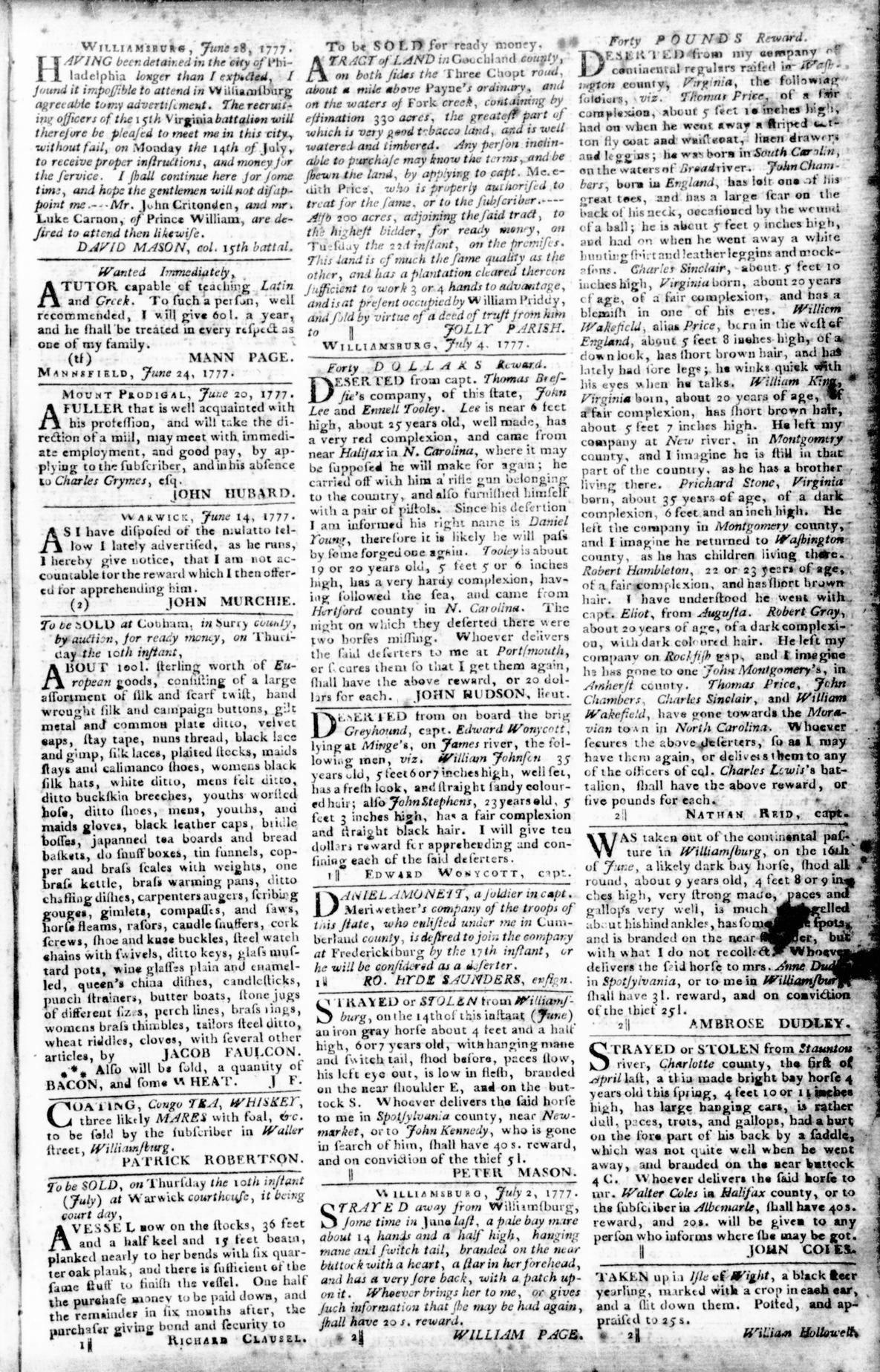
Although not uniformed like some of their Loyalist enemies, several trends can be noted in Patriot militia clothing and equipment. Wallets and rifles seem to have been commonplace. Although several hunting shirts are present in Washington County Virginia probate inventories before and after the battle (as well as a July 4, 1777 deserter ad for a Washington county man clad in a "white hunting shirt...leather leggings and mockasons"). I was surprised at the scarcity of primary source information on them from Patriot militia participants (this may be due to the cold weather).

North Carolina booklet : great events in North Carolina history [1918 : July, v.1 : no.1]Volume 18, Number 1 (July 1918)
Shelby's autobiography mentions that the Patriot militia were forced to "keep their guns dry by wrapping their bags, blankets and hunting shirts around the locks, which exposed their bodies to a heavy and incessant rain." Another Washington County man, Thomas Maxwell was killed while wearing a white hunting shirt in 1782. South Carolina militiaman William Shaw's pension application states that "at the battle at Kings Mountain your petitioner was able to show a hunting shirt struck with several balls and nothing but a kind & overruling Providence preserved his life."

An original 18th century linen wallet marked "CD" in red thread. Private Collection

An original 18th century linen wallet marked "CD" in red thread. Private Collection
Ensign Robert Campbell mentions the mounted militia rushing to attack Ferguson were commonly equipped with wallets or saddlebags (a tidbit also mentioned in the Draper MS in the 19th century).
Multiple sources indicate Colonel William Campbell fought in his "shirt sleeves" after removing his "light colored coat" (Isaac Shelby account The Battle of Kings Mountain: Eyewitness Accounts by Robert M. Dunkerly). There is also evidence that Campbell may have previously owned an Indian beaded shot bag or shot bag strap, likely similar to those depicted being worn by American soldiers in Trumball's 1786 painting Death of General Montgomery (detail shown below).
"Jacob Stern to William Campbell...1774 To a Beaded Shot Bag [and?] Strap..."
(The Montgomery County Story, 1776-1957: Crush, Charles W. )

Probate inventories from several of the men from Washington County Virginia who were killed in the battle mention typical civilian clothing such as blue coats and leather breeches. Some of the participants from Washington County also owned greatcoats, as found in Captain Wm Edmiston's estate. The (wartime inflated) appraised values are noted.
"One blue broadcloth [coat] and linen jacket £150...One pair of leather breeches £75...One great coat £150...One horse £600"
"One blue broadcloth [coat] and linen jacket £150...One pair of leather breeches £75...One great coat £150...One horse £600"
In addition to the probates of men who were killed at the battle [I highly recommend Washington County Virginia Will Book 1 1777-1792 Abstracted & annotated by Jack Hockett & indexed by Donald Helton Iberian Publishing ] claims were also made for items lost by survivors (a few of the more interesting ones are included below).
"Agreeable to an Act for adjusting claims for property impressed or taken for public service- The following claims was ordered to be reported to the General Assembly.
Nathaniel Gist heir at Law to Richard Gist one rifle gun lost at Kings Mountain 11/6d
Lattice Laird Executrix of James one rifle gun lost at Kings Mountain 6/10d
Jeremiah Alexander a horse 13 hands and one inche high seven years old 12/18d
Robert Hamilton curing Thomas Hobbs do
Wounded Soldier 2L
Robert Hickinbottom a horse Saddle bridle and blanket 11/6d
James Cock twenty two pounds and a half of dry Beef and three and half pounds of Bacon 11s/3d
Charles Cock fifty pounds of Venison 4s/2d
Charles Cock fourteen pounds of Bacon 10s/3d....
Charles Cock fifty pounds of Venison 4s/2d
Charles Cock fourteen pounds of Bacon 10s/3d....
p1119At a Court continued and Held for Washington County September 19th 1782...William Edmondson for Saddle bridle bagg two blankets one pair of Leggons- Continental use 5L/6s/6d
Many of the Washington County men seem to have been armed with rifles. Draper's Secondary source "King's Mountain and its heroes" makes a point to mention that many of the men were armed with rifles by "Deckert" or as we know him Jacob Dickert, of Pennsylvania. Dickert's rifles were known in North Carolina in years prior as discussed here.
Many of the Washington County men seem to have been armed with rifles. Draper's Secondary source "King's Mountain and its heroes" makes a point to mention that many of the men were armed with rifles by "Deckert" or as we know him Jacob Dickert, of Pennsylvania. Dickert's rifles were known in North Carolina in years prior as discussed here.
principally of parched corn meal, mixed, as it generally was, with maple sugar, making a very agreeable repast, and withal full of nourishment. An occasional skillet was taken along for a mess, in which to warm up in water their parched meal, and cook such wild or other meat as fortune
should throw in their way. " ( "King's Mountain and its heroes" )

This notion of Dickert's rifles being preferred by the "Overmountain" men from Virginia is backed up by at least two of the surviving (sadly restocked and altered) rifles with King's Mountain provenance being signed or having a family provenance of starting out as Dickert's work. The Edmundson gun at the Muster Grounds museum in Abingdon is signed "J. Dickert 1773" on the barrel and the also heavily modified- Robert Young rifle known as "Sweetlips" at the Tennessee State Museum has a provenance that mentions Deckert being the original maker.
J. G. M. Ramsey’s Annals of Tennessee (1853) mentions that the Patriot forces at King's Mountain were “well mounted, and nearly all carried a Deckhard rifle,” “so called,” a note elaborated, “from Deckhard, the maker, in Lancaster, Pa.” ( quoted from this excellent article on Dickert by Scott Paul Gordon).

Dillin's 1924 book, The Kentucky rifle mentions 180 to 300 grain balls being found at the battle site. These would be roughly .50-60 caliber lead balls from either fowling pieces (commonly 1/2 and or 5/8 or 20 gauge bores) or rifles. The pattern 1756 King's pattern muskets of the Loyalist troops would have fired roughly 500 grain balls, the French muskets used by Loyalist troops would have fired carbine bore balls weighing around 350 grains.
At least one Washington County, Virginia man named Banning was armed with a "smooth [bore] gun.
"At a Court held for Washington County, April 15, 1783: Present — James Dysart, Aaron Lewis, Alexander Outlaw, John Lowrey, Samuel Newell. Gentlemen :
"Ordered that Benoni Banning be allowed for a mare the sum of six pounds; for a saddle, one pound ten shillings; for a bridle, six shillings; for a smooth gun, two pounds; for a bell, four shillings; twelve shillings for a shirt and wallet; for a pocket-book and nine dollars paper money, six shillings, he having made sufficient proof to the Court that he lost them when he was wounded at the battle of King's Mountain."
The Pension application of Abner Lee R6257 states that " The Company in which I served was of the Virginia Militia: We were footman and was armed with Rifles mostly but had muskets & shotguns generally as we owned them before we started.
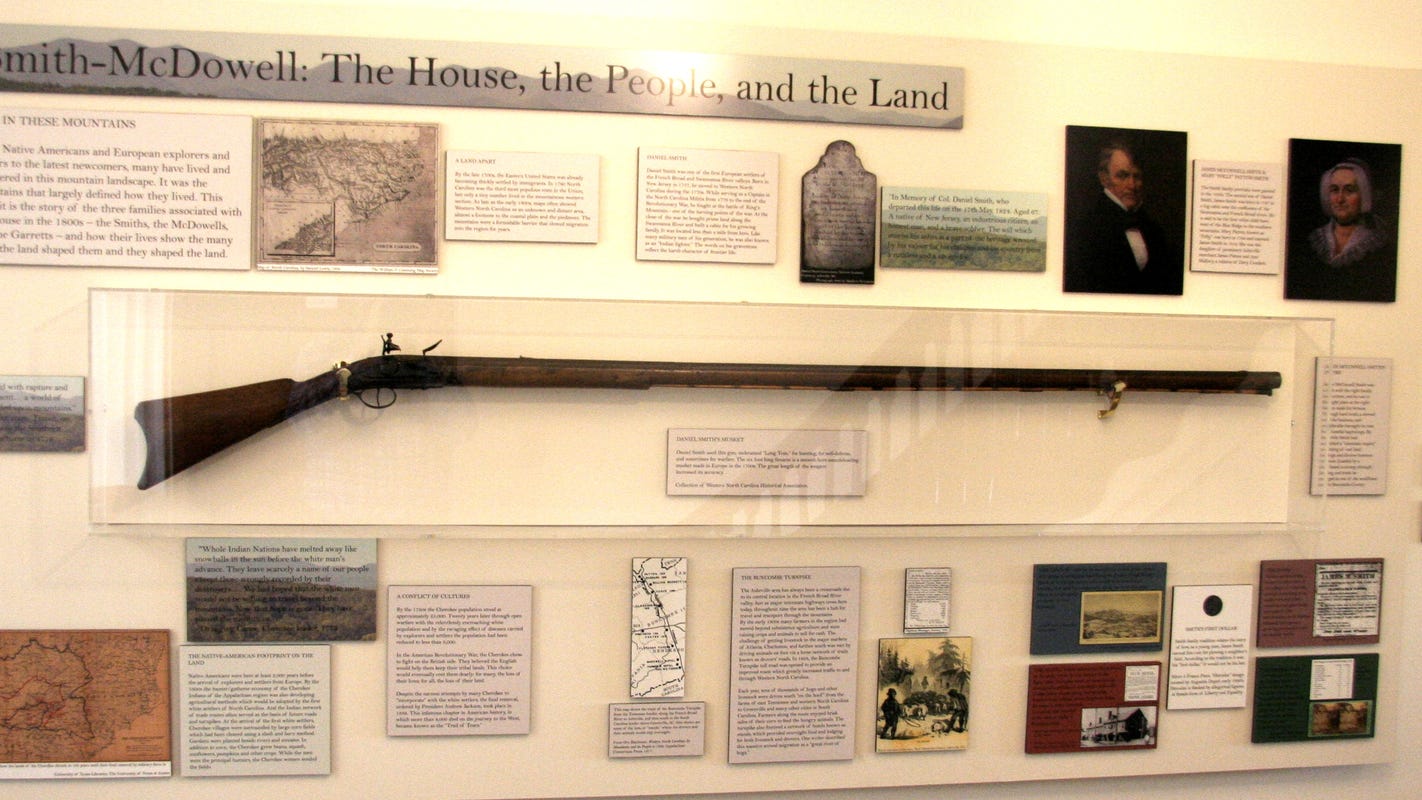

"Old Tom" at the Smith McDowell house museum
The Smith-McDowell House Museum in North Carolina displays a restocked smooth bore shotgun that belonged to North Carolinian Daniel Smith who participated in the battle.

A pipe tomahawk from eastern Tennessee Colonial Williamsburg Collection 1973-354
Charles Bowen's Pension application ( S16055 ) mentions that "friendly fire" almost cost him his life in the confused combat during the pitched battle "-declarant [Bowen] stepped behind a tree, leveled his Gun and shot the first man who hoisted the flag among the enemy and immediately turned his back to the tree to reload his Gun when Col Cleveland advanced, called on declarant for the countersign, which declarant did not immediately recollect, nor could he give it. Col Cleveland instantly leveled his rifle at Declarant's breast and attempted to fire, but the Gun snapped. Declarant jumped at Cleveland seized him by the collar, drew his tomahawk, and would have sunk it in Cleveland's head if his arm had not been arrested by a soldier by the name of Beanhannon [sic, Buchanan?], who knew the parties. Declarant immediately recollected the countersign which was “Blueford,” [sic, Buford] named it and Cleveland dropped his gun and clasped Declarant in his arms."
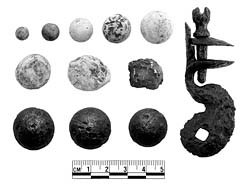
Arms artifacts excavated at King's Mountain by the NPS
North Carolinian Major Thomas Young's Narrative of the battle mentions his painful lack of shoes and his "large old musket":
"...After we had fairly got on the Mountain, I heard a great noise & voices saying, Col. Williams is shot-I ran to him- his son Daniel had raised him up; they ran into a tent and got some water & washed his face so that he could speak. The first words he spoke were "For God's sake, boys, don't give up the hill." We now had the Enemy huddled up on the top of the Mountain; they whelled to fire a platoon over us, some of our men ranback, but I was too much fatigued to run. They fired, but without effect. They soon hoisted two flags & surrendered. I had no shoes, and of course
fought in this battle barefoot; when it was over, my feet were much torn and bleeding all over."...The next morning we were ordered to fire a round. I fired my large old musket, charged at the time of the battle with two musket balls, as I had done every time during the engagement; and the recoil, in this case was dreadful, but I had not noticed it in the battle..."
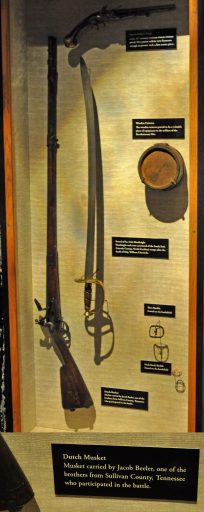
An iron mounted Dutch musket that has a round lock and at some point appears to have been retrofitted with French style barrel bands is on display at the King's Mountain visitor's center. This musket has a family provenance of being used by Jacob Beeler at the battle. According to his pension application, Beeler originally hailed from Virginia, and removed to the Holston river in North Carolina around 1770 and volunteered under Captain John Pemberton to go against Ferguson in the King's Mountain campaign.
For further reading of primary sources, I highly recommend The Battle of Kings Mountain: Eyewitness Accounts by Robert M. Dunkerly.
"...After we had fairly got on the Mountain, I heard a great noise & voices saying, Col. Williams is shot-I ran to him- his son Daniel had raised him up; they ran into a tent and got some water & washed his face so that he could speak. The first words he spoke were "For God's sake, boys, don't give up the hill." We now had the Enemy huddled up on the top of the Mountain; they whelled to fire a platoon over us, some of our men ranback, but I was too much fatigued to run. They fired, but without effect. They soon hoisted two flags & surrendered. I had no shoes, and of course
fought in this battle barefoot; when it was over, my feet were much torn and bleeding all over."...The next morning we were ordered to fire a round. I fired my large old musket, charged at the time of the battle with two musket balls, as I had done every time during the engagement; and the recoil, in this case was dreadful, but I had not noticed it in the battle..."
An iron mounted Dutch musket that has a round lock and at some point appears to have been retrofitted with French style barrel bands is on display at the King's Mountain visitor's center. This musket has a family provenance of being used by Jacob Beeler at the battle. According to his pension application, Beeler originally hailed from Virginia, and removed to the Holston river in North Carolina around 1770 and volunteered under Captain John Pemberton to go against Ferguson in the King's Mountain campaign.
For further reading of primary sources, I highly recommend The Battle of Kings Mountain: Eyewitness Accounts by Robert M. Dunkerly.