Wednesday, April 25, 2012

Venison Ham

One of the fairly common foodstuffs in back country Virginia that seems to have become somewhat uncommon in the modern era is the Venison ham. Venison hams were sold in McCorkle's store in New Dublin - modern Pulaski, Virginia (likely a sideline for those involved in the deerskin trade) and are mentioned by Smyth as a typical Virginia food in warm weather. John Ferdinand Smythe: A Tour in the United States of America 1784 http://books.google.com/books?id=cCUwAAAAYAAJ&pg=PA41&dq=venison+hams+%2B+tour+of+the+united+states&hl=en&sa=X&ei=lF1FT8jDMcTb0QGstanqAw&ved=0CE4Q6AEwAQ#v=onepage&q&f=false
"The gentleman of fortune rises about nine o'clock; he may perhaps make an excursion to walk as far as his stable to see his horses, which is seldom more than fifty yards from his house; he returns to breakfast between nine and ten, which is generally tea or coffee, bread-and-butter, and very thin slices of venison-ham, or hung beef."
Creswell also mentions them: http://rs6.loc.gov/cgi-bin/query/r?ammem/lhbtn:@field%28DOCID+@lit%28lhbtn30436div15%29%29:
""On Board the Pilot Boat "Sally," Potowmeck River--Thursday, April 24th, 1777. Sailed from Alexandria about noon. Mr. Crafts gave me three venison Hams."" "We gave them a Bottle of Whiskey, a Venison Ham and left them to condole their misfortunes together, but we first took care to secure the Hatch."
A hunter's contract from 1784 specifying Venison hams(thanks to Fred for sharing this info!): http://books.google.com/books?id=DWxXAAAAYAAJ&pg=PA926&dq=1784+venison+ham+cured&hl=en&sa=X&ei=egSYT9OcEqXW0QGwqYnlBg&ved=0CE0Q6AEwAA#v=onepage&q=1784%20venison%20ham%20cured&f=false
"Articles of agreement Enterd Into This Eighteenth Day of October 1784 Between Genl George Rogers Clarke & Alexr. Skinner Physician on the one & John Saunders of the other Part all of Jefferson County in the State of Virginia & Country of Kentucky Witnesseth that the Said Genl. G. Rogers Clark and Alexander Skinner, are to furnish on their Part Three men & one pack Horse with Salt and & Ammunition for the purpose of Making a Hunt procuring Beef - Bear Meat - Bears Oil & Vennison Hams & Curing them in a proper Manner for Keeping Sound of it for use during the winter & Spring - That the said Saunders on his part is as a Hunter to use every possible Means to procure the said Meats &c by pitching upon Good Hunting Grounds & being Assiduous & Industrious & the said Saunders is to See that the meat is properly Salted at the Camp & Send it from time to time to the falls of ohio - The Bears oil properly Curd & The Hams properly Dried - The meat is to be Delivered to the said Skinner at the falls of Ohio - to be disposd off or put up in Bulk or Dried as may be most Convenient The said said Saunders in Consideration of this Duty faithfully to be performd is to be entitled to one third of all the meat & oil so to be procurd which third part shall either be sold when a Market offers on its arrival at the falls or preservd with the Rest he paying his proportion of any farther Curing that may be necessary when it arrives atthe falls or it..."
Cresswell also writes on American ham/bacon preparation, and I took my lead from that method and the sage advice of a very helpful friend who has a lot of experience in curing hams. http://rs6.loc.gov/cgi-bin/query/r?ammem/lhbtn:@field%28DOCID+@lit%28lhbtn30436div14%29%29
"The bacon cured here is not to be equalled in any part of the world, their hams in particular. They first rub them over with brown sugar and let them lie all night. This extracts the watery particles. They let them lie in salt for 10 days or a fortnight. Some rub them with hickory ashes instead of saltpetre, it makes them red as the saltpetre and gives them a pleasant taste. Then they are hung up in the smoke-house and a slow smoky fire kept under them for three or four weeks, nothing but hickory wood is burnt in these smoke-houses. This gives them an agreeable flavour, far preferable to the Westphalia Hams, not only that, but it prevents them going rancid and will preserve them for several years by giving them a fresh smoking now and then. Beef cured in this manner is but very indifferent eating. Indeed the Beef in this country is not equal in goodness to the English, it may be as fat, but not so juicy."
I was lucky enough to get a little space for my deer ham in a local smokehouse after the meat spent some quality time in a salt tub with brown sugar and saltpeter. For a bit of background on Virginia smokehouses, I recommend this article: http://www.history.org/foundation/journal/winter04-05/smoke.cfm As for those in the back country, the Sayer's plantation smoke house (ca 1754-1765) at the site that eventually became Fort Chiswell bucked the 8 or 12 foot square trend noted in the above article and was only 5 feet square. Surprisingly, bricks were used in the foundation and fireplace despite being a very remote homestead when it was constructed (Excavations at Fort Chiswell : an archaeological perspective of Virginia's western frontier by Thomas Claude Funk). After a few weeks smoking, I had a very nicely preserved Venision ham that was very tasty, although a bit more like jerky than the fattier pork hams from the same lot! All in all, a great experiment and I hope to them again. Happy smoking!

Thursday, October 13, 2011

Virginia's "Best Rifle Counties" ca. 1781


Frederick Klette signed rifle of circa 1775-80 Stevensburg in Culpeper County, VA 
 
"I am sorry it has not been in your power to send me the County Returns of Militia. I assure you returns weekley are indispensably necessary to enable the Executive to keep Militia in the Field. I did however on receiving Information from Colo. Walker that the Enemy were reinforced call for one Fourth of the Militia of Washington, Montgomery, Botetourt, Rockbridges Augusta Rockingham and Amherst, which (the last excepted) are our best rifle Counties. They will rendezvous at Charlottesville and there expect your orders..."

Thomas Jefferson to Lafayette May 29th, 1781 (Lafayette in the American Revolution Vol. IV page 143)


Link to Western Va county maps showing the evolution of counties from 1738 on:

http://www.rootsweb.ancestry.com/~vaaugust/maps.html


Virginia's Counties in 1738

Virginia's Counties in 1770

 Virginia's Counties in 1776


Washington County Virginia Wills from 1777-1785 include about:

21 rifles or" Rifle guns"(some described as "old" )
4 Musquet/Musquot/Muskets (one described as "large" and one " old musket & cartridge box ")
4 Shot guns (1 described as a "small shot Gun")
6 described as a "Smooth gun" 

Contrasting that with the data from an article titled Henry County. From Its Formation in 1776 to the End of the Eighteenth Century (The Virginia Magazine of History and Biography Vol. 9, No. 4, Oct 1902); which contains some very interesting extracts detailing the prices of arms for the use of that county during the American Revolution. In all, Henry county impressed 10 smooth bored guns/shot guns and 8 Rifle Guns for the militia of the county from 1776 to 1781.

Tuesday, October 4, 2011

Fun link: the "Mayo Island" Powder horn


From Colonial Williamsburg's excellent online Emuseum


Mayo Island powder horn
May 20, 1774
Maker: George Deval
Origin: America, Virginia, Richmond area
OL: 14" OW: 3 1/8"
Cow horn, wood, ink & brass
Museum Purchase

Acc. No. 2011-4
Engraved powder horn with faceted & carved spout, embellished with a reinforcing ring set slightly back from the tip. The whole of the horn goes from a dark cream color to a darker greenish color as it nears the spout. Its rounded soft wood base plug is retained by 5 cast brass tacks (one of which is missing) and has a rectangular patched repair, with a tiny brass wire loop, is inlet into the center of the plug. Engraving shallowly executed, a problem compounded by subsequent wear.
Inscription(s): "George Deval His Powder Horn Come From Isld. Mayo May 20, 1774"
Label:
By the French and Indian War, engraved powder horns were extremely popular in the American Colonies, and were carried hunting and during military duty alike.
This horn was created either by or for a George Deval of Mayo Island in the spring of 1774. Since the only locatable Mayo Island is in the James River at Richmond, this piece is an extremely rare example of a pre-Revolutionary War Virginia powder horn.


Engraved on the horn is a scene of large masted ships and manned rowing craft filling the waterway around a hilly town, likely representing Richmond. Other decorative engravings include geometric designs, trees and a bird. In a band spanning the lower portion of the horn is the inscription "George Deval His Powder Horn Come From Isld. Mayo May 20, 1774."

Thursday, June 16, 2011

Morgan Morgan, Indian Spy and travelling man....

Morgan Morgan, son of Nathanial Morgan (a fellow who just wasn't always very creative in naming his children) served in quite a few places during the revolutionary war, in addition to being a customer at McCorkle's store in New Dublin Va (see http://ofsortsforprovincials.blogspot.com/2011/06/self-sufficiency-mythor-what-was-in.html he served as a "spy" against Indians and Tories, was with Wm. Preston of Smithfield plantation in North Carolina, marched against the Cherokees and was part of the guard at Fort Chiswell.

Morgan's pension application from 1833 details his service:

http://www.southerncampaign.org/pen/s31265.pdf

Morgan's father ran this ad in the Va Gazette in 1775 (NB the sideplate may have been marked MM for Morgan Morgan):

FINCASTLE, May 21, 1775. RUN away from the subscriber, living on Neck creek, near Mr.Thopson's mill, an Irish servant man named THOMAS BENSON, about 5
feet 9 inches high, wears his own long black hair tied, and has lost the half of his left hand little finger; had on a home made flax linen shirt, a pair of tow linen trousers, and carried with him a blue home made cloth coat, a red and yellow silk and cotton waistcoat, buckskin breeches, a rackoon hat, a brass mounted long smooth-bore gun, marked on the side-plate MM 1769, and on the barrel W. MORGAN, a shot-bag and powder-horn, a canister with 2 lbs. of powder, a falling axe, a pocket compass, &c. &c. He likewise stole his indentures, and, being a very good scholar, it is probable he may make an assignment on them. He is supposed to be with Samuel Ingram's servant man, as they both went off about the same time. Whoever secures the said servant, so that I get him again, shall have 5 l. reward, and, if out of the county, reasonable charges, paid
by
NATHANIEL MORGAN.


For more information about the family:

http://www.yeahpot.com/gedcom/morgan/pafg01.htm

Wednesday, June 15, 2011

Reproducing the Hunting shirt- the quick and dirty version


First,

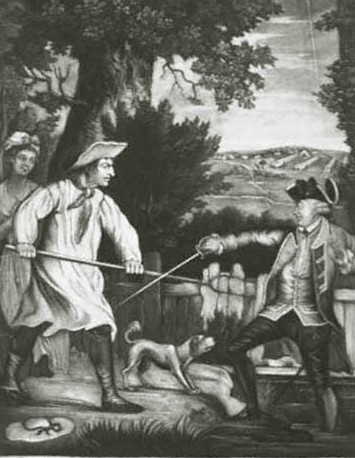
this image to the left is *NOT* a hunting shirt- and is fit for wear over clothes while on the dung heap or a waggon. It is made of the same materials, and has some of the same shapes, but seriously, no matter how much folks want it to be, it just plain doesn't fit the period descriptions and images (most solidly being caped, fringed and "open before"). The origins of this early American garment are murky at best, and definitive documentation on that front is elusive. If you do an F&I impression, there are likely FAR better choices than this garment (like a coat/matchcoat/jacket and etc), or for that matter a shabby undocumented attempt at "backdating" it by omitting the capes/fringe or any of the other elements that make a hunting shirt unique. Instead of making something up, why not copy and actual garment that fits with period descriptions and images?!? Although possible, there doesn't seem to be any concrete evidence of a pull over "hunting shirt" in the 18th century, so smart money goes with something that is split down the front.

Neal Hurst's Honors Thesis is a must read on the topic:


Trumbull on the topic:

Sir,
You expressed an apprehension, that the rifle-dress of General Morgan may be mistaken hereafter for a wagoner's frock, which he, perhaps, wore when on the expedition with General Braddock; there is no more resemblance between the two dresses, than between a cloak and a coat; the wagoner's frock was intended, as the present cartman's, to cover and protect their other clothes, and is merely a long coarse shirt reaching below the knee; the dress of the Virginia rifle-men who came to Cambridge in 1775, (among whom was Morgan,) was an elegant loose dress reaching to the middle of the thigh, ornamented with fringes in various parts, and meeting the pantaloons of the same material and color, fringed and ornamented in a corresponding style. The officers wore the usual crimson sash over this, and around the waist, the straps, belts, &c., were black, forming, in my opinion, a very picturesque and elegant, as well as useful dress. It cost a trifle; the soldier could wash it at any brook he passed; and however worn and ragged and dirty his other clothing might be, when this was thrown over it, he was in elegant uniform.

I remember to have seen in Connecticut a regiment of militia drawn up for review, of which the battalion companies had adopted this rifle-dress of white linen with black straps and hats. A grenadier company had been selected of the tallest and finest men, and dressed at considerable expense in a handsome uniform of blue coats and scarlet under-dress. I first saw the regiment at the distance of half a mile; the grenadiers appeared small, and the rest of the regiment seemed grenadiers; the cause is obvious - the rifle-dress is loose, and the sleeves above the elbow loose like the ladies’ dresses of the present day, and the figure of course appears larger than if dressed in a coat with tight sleeves and body; besides which, opticians teach us that white objects always seem larger than objects of the same size, but of any other color.
J. T.” p. 18.


Longacre, James B., and Herring, James; “The National Portrait Gallery of Distinguished Americans.” Volume III. Henry Perkins, Philadelphia. 1836. [Google Books.]

By 1768, ads in the Va Gazette indicate that Virginians knew what a "hunting shirt" was, although correspondence in the Washington papers makes a strong case for this apparently Virginia born garment being fairly unknown outside of areas north of Pennsylvania. Incidentally, Pennsylvania broadsides from 1775 proclaim that "The Virginian back Woods Men have a very good Reason for their hunting shirts, for as they wear no Breeches, Decency requires that their upper Dress should be of this Form "

Portrait of Captain Samuel Blodget in Rifle Dress


As with anything else, step #1 is to do your homework first to ensure that such is the *right* (or appropriate) garment for your who/what/when/why- for our purposes (Western Va ca 1768-1783) we have that nailed down as a fairly common garment (the image is Blodgett in Rifle Dress by Trumball, at the VMFA).

For a legit RevWar period hunting shirt pattern in a low priced book see Sketchbook '76 by Robert L. Klinger (also patterned in Katcher's excellent Uniforms of the Continental army):

http://www.trackofthewolf.com/categories/partdetail.aspx?catid=4&subid=22&styleid=62&partnum=book-sb76

Further info on this particular shirt can be found here:

http://books.google.com/books?id=jSBDlSw_VtMC&lpg=PA70&ots=N58-PJcJIZ&dq=duryea%20hunting%20shirt&pg=PA70#v=onepage&q=duryea%20hunting%20shirt&f=false


Numerous vendors sell both unbleached/natural linen (aka osnabrigs aka BROWN LINEN) and white linen (which is what three of the four surviving shirts are made of)- this seems to be a common material for these things in the period. Manufactured pre fab 'fringe' that matches the originals is hard to come by, for many applications, unraveling a two inch or so strip of the same fabric used for the body is a good way to go for fringe.

A few quotes on the subject can be found here:

http://www.oldetoolshop.com/trekking/library/huntingshirts.html

and some references to colors here (don't be afraid to use WHITE or natural undyed linen):

http://www.oldetoolshop.com/trekking/library/shirtcolors.html

Get three or four yards and wash and iron it first.


These folks usually stock a good selection of appropriate linen:

http://www.burnleyandtrowbridge.com/


Period descriptions and surviving garments show a few variations existed- amount, construction and location of fringe, some had pockets, wrist closures (buttons and loops vs sleeve buttons and etc) and some appear to have had ties in the front or were closed with a belt.

Original Hunting shirt on view at Fort Pitt, note dark spots showing remnants of woolen ties


If you are a total hand sewing neophyte, you might want to go through Gilgun's Tidings from the 18th century.

after that, read this:

Neal Hurst on Hunting shirt construction


Speaking very broadly, you need to make a normal 18th c style body shirt that is split down the front, caped and fringed (some of the original shirts do exhibit subtle nuances that differ).  Original shirts were sometimes folded over at the shoulder line or in some cases folded at the sides.  Most shirts would have been made of a fairly narrow linen (26-32 inches or so wide).  Additionally, you might want to pleat the forearms and cover that transition line with fringe after stitching them down, as seen in the picture below.


 The sleeve pleating can be applied either before or after the wrist band (cuff) has been finished, but the majority of surviving shirts appear to have had this applied after the cuff was completed.

As with a lot of this stuff, DIY is cheaper, and you are learning a period hands on activity- or you can do what I did when I first started and spend hard earned money on something that is quick and easy and not right at all.  Another option (likely the BEST way to go as he has examined more originals than anyone I know of ) would be to take one of the great detail heavy Hunting shirt workshops with Neal Hurst.

18th century material culture slideshow on hunting shirts

Thursday, June 9, 2011

The Self sufficiency myth...or what was in a frontier store?


A frequent topic amongst those obsessed with backcountry history is the availability or lack thereof of European manufactured material goods. A lot of 19th and quite a few 20th century authors placed a heavy emphasis on the romantic image of the stalwart frontiersman (and woman) in buckskin clothing head to toe, weaving coarse linsey woolsey by their fires at night and producing all of their family's necessaries (I assume folks could weave, farm and hunt much more rapidly in the 18thc century as those are time consuming ventures!). Although in some cases families did weave and produce limited amounts of textiles for their own consumption and at times barter or sale, taking a hard look at probate inventories, store accounts and primary documents quickly deflates the notion that frontier Americans were not a part of the global economy and consumers of large quantities of imported goods (even those engaged in the deer skin trade or those living in far flung areas).


One of my favorite recent books on the subject is a discussion of John Hook's store in New London (Bedford) Virginia is Martin's Buying into the World of Goods. http://books.google.com/books?id=J0P6rmhhP6IC&printsec=frontcover&dq=buying+into+the+world+of+goods+martin&hl=en&ei=vy3xTZiyLNS_gQee8uWzBA&sa=X&oi=book_result&ct=result&resnum=1&ved=0CCoQ6AEwAA#v=onepage&q&f=false Although many Virginia stores in the back country trafficked heavily in rum and coarse osnaburg linen many also carried items that were purely luxury goods. Conway Smith's Book The Land That Is Pulaski County features a lengthy description of the goods available ca. 1774-1777 at McCorkle's store in New Dublin Virginia.


Original swatch of "Striped Camblet" from the Foundling Museum's Threads of feeling Exhibit


Fabrics:
colored baize, silk ferret, gingham, muslin,
frieze, cambleteen, white and green Persian, tammy cloth, silk cloth, "oznabrig", Irish linen, holland, stroud; cambric, calico, queens net, "forrest" cloth, flowered lawn, dimity, broadcloth, callimanco, flannel, blue and green "durant", shalloon, buckram, gauze, permentum, brown and white sheeting, plush "for making shot pouches", apron lawn, saddle cloth, cloth for "leggons" (leggings), coating material, fringed housing, deer skins and otter skins. There were also white and colored threads, needles, thimbles, scissors, papers of pins, a variety of buttons, hanks of silk, tapes, ribbons, lace-and for dyeing cloth, indigo and copperas.


As far as clothing and accessories:

[locally manufactured] raccoon hats, felt hats, gloves, fine and plain shoes, coat strops, shirts, stocking breeches, stockings, garters, shoe buckles, shoe brushes, razors, pocket looking glasses, and watch chains. For the ladies there were silk bonnets, calico gowns, stockings, garters, necklaces, fans, silk gauze handkerchiefs, linen and spotted lawn handkerchiefs, printed and check handkerchiefs, shoes, gloves ,looking glasses...hunting shirts ,leggings,children's shoes and hats.

Hardware included:

pewter tableware, queen china plates, knives and forks, pewter spoons, toddy ladles, toddy spoons, teaspoons, teakettles, brass kettles, skillets, iron pots, brass pots, tin pans, tin kettles, frying pans, butcher .knives, irons, combs and brushes, rugs, trunks, Dutch blankets, pewter candle molds and candle snuffers, guns, gun flints, lead, powder, shot, shot pouches, knives, lead bars, pig iron, chest locks, cupboard locks, padlocks, grindstones, shears, reaping hooks, carpenter's rules, carpenter's compasses, claw hammers, hinges, nails, screws, cuttoes, drawing knives, handsaws, whipsaws, rasps, files, chisels, gimlets, rope, catgut, scales, money weights, salt bags, sacking, alum, soap, tallow, hemp, Dutch quills, penknives, inkholders, ink powder, paper by the quire and sealing wax....

Foodstuffs included:

Venison hams, salt, pepper, white and brown sugar, butter, all­spice, nutmegs, coffee, rum, tea and chocolate.

Smith concludes:

"The year of 1774 found settlers in the land that is now Pulaski County living better than we had imagined."

 Similar goods were available in the Matthews store (both of the publications listed below are available by contacting the Greenbrier Historical Society).  Sampson and George Mathews ran two stores, one in Staunton and another near the modern community of Caldwell, West Virginia.


The Mathews Trading Post", published in The Journal of the Greenbrier Historical Society: Volume 1, Number 1 (Lewisburg, West Virginia: Greenbrier Historical Society, August 1963).


Frances Alderson Swope, comp., "The Matthews Trading Post Ledger, 1771-1779,"
Journal of the Greenbrier Historical Society 4 (1984), 20.


A carved and silver mounted coconut labeled "Sampson and George Mathews Stannton  Jan 27 1773" underlines the global involvement of back country merchants (Farmer auctions).


 Happy shopping and research!
Wednesday, May 25, 2011

Moccasins and Shoe packs

"Their Shoes,when they wear any are made of an entire piece of Buck-Skin;except when they sow a piece to the bottom, to thicken the Soal. They are fasten'd on with running Strings ,the Skin being drawn together like a Purse on top of the Foot,and tyed round the Ankle. The Indian name of this kind of Shoe is Moccasin"

"The History and Present State of Virginia,in Four Parts:
By Robert Beverly, 1705, Pages 163-164


Two views from here and here of the Fort Ligonier moccasin with a reproduction 

Beverly's description includes the use of an applied sole, something many descriptions and extant 18th century moccasins lack. The dug moccasin from Fort Ligonier (illustrated in Sketchbook '76 and shown above) has that feature, although many argue this is a working life repair. Evidence exists that such repairs were being done in the period.  Intrepid researcher Steve Rayner recently uncovered and shared the following:

17th [February 1766] I got a pair of Mogoseens that David Moor mended for me he soled and heel tapd them and I found the thread he charged 11s/Bay old Tenr. 

p 165 (Diary of Matthew Patten of Bedford, NH from 1754-1788, Rumford Printing company, Concord, NH 1903).

In addition, a March 19th, 1776 dated account (courtesy Nathan Barlow) lists the following line item among other footwear repairs.


To Soleing one pair of Mongesons & mending Shoes -/2/6

Although the expenses are listed for "Captain Jonathan Clark", the inclusion of the name John Hoy points this towards being Clark's company of the 8th Virginia Regiment as both men's names are mentioned in this 8th Virginia pension application and this muster roll.

 "Shoe packs" or "shoepacks" seem to have been an Anglo adaptation of Native Moccasins.

19th century writer Rev. James B. Finley defined them as "shoe-packs, or a kind of half shoe and half moccasin."

http://books.google.com/books?id=_pJuAAAAMAAJ&dq=When%20dressed%20it%20was%20made%20into%20shoe-packs%2C%20or%20a%20kind%20of%20half%20shoe%20and%20half%20moccasin.%E2%80%9D&pg=PA74#v=onepage&q=When%20dressed%20it%20was%20made%20into%20shoe-packs,%20or%20a%20kind%20of%20half%20shoe%20and%20half%20moccasin.%E2%80%9D&f=false


Joseph Doddridge on shoe packs:

http://books.google.com/books?id=rvgpAAAAYAAJ&pg=PA165&dq=To+the+shoepack+a+sole+was+sometimes+added&hl=en&ei=lDXdTaOxNsKRgQfK_rQQ&sa=X&oi=book_result&ct=result&resnum=5&ved=0CD0Q6AEwBA#v=onepage&q=shoepack&f=false


"Almost every family contained its own tailors and shoemakers. Those who could not make shoes, could make shoepacks. Those, like mocassons, were made of a single piece of leather with the exception of a tongue piece on the top of the foot. This was about two inches broad and circular at the lower end. To this the main piece of leather was sewed, with a gathering stitch. The seam behind was like that of a moccason . To the shoepack a sole was sometimes added."

June 23, 1768
The Pennsylvania Gazette Augusta County, in Virginia, June 6, 1768.
RUN away from the Subscriber, living near Stanton, the first Day of May last, a Convict Servant Man, named Michael Ferral, about 28 Years of Age, of a fair Complexion, has pale curled Hair, is about 5 Feet 9 or 10 Inches high, thick lipped, round shouldered, and small legged; He had on, and took with him when he went away, a brown Coat, and Jacket, bound round with Worsted Ferriting, Buckskin Breeches, and a Fur Hat, all about half worn, two Pair of Worsted Stockings, one Pair black, the other blue, and a Pair of Shoe packs on his Feet. Said Servant pretends to be a Doctor, and a Weaver; he has with him a Bank Note, upon the Bank in London…

October 22, 1778 The Pennsylvania Packet

THIRTY DOLLARS REWARD.
RAN AWAY from Mossy Creek Iron Works, Augusta county, Virginia, on the 30th of September last, an English convict servant man named THOMAS ORTON, about thirty years of age, near six feet high, slender made, marked with the smallpox, speaks thick and a little through the nose, has a down look, and in common very dirty; had on when he went away, a tow shirt and trowsers, a short jacket made without skirts, of light colour, lined with linen, a straw hat looped with blue wool, a
pair of shoe packs, and is supposed to have a pass of good hand writing. Whoever taken up the said servant, and either brings him home or secures him in any gaol so that his master may get him again, shall have the above Reward and reasonable charges, paid by HENRY MILLER.


Although not a great choice in wet weather (save those pennies for an additional pair of handmade 18thc European style shoes!), Moccasins or shoe packs were at times worn on the frontier out of necessity for lack of European style shoes:

Doctor Thomas Walker's Journal
(6 Mar 1749/50 - 13 Jul 1750)

http://www.tngenweb.org/tnland/squabble/walker.html

April 16th. Rai(n). I made a pair of Indian Shoes, those I brought out being bad.

May 10th. We staid on the River and dressed an Elk skin to make Indian Shoes--ours being quite worn out.

11th. We left the River, found the Mountains very bad, and got to a Rock by the side of a Creek Sufficient to shelter 200 men from Rain. Finding it so convenient, we concluded to stay and put our Elk skin in order for shoes and make them.

14th. When our Elk's skin was prepared we had lost every awl that we brought out, and I made one with the shank of an old Fishing hook, the other People made two of Horse Shoe Nails, and with these we made our Shoes or Moccosons.

July 7. We kept up the Creek, and about Noon 5 men overtook us and inform'd that we were only 8 miles from the inhabitants on a Branch of James River called Jackson's River. We exchanged some Tallow for Metal and Parted. We camped on a Creek nigh the Top of the Alleghaney Ridge, which we named Ragged Creek.

8th. Having Shaved, Shifted and made New shoes we left our useless raggs at ye camp and got to Walker Johnston's about Noon. We moved over to Robert Armstrong's and staid there all night. The People here are very Hospitable and would be better able to support Travellers was it not for the great number of Indian Warriers that frequently take what they want from them, much to their prejudice.


Moccasins ca 1775 collected by Col. Frederick Thomas 1st Foot Guards 
(in America 1775-1780 died in 1783)


John Ferdinand Smyth Stuart described moccasins of the "Back Wood's Rifleman":

"On their feet they sometimes wear pumps of their own manufacture, but generally Indian moccossons, of their own construction also, which are made of strong elk's, or buck's skin, dressed soft as for gloves or breeches, drawn together in regular plaits over the toe, and lacing from thence round to the fore part of the middle of the ancle, without a seam in them, yet fitting close to the feet, and are indeed perfectly easy and pliant."


Pension Application of Philip Harless: R4613

http://www.rootsweb.ancestry.com/~vacraig/philipharlessr4613.htm

Boutetourt, VA
That in the spring of 1779 he volunteered under the command of Captain John Lucas
[pension application W5468] and served from the 1st of April untill the first of October That he took the Oath of fidelity as an Indian Spy to be engaged against the Indians and was stationed in a garrison situated on Sinking Creek a tributary stream of New river in that part of Bottetourt County that is now Giles…….. That he recollects of a party of Indians commiting murder on some of the Inhabitants and that a part of the men from the garrison where he was stationed persued after the Indians to rescue a prisoner and persued on untill some of them become bear footed and was compelled to make Mocquinsans out of raw Deerskins
Sometimes moccasins may have been used for concealment of the wearer's identity:

Adam Stephen to George Washington, September 27, 1755, Report on Fort Cumberland, Maryland

FT CUMBERLAND Sept 27th. 1755
SIR,

A party of Volunteers were ordered out, under command of Capt. Savage to reconnoitre the Bottom of Will's Creek. They Rous'd three Indians and fired at them but Soon lost Sight of them. We Continue Alert, and want men much. The Indians discover our Parties by the Track of their Shoes. It would be a good thing to have Shoe-packs or Moccosons for the Scouts. --


Cresswell had them made for him:

The journal of Nicholas Cresswell, 1774--1777

Saturday, August 19th, 1775. Waiting for Mr. Anderson. Employed an Indian Woman to make me a pair of Mockeysons and Leggings.

Tuesday, September 5th, 1775. At Kanaughtonhead.
Went to the meeting where Divine service was performed in Dutch and English with great solemnity. This Chapel is much neater than that at Wale-hack-tap-poke. Adorned with basket work in various colours all round, with a spinet made by Mr. Smith the parson, and played by an Indian. Drank Tea with Captn. White-Eyes and Captn. Wingenund at an Indian house in Town. This Tea is made of the tops of Ginsing, and I think it very much like Bohea Tea. The leaves are put into a tin canister made water tight and boiled till it is dry, by this means the juices do not evaporate. N. did not choose to go into the town, but employed herself in making me a pair of Mockesons.

Fort Pitt--Thursday, September 14th, 1775. Got to Fort Pitt about noon. Left our Girls amongst the Indians that are coming to the Treaty. Great numbers of people in Town come to the Treaty. Terrible news from the Northward, but so confused I hoped there is little truth in it. Friday, September 15th, 1775. Very few of the Indians come in yet, the commissioners have been waiting for them a week. Shall be obliged to stay here some time to see the Treaty. Saturday, September 36th, 1775. Got acquainted with Mr. Ephraim Douglas, an Indian trader. Found him sensible and an agreeable companion. N. finished my Leggings and Mockeysons, very neat ones.


Virginia Gazette(Purdie), Williamsburg ,September 20, 1776.

RUN away from the subscriber in Alexandria, the 12th of August last, ANDREW KELLY, an Irish servant man about 5 feet 8 inches high, by trade a brick-maker, of a fair complexion, has short brown hair, very talkative when in liquor, which he is fond of, and is inclined to be fat; had on, when he went away, short brown cloth coat and waistcoat, old brown linen shirt and trousers, and buckskin mockasons. Possibly he may offer to enlist in the land or sea service, or attempt again to go to the British troops. Whoever secures him in any jail, so as I get him again, shall have SIX DOLLARS reward.JAMES PARSONS.

THE VIRGINIA GAZETTE 3 July 4, 1777

DESERTED from my company of continental regulars raised in Washington county, Virginia , the following soldiers, viz. Thomas Price , of a fair complexion, about 5 feet 10 inches high, had on when he went away a striped cotton fly coat and waistcoat, linen drawers and leggings; he was born in South Carolina , on the waters of Broad river. John Chambers , born in England , has lost one of his great toes, and has a large scar on the back of his neck, occasioned by the wound of a ball; he is about 5 feet 9 inches high, and had on when he went away a white hunting shirt and leather leggings and mockasons. ... Whoever secures the above deserters, so as I may have them again, or delivers them to any of the officers of col. Charles Lewis 's battalion, shall have the above reward, or five pounds for each.

Another possibility is “The Virginia moccasin is made of one piece of skin gathered by means of a seam along the upper side of the foot and another along the heel. A part of the skin formed a loose flap on each side, reaching a few inches up on the leg and fastened around the ankle by means of strings, or the moccasin was drawn together like a purse around the ankle. [1] ...”

[1] “W. R. Gerard, ‘Virginia Indian Contributions to English.’ /American Anthropologist/ (N. S.) vol. 9, p. 97.” p. 153.

http://books.google.com/books?id=RLsEAAAAYAAJ&pg=PA154&lpg=PA154&dq=%22AMERICAN+ANTHROPOLOGICAL+ASSOCIATION%22+morgantown+moccasin&source=bl&ots=xUUlfLSb_3&sig=rIDIESh4JMUZfYdj8T-usEZwI14&hl=en&ei=SA0WTYGmKs3VngeL3cD8DQ&sa=X&oi=book_result&ct=result&resnum=1&ved=0CBMQ6AEwAA#v=onepage&q&f=false

My first attempt at Moccasin making (based on the Sketchbook '76 drawing) went very poorly. I hope to give it a whirl again later and will post the results if I have a better time of it than my first trial. Further discussion from more successful folks on making moccasins can be found here:

http://buffalotrace1765.blogspot.com/2010/10/moccasin-makingrepair-kitor-i-need-to.html

A really good online tutorial can be found here:

https://www.colonialwilliamsburg.org/learn/living-history/making-moccasins/


A pattern here:

http://www.southernindiandept.org/mocpattern.htm


And an instructional DVD:

http://www.redaviscompany.com/1044.html